

Journal of Creation 20(1):86–92, April 2006
Browse our latest digital issue Subscribe
Disclaimer: The many and varied aspects of ancient Egypt and, in particular, how it relates to the biblical narrative, is a difficult and complex subject. For many years, Creation Ministries International (CMI) has published a range of views by various authors in its publications (CREATION.com, Journal of Creation, Creation Magazine etc.). These views do not necessarily agree with the present views of CMI’s writers on this topic, but remain available online as they form part of CMI’s historical archives of its publications. For a summary of key articles about this subject see our QA section on Egypt.
The story of Jericho
The Bible presents the story of the conquest and destruction of Jericho by Joshua and the Israelite army as an historical incident. The location of Jericho is not disputed and excavations should be able to confirm that these events really happened. There should be evidence of toppled walls, a layer of ash caused by the deliberate conflagration above that, ceramic, and circumstantial evidence of a new people with a new culture. There is plenty such evidence but archaeologists have dated it to a time period 600 years before the Israelites arrived. However, the archaeological strata have been incorrectly dated and all this obvious evidence can be correctly attributed to the Israelite invasion, thus vindicating the biblical record and supplying the archaeological world with a plausible explanation for the evidence of destruction for which it, at present, can find no historical information.

Click here for larger view
Jericho is much in the archaeological news recently, so a review of the history and archaeology of this city is rather relevant. Excavations have yielded some spectacular results, and the interpretation of these finds has proven to be extremely controversial.
According to the book of Exodus, about two million people, who had been slaves in Egypt, escaped in the Exodus and headed into the Sinai Peninsula. They came to Mount Sinai where they stayed for about one year.
From Mount Sinai they proceeded to Kadesh Barnea where Moses sent out twelve men, representing the twelve tribes of Israel, to spy out the Promised Land. After 40 days they returned with the report that it was indeed a goodly land but ten of the spies said, ‘We are not able to go up against the people for they are stronger than we’ (Numbers 13:31). The other two, Caleb and Joshua, protested saying, ‘Let us go up at once and take possession, for we are well able to overcome it’ (verse 30). The majority sided with the ten pessimistic spies and wished that they had stayed in Egypt.
Because of this lack of faith the whole congregation, except Joshua and Caleb, from twenty years old and upwards were doomed to wander in the wilderness for forty years and die there (Numbers 14:29–34).
At the end of this forty year period the Israelites moved northwards from the Red Sea where Aqaba now is, skirting the land of Edom until they came to the River Jordan opposite Jericho. While encamped there Moses died and Joshua became the leader. The Jordan River was in flood, but according to Joshua 4:16 the water was dammed up at a city called Adam, ‘and all Israel crossed over on dry ground’ (Joshua 3:17).
The Israelite army then marched around Jericho every day for a week blowing their trumpets and on the seventh day they marched around the city seven times. After the last circuit,
‘the people shouted when the priests blew the trumpets. And it happened when the people heard the sound of the trumpet, and the people shouted with a great shout, that the wall fell down flat. Then the people went up into the city, every man straight before him, and they took the city. And they utterly destroyed all that was in the city … . They burned the city and all that was in it with fire’(Joshua 6:20–24) .
Then Joshua placed a curse on Jericho and anyone who rebuilt it (verse 26). Nobody presumed to do so until some 550 years later when it was rebuilt during the reign of the apostate King Ahab (1 Kings 16:34) when it once more became an important city.
Early excavations at Jericho
Now if these events really happened as described in the biblical record, archaeologists should be able to find the evidence: toppled walls, destruction by fire, a new people with a new culture coming into the land, a gap in occupation, and then the city being rebuilt, but this is what all the fuss is about. There are fallen walls, thick layers of ash and indication of a new culture on top of that, but according to the traditional chronology, it all happened 600 years before the Israelites arrived. As Time magazine 18 December 1995 put it, ‘Kathleen Kenyon, who excavated at Jericho for six years, found no evidence for destruction at that time.’1
‘At that time’—time is crucial to the interpretation of archaeology. According to 1 Kings 6:1, the exodus must have occurred about 1445 BC and the conquest of Jericho forty years later about 1405 BC, but the evidence for the destruction of Jericho occurred at the end of the Early Bronze Period which is usually dated to about 2000 BC. Let us look at the archaeological history of Jericho.
As long ago as 1867, the Palestine Exploration Fund made a survey of sites in Palestine. As part of these activities Charles Warren dug some shafts at Tell es-Sultan, the Arabic name for Joshua’s Jericho. One shaft at the south end of the tell went down 3 m and struck some charred timber, but without any means of dating this layer, it proved nothing.
In 1908 an Austro-German expedition under L. Sellinger and T. Watzinger tackled Jericho. As became the methodical Germans the work was meticulously carried out, but as pottery identification had not been developed in their day they also had no means of identifying the layers that they excavated.
Garstang’s excavations seemed to support the Bible record
From 1930 to 1936, an expedition of a much more capable team was conducted by Professor John Garstang of the Liverpool University. He wrote a very readable book called The Story of Jericho.2 Garstang had an obvious respect for the Bible but was not convinced of its infallibility. He was not out to prove the reliability of the biblical records. He stated:
‘Much of the work done in the Holy Land has been stripped of its scientific value by the assumption that the scriptures are above criticism and necessarily exact in every detail … . In the search for truth the only safe procedure in such a case, we submit, is to present the facts first, and then to examine the relevant passages in the Bible, to see to what extent they agree or disagree with the material evidence, and whatever the result to state it without prejudice or concealment.’3
However on page 20 of his book he claimed that the biblical ‘episodes are confirmed in all material particulars: the fallen walls have been laid bare, while the burning of demolished buildings is found to have been general and so conspicuous as to suggest a deliberate holocaust.’
Concerning the subsequent uninhabited period he wrote, ‘Our excavations have in fact proved that after its destruction the walled city was not reconstructed, nor was the site more than partially inhabited, for about 500 years.’4

Click here for larger view
Garstang’s conclusions were based on his identification of the fallen walls as of Late Bronze origin. The Late Bronze Period is usually dated about 1550 to 1200 BC, so Garstang wrote, ‘With the destruction of this fourth system about 1400 BC the old city of the Bronze Age was brought to its end.’5
Actually Gastang found the evidence for the invasion of Palestine under Joshua but he did not recognize it. Following the traditional dating he wrote:
‘About 2000 BC, or rather later, a major catastrophe overwhelmed the aged city … . An entirely new culture, that of the middle Bronze Age [MB], replaced the old. Moreover the change was general, and it affected in similar fashion all the great cities of the highlands above the Jordan Valley … . These traces of occupation, to quote from our formal report at this time, indicate the incoming of a people without resources or aptitude for building.’6
People who had lived for forty years in tents could hardly be expected to have any aptitude for building.
By the revised chronology adopted in the magazine Archaeological Diggings (of which I am the editor), the Israelites left Egypt early in the 13th dynasty, and Egypt was overcome by the Hyksos who invaded the country. Significantly Garstang reported that ‘no less than 165 scarabs of the Hyksos period were recovered’.7

Click here for larger view
At the time of its destruction Jericho was well-stocked with food. It could not be said that the Israelites conquered the city by starving out the inhabitants. Most of the store-rooms ‘were found to be stacked with grain bins containing charred remains of barley, oats, millet and sesame, as well as a special kind of sealed jar which still retained traces of wine and barley-beer’.8
In his chapter entitled ‘The city destroyed by Joshua’, Garstang wrote:
‘The main defences of Jericho in the Late Bronze Age [LB] followed the upper brink of the city mound, and comprised two parallel walls, the outer six feet and the inner twelve feet thick. Investigations along the west side show continuous signs of destruction and conflagration. The outer wall suffered most, its remains falling down the slope. The inner wall is preserved only where it abuts the citadel, or tower, to a height of eighteen feet; elsewhere it is found largely to have fallen, together with the remains of buildings upon it, into the space between the walls which was filled with ruins and debris. Traces of intense fire are plain to see, including reddened masses of brick, cracked stones, charred timber and ashes. Houses alongside the wall were found burnt to the ground, their roofs fallen upon the domestic pottery within.’9

Click here for larger view
Concerning the results of fire he then wrote:
‘In another room abutting the same western wall, but more to the south, the traces of fire upon its walls were as fresh as though it had occurred a month before; each scrape of the trowel exposed a black layer of charcoal, where the roof had burned, or caused the piled up ashes to run down in a stream. On a brick ledge in a corner of this room we found the family provision of dates, barley, oats, olives, an onion and peppercorns, all charred but unmistakable; while a little store of bread, together with a quantity of unbaked dough which had been laid aside to serve as leaven for the morrow’s baking, told plainly the same tale of a people cut off in full activity.’10
The author had no doubt that this was no accidental fire. He said:
‘One gets used to burnt layers in excavations of this kind, for it was the usual fate of houses and cities to perish by fire; but this was no ordinary burning. The layer of ashes was so thick and the signs of intense heat so vivid, that it gave the impression of having been contrived, that fuel had been added to the fire.’11
Kenyon’s excavations cast doubt on the Bible record
All this was very gratifying to Bible lovers, but then in 1952 came Dame Kathleen Kenyon. She not only had the benefit of the archaeological knowledge that had accumulated over the 16 years since Garstang’s expedition, but introduced radical and superior new methods that were subsequently adopted by the archaeological world.
However, she was constrained to reject Garstang’s identification of Jericho’s fallen walls as the walls that fell in Joshua’s day. Garstang dated these walls to the Late Bronze Period and this would have fitted the Bible date, but Kenyon wrote:
‘We have nowhere been able to prove the survival of the walls of the Late Bronze Age, that is to say, of the period of Joshua. This is at variance with Professor Garstang’s conclusions. He ascribed two of the lines of walls which encircle the summit to the Late Bronze Age. But everywhere that we examined them it was clear that they must belong to the Early Bronze.’12
Kenyon continued her work until 1956, and I made my first visit to Jericho two years later when the excavations were still sharp and distinct. Unfortunately, since then, rain and wind have blurred the trenches and pits and it is sometimes difficult to identify what has been found.13
The Early Bronze Age people paid a lot of attention to rebuilding and strengthening the already massive walls, but it all came to a disastrous end. Kenyon concluded that an earthquake had brought the walls down. ‘The face of the wall can be seen fallen outwards from the stone foundations.’14
This earthquake apparently came at a very convenient time for the invaders who brought this Early Bronze Age to an abrupt end. ‘There is no evidence in the excavated areas that any of the collapses were due to breaching or undermining by enemies. But in a number of places the walls have been destroyed by fire, which is almost certainly the work of enemies.’14
These enemies then proceeded to systematically destroy the whole city.
‘The wall was violently destroyed by fire. The layers of ash, in beautiful pastel shades of blues, greys and pinks, suggesting brushwood or thatch as did the other fire, come right down against the stones of the foundations, showing that they were exposed when the fire took place. The brickwork, normally mud-coloured, is burnt bright red throughout, clear evidence of the strength of the conflagration … The disaster was indeed complete, for this was the end of Early Bronze Age Jericho.’15
A revised chronology supplies the answers

Click here for larger view
Because Kenyon adhered to the traditional dating she was mystified as to who these invaders were, but it was very clear to her that they did not come from within Palestine. They were a totally different people.
‘The Jericho evidence very strongly emphasises the great difference of the phase from both the preceding and the succeeding ones, a difference both in the objects in use, such as pottery and weapons, and in the entire way of life of the population. There was, certainly at Jericho, and very probably elsewhere (on the existing evidence), such a wholesale incursion of newcomers that the existing population was completely submerged.’16
She concluded that these invaders were nomads, used to living in tents, were made up of separate tribes and were a religious people.
‘It can in any case be deduced that the newcomers were concerned with things spiritual from the care they took in the disposal of the dead. Probably long before they started to build houses they were excavating elaborate tombs in the rock of the surrounding hillsides … . The tombs fall into a number of sharply defined groups, which may be called the Dagger Tombs, the Pottery Tombs, the Square-shaft Tombs, an Outsize type which might be called the Bead type … . The newcomers had a nomadic way of life when they arrived, and it seems to me that this differentiation can be explained as evidence of a number of tribal groups, each with its own burial custom, coming together as a loose tribal confederation, living side by side on the tell and the surrounding slopes, but each retaining its own burial customs.’17
‘Other sites in Palestine have produced evidence which can also be interpreted as showing the presence of similar tribal groups.’18
But though they were desert nomads they were highly intelligent and inventive. They quickly introduced a new and better way of life.
‘As our detailed knowledge of Palestinian archaeology has gradually increased over the past thirty years or so, it has become apparent that there was a very sharp break between the Early Bronze Age of the third millenium and the Middle Bronze Age of the first half of the second. Common everyday pots are the most sensitive barometer of a drastic change in population. There is virtually no continuity in pottery between the two periods, and it is perhaps excessive caution to use the qualifying `virtually.’ It is not merely that there is a great technical advance in potting, in that the vessels in common use in the Middle Bronze Age are made on a fast wheel, whereas those of the Early Bronze Age only show a tentative use of a slow wheel in finishing some of the vessels, but all the forms of the vessels are different. In other directions the change is equally marked; bronze, for instance, takes the place of copper as the common metal.’19
The furniture found in the tombs also demonstrated remarkable skill.
‘The joints were excellently fitted together by tenon and mortise, held together by wooden pegs; no metal was employed in the structure. The carpenters’ tools apparently consisted of ripping saws, adzes, morticing chisels, drills, and probably a lathe.’20
James Pritchard, who excavated in Gibeon in 1956, found the same type of evidence. Writing of his own discoveries at Gibeon he stated:
‘These relics of the Middle Bronze I people seem to indicate a fresh migration into the town of a nomadic people who brought with them an entirely new tradition in pottery forms and new customs in burial practices. They may have come into Palestine from the desert at the crossing of the Jordan near Jericho and may then have pushed on to settle eventually at places such as Gibeon, Tell el-Ajjul and Lachish, where tombs of this distinctive type have been found.’21
Click here for larger view
Nothing could more aptly fit the biblical record of the Israelites coming in from their desert wanderings, crossing the Jordan at Jericho and occupying the Promised Land.
Kenyon comments on their superior technical abilities:
‘The new pottery is completely wheel-made, much of it of a high technical excellence … . Another very striking change is in the metal objects. Metal had been used in the Early Bronze Age [EB], and had been comparatively common in the succeeding period. But so far as the analyses which have been carried out show, all the objects were of copper. Now bronze comes into common use, which means, of course, a considerable increase in the efficiency of the tools, weapons and other objects. Weapons are as a matter of fact not very common, not nearly as much so as in the EB-MB period. The newcomers were peaceful townsfolk, not nomadic warriors.’22
These invaders wiped out most of the existing population and for a while continued to live in tents.
‘Since there is this interval before houses appear, they must have lived in tents or very slight structures, thus providing clear evidence of their nomadic origin. Though they lived on the tell, they were not really interested in it as a town. Their occupation spread right down the slopes, and they never built themselves a town wall.’23
So much for the early invaders. But after a gap in time, Middle Bronze II Jericho was rebuilt with an entirely new form of defence—powerful walls flanked by a glacis, a sloping ramp surfaced with smooth lime plaster. Enemies trying to attack the walls would first have to ascend this slippery surface to reach the walls themselves.
The evidence points to the Israelites
Kenyon makes an interesting comment on the religion of Middle Bronze Age Jericho during this period: ‘Within the limited area in which the buildings of the period survive, there is nothing that resembles a temple, and no objects suggesting a ritual significance have been found.’24 This would be consistent with the biblical command. Dire threats were made against any who would offer sacrifice except at the door of the tabernacle which was later at Jerusalem (Leviticus 17:3,4).
The remains of these MB walls are ‘the highest surviving point of the tell’.25 In other words, no Late Bronze walls; and this is one of the reasons critics have concluded that the Bible record is invalid. No walls when Joshua arrived. Kenyon charitably suggests that the Late Bronze town may have been washed away,26 but that is sheer conjecture.
Jericho was again destroyed at the end of the Middle Bronze Age. The ash of the burnt city ‘is about a metre thick, and consists of streaks of black, brown, white and pinkish ash’,27 and Bimson has tried to identify this destruction as the Israelite invasion, but he faces the problem of continuity of culture between MB and LB. Bimson admits this and tries to explain it away by claiming that newcomers would adopt the life style of the country they conquered.
‘As far as Palestine is concerned, the introduction of the new type of defence meant no break in culture. From the first beginnings of the Middle Bronze Age down to its end, and long past it, all the material evidence, pottery, weapons, ornaments, buildings, building methods, is emphatic that there is no break in culture and basic population. Are there any cultural changes at the start of LBI which could attest the arrival of the Israelite groups? Unfortunately the answer to this question is, no. I do not consider that this in any way weakens the theory offered here in comparison with the conventional view.’28
But that is not the way it was at the end of the Early Bronze Age. There was a distinct break in culture as could be expected by people coming out of the desert from Egypt.
But why look any further? The excavations at Jericho have produced striking evidence that parallels what could be expected from the Exodus and invasion of Palestine. Only a chronological revision is needed to match both records. Unfortunately the orthodox chronology is such a sacred cow to most scholars that there seems little hope of a universally accepted revision. But there are some prominent scholars who have recognized the need for revision.
This Israeli archaeologist should know
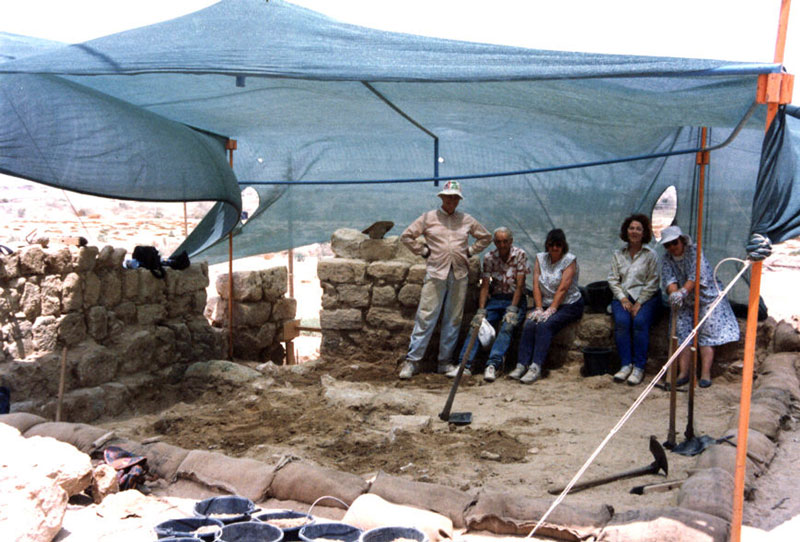
Dr Rudolph Cohen was the head of the Israel Antiquities Authority when I first met him in 1992. The following year I and my group of Australian volunteers excavated with Dr Cohen’s team in 1993 at Ein Hatzeva, 30 km south of the Dead Sea. Dr Cohen had been digging in the Negev (area south of Beer Sheba) for 25 years. During the Israeli occupation of the Sinai Peninsula he excavated at Kadesh Barnea. That was where Moses sent out the twelve spies and the Israelites waited 40 days for them to return (Numbers 13).
Two million people would leave behind a lot of broken pottery after forty days on the site, and Dr Cohen found the pottery and identified it as MBI. Writing in the July1983 edition of Biblical Archaeology Review, in an article headed ‘The Mysterious MBI People’, he asked,
‘Who were the MBI people? We really don’t know … . In fact, these MBI people may be the Israelites whose famous journey from Egypt to Canaan is called the Exodus … .
>‘I have been studying the MBI sites in the Central Negev for almost two decades now. The result of this study can, I believe, elucidate some of the outstanding issues … . New aspects of MBI culture, including burial customs and social structure, imply a new ethnic element. Thus, the MBI culture is also intrusive, migrating people who destroyed the existing urban centres must be involved … . In my view, the new MBI population came from the south and the Sinai, the route of the Israelites on that journey known as the Exodus.
‘This migratory drift, as I have reconstructed it, bears a striking similarity to that of the Israelites’ flight from Egypt to the Promised Land, as recorded in the book of Exodus. The concentration of MBI sites in the relatively fertile district east of Kadesh Barnea recalls the tradition that the Israelites camped near this oasis for 38 of their 40 years of wandering after leaving Egypt (Deuteronomy 1:46) … . The establishment of the MBI settlements directly over the ruins of the EBII-EBIII sites in the Central Negev is consistent with the tradition that the Israelites dwelled in the area previously inhabited by their Amelekite foes (Deuteronomy 25:17–19). The northeastward migration of the MBI population into Transjordan has parallels in the Biblical recollection that the Israelites remained in Moab before crossing the Jordan River and laying siege to Jericho (Deuteronomy 3:29). In this connection too, it is interesting to note that Early Bronze Age Jericho was destroyed by a violent conflagration, and the site was thinly reoccupied by MBI newcomers, who were apparently unaccustomed to urban dwellings.’29
>‘God specifically instructed that these cities should not be rebuilt. Interestingly enough, after the EBIII destruction of Jericho and Ai, both cities lay in ruins for hundreds of years … .
‘The similarity between the course of the MBI migration and the route of the Exodus seems too close to be coincidental. The Late Bronze Age (1550–1200 BC)—the period usually associated with the Israelites’ flight from Egypt—is archaeologically unattested in the Kadesh Barnea area (as elsewhere in the Central Negev, for that matter), but MBI remains abound and seem to provide a concrete background for the traditions of settlement.’30
While we were working on the dig at Ein Hatzeva, I was visited by Yigal Israel who was site supervisor of the Israeli team. I asked him if he accepted Dr Cohen’s views about the MBI people. He replied, ‘Yes, of course. We all do down here.’ I remarked that the archaeologists in the north do not accept that view. He replied, ‘They do not know what they are talking about. They have not excavated in the south.’
While excavating in Israel in 2004, I visited Yigal who lived not far from where we were digging. I asked him if he still holds the same views, and he assured me that he did. So while the majority of Israeli archaeologists adhere to the traditional identification of the archaeological strata, there is a division of opinion on the subject.
But how can scholars fiddle with the dates of Egyptian history on which the chronology of ancient Israel is based? The average reader can buy beautiful books with shiny pages that quote dates that seem to be as firmly established as the dates for World War I. What most casual readers do not realise is that every book will have a different set of dates. In particular there is much confusion over the Third Intermediate Period (the TIP) of Egyptian history. There is little known of these dynasties 21–24 and some scholars maintain that they did not exist as independent dynasties, and there are other periods when one Pharaoh was ruling in the north while another Pharaoh was ruling in the south.
Cambridge professor supports revision

Click here for larger view
In 1991, five scholars published a book called Centuries of Darkness in which they claimed that the TIP should be omitted from Egyptian history, reducing the dates of the dynasties before then by 250 years. A forward to this book was written by Professor Colin Renfrew of Cambridge University. He wrote:
‘This disquieting book draws attention, in a penetrating and original way, to a crucial period in world history, and to the very shaky nature of the dating, the whole chronological framework, upon which our current interpretations rest … . The revolutionary suggestion is made here that the existing chronologies for that crucial phase in human history are in error by several centuries, and that, in consequence, history will have to be rewritten … . I feel that their critical analysis is right, and that a chronological revolution is on its way.’31
While I was in London in 2004 I talked with Professor Renfrew. In the meantime he had been promoted to the House of Lords as a result of his reputation as a distinguished scholar. Among other matters, I asked him if he still holds the views about chronology which he expressed in his forward to Peter James’ book. He assured me that he did and that he promotes it in his classes at Cambridge University.
Conclusion
The dates of Egyptian history are by no means set in concrete—they are not astronomically fixed as some enthusiastic writers would have us believe. A reduction in dates for the dynasties of Egypt will be reflected in a reduction in dates for the archaeological strata in Israel, and if the end of the Early Bronze Period is recognized as the time when Joshua and his army destroyed Jericho, striking archaeological evidence will be found to support the biblical record (see table 1).
References
- Time, 18 December 1995, p. 54. Return to Text.
- Garstang, J., The Story of Jericho, Marshall, Morgan and Scott, London, 1948. Return to Text.
- Garstang, ref. 2, p. 133. Return to Text.
- Garstang, ref. 2, p. 20. Return to Text.
- Garstang, ref. 2, p. 46. Return to Text.
- Garstang, ref. 2, p. 91. Return to Text.
- Garstang, ref. 2, p. 99. Return to Text.
- Garstang, ref. 2, p. 101. Return to Text.
- Garstang, ref. 2, p. 136. Return to Text.
- Garstang, ref. 2, p. 141. Return to Text.
- Garstang, ref. 2, p. 142. Return to Text.
- Benn, E., Digging up Jericho, Ernest Ltd, London, pp. 47, 170, 1957. Return to Text.
- A visit to Jericho is still an exciting experience if you are with someone who can identify the relevant features. The annual Archaeological Diggings tour to Egypt and Israel can be recommended. Return to Text.
- Benn, ref. 12, p. 176. Return to Text.
- Benn, ref. 12, p. 189. Return to Text.
- Benn, ref. 12, p. 187. Return to Text.
- Benn, ref. 12, pp. 194–195. Return to Text.
- Benn, ref. 12, p. 207. Return to Text.
- Benn, ref. 12, p. 186. Return to Text.
- Benn, ref. 12, p. 241. Return to Text.
- Pritchard, J., Gibeon, Where the Sun Stood Still, Princeton University Press, NJ, p. 153, 1975. Return to Text.
- Benn, ref. 12, p. 211. Return to Text.
- Benn, ref. 12, p. 192. Return to Text.
- Benn, ref. 12, p. 253. Return to Text.
- Benn, ref. 12, p. 216. Return to Text.
- Benn, ref. 12, p. 262. Return to Text.
- Benn, ref. 12, p. 259. Return to Text.
- Bimson, J., Redating the Exodus, The Almond Press, Sheffield, pp. 130, 219, 1981. Return to Text.
- Cohen, R., The mysterious MBI people, Biblical Archaeology Review 9(04):28, July1983. Return to Text.
- Cohen, ref. 28, p. 29. Return to Text.
- James, P., Thorpe, I.J., Kokkinos, N., Morkot, R. and Frankish, J., Centuries of Darkness, Pimlico, London, pp. xv–xvi, 1992. Return to Text.
Readers’ comments
Comments are automatically closed 14 days after publication.