
Backwardly wired retina “an optimal structure”: New eye discovery further demolishes Dawkins
Summary
On Darwin’s bicentennial last year, his most prominent defender and ardent antitheist Richard Dawkins wrote a new book, The Greatest Show on Earth: The Evidence for Evolution. Ironically, he admits about all his previous pro-evolution books:
“Looking back on these books, I realized that the evidence for evolution is nowhere explicitly set out, and that it seemed like a good gap to close.”
One of his favourite examples, one he has been using for decades, is the alleged backwardly wired retina, a favourite example of supposed bad design. First, we republish a sample section from our refutation, The Greatest Hoax on Earth? showing that even with existing knowledge, Dawkins had no case. Then we report on a new discovery, conclusively showing that the allegedly inferior design is actually superior in producing sharper images and better colour distinctions.
From Greatest Hoax?:
Backwardly-wired retina?
Dawkins repeats a claim he has been making for over 20 years:
“But I haven’t mentioned the most glaring example of imperfection in the optics. The retina is back to front.
“Imagine a latter-day Helmholtz presented by an engineer with a digital camera, with its screen of tiny photocells, set up to capture images projected directly on to the surface of the screen. That makes good sense, and obviously each photocell has a wire connecting it to a computing device of some kind where images are collated. Makes sense again. Helmholtz wouldn’t send it back.
“But now, suppose I tell you that the eye’s ‘photocells’ are pointing backwards, away from the scene being looked at. The ‘wires’ connecting the photocells to the brain run over all the surface of the retina, so the light rays have to pass through a carpet of massed wires before they hit the photocells. That doesn’t make sense … ” (pp. 353–4)
Actually it does make sense, as ophthalmologists know, and have explained for years, so Dawkins has no excuse for repeating such discredited arguments. Dawkins’ analogy fails because photocells don’t have to be chemically regenerated, while the eye’s photoreceptors are chemically active, and need a rich blood supply for regeneration. As I wrote in By Design [see review], ch. 12:
Regenerating photoreceptors
Someone who does know about eye design is the ophthalmologist Dr George Marshall, who said:
“The idea that the eye is wired backward comes from a lack of knowledge of eye function and anatomy.”1
He explained that the nerves could not go behind the eye, because the choroid occupies that space. This provides the rich blood supply needed for the very metabolically active retinal pigment epithelium (RPE). This is necessary to regenerate the photoreceptors, and to absorb excess heat from the light. So the nerves must go in front rather than behind. But as will be shown below, the eye’s design overcomes even this slight drawback.
In fact, what limits the eye’s resolution is the diffraction of light waves at the pupil (proportional to the wavelength and inversely proportional to the pupil’s size); so alleged improvements of the retina would make no difference to the eye’s performance.
It’s important to note that the ‘superior’ design of Dawkins with the (virtually transparent) nerves behind the photoreceptors would require either:
- The choroid in front of the retina—but the choroid is opaque because of all the red blood cells, so this design would be as useless as an eye with a hemorrhage!
- Photoreceptors not in contact with the RPE and choroid at all—but without a rich blood supply to regenerate, then it would probably take months before we could see properly after we were photographed with a flashbulb or we glanced at some bright object.
Are squid eyes ‘properly’ wired?
Some evolutionists [including Dawkins in The Blind Watchmaker] claim that the cephalopod (e.g. squid and octopus) eye is somehow ‘right’, i.e. with nerves behind the receptor. They use this as a counter-argument to the points in the previous section about the need for the “backward” wiring. But no-one who has actually bothered to study cephalopod eyes could make such claims with integrity. In fact, cephalopods don’t see as well as humans, e.g. no colour vision, and the octopus eye structure is totally different and much simpler. It’s more like ‘a compound eye with a single lens’. And it is no accident that we say ‘eyes like a hawk/eagle’ rather than ‘eyes like a squid’, because the former really are sharper, despite their alleged ‘backward’ wiring.
Fibre optic plate
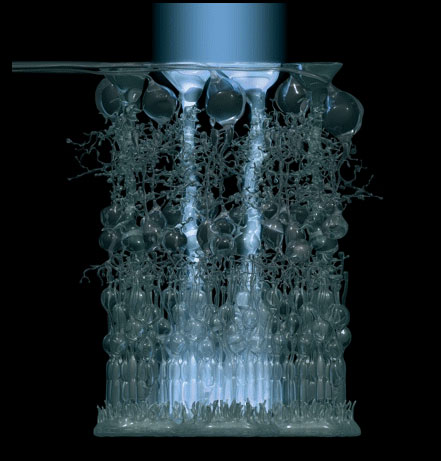
The above section explains why the vertebrate retina must be wired the way it is. But scientists at Leipzig University have recently shown that the vertebrate eye has an ingenious feature that overcomes even the slight disadvantage of the transparent nerves in front of the light receptors [the “carpet of massed wires” that Dawkins complains about].2
The light is collected and funnelled through the nerve net to the receptors by the Müller glial cells, which act as optical fibres. Each cone cell has one Müller cell guiding the light to it, while several rods can share the same Müller cell.
The Müller cells work almost exactly like a fibre optic plate that optical engineers can use to transmit an image with low distortion without using a lens. The cells even have the right variation in refractive index for “image transfer through the vertebrate retina with minimal distortion and low loss.”2
Indeed, Müller cells are even better than optical fibres, because they are funnel-shaped, which collects more light for the receptors. The wide entrances to Müller cells cover the entire surface of the retina, so collect the maximum amount of light.
One of the research team, Andreas Reichenbach, commented:
“Nature is so clever. This means there is enough room in the eye for all the neurons and synapses and so on, but still the Müller cells can capture and transmit as much light as possible.”3
Blind spot
Dawkins complains further:
“ … it gets even worse. One consequence of the photocells pointing backwards is that the wires that carry their data somehow have to pass through the retina and back to the brain. What they do, in the vertebrate eye, is all converge on a particular hole in the retina, where they dive through it. The hole filled with nerves is called the blind spot, because it is blind, but ‘spot’ is too flattering, for it is quite large, more like a blind patch, which again doesn’t inconvenience us much because of the ‘automatic Photoshop’ software in the brain. Once again, send it back, it’s not just bad design, it’s the design of a complete idiot.
“Or is it? If it were, the eye would be terrible at seeing, and it is not. It is actually very good. It is good because natural selection, working as a sweeper-up of countless little details, came along after the big original error of installing the retina backwards, and restored it to a high-quality precision instrument.” (pp. 354–5)
Once more, Dawkins shows no understanding of the need to regenerate the photocells, which necessitates this ‘backward wiring’. He also begs the question of how mutations and natural selection could create the sophisticated software, which rather speaks of intelligent programming (as does the real Photoshop). Some of this programming was explained in By Design, ch. 1:
Signal processing
Another amazing design feature of the retina is the signal processing that occurs even before the information is transmitted to the brain. This occurs in the retinal layers between the ganglion cells and the photoreceptors. For example, a process called edge extraction enhances the recognition of edges of objects. John Stevens, an associate professor of physiology and biomedical engineering, pointed out that it would take “a minimum of a hundred years of Cray [supercomputer] time to simulate what takes place in your eye many times each second.”4 And the retina’s analog computing needs far less power than the digital supercomputers and is elegant in its simplicity. Once again, the eye outstrips any human technology, this time in another area.
Indeed, research into the retina shows that the 12 different types of ganglion cells send 12 different ‘movies’, i.e. distinct representations of a visual scene, to the brain for final interpretation. One movie is mainly a line drawing of the edges of objects, and others deal only in motion in a specific direction, and still others transmit information about shadows and highlights. How the brain integrates these movies into the final picture is still a subject of intense investigation. Understanding this would help researchers trying to design artificial light sensors to help the blind to see.5
Ophthalmologist Peter Gurney, in his detailed response to the question, “Is the inverted retina really ‘bad design’?”6, also addresses the blind spot. He points out that the blind spot occupies only 0.25% of the visual field, so Dawkins is exaggerating to try to call it a patch rather than a spot. Furthermore, it is far (15°) from the visual axis, so that the normal visual acuity of the region is only about 15% of the foveola, the most sensitive area of the retina right on the visual axis. And having two eyes effectively means there is no blind spot. So the alleged defect is only theoretical, not practical. The blind spot is not considered handicap enough to stop a one-eyed person from driving a private motor vehicle. The main problem with only one eye is the lack of stereoscopic vision.
Problem for Dawkins’ own just-so story of eye evolution
In Dawkins’ earlier book Climbing Mt Improbable, he cited a computer simulation by Dan Nilsson and Susanne Pelger from a widely publicized paper.7 Taking their cue from Darwin, who started with a light-sensitive spot when ‘explaining’ the origin of the eye, their simulation starts with a light-sensitive layer, with a transparent coating in front and a light-absorbing layer behind. But the hypothetical ancestor starts with the nerve behind the light-sensitive spot, rather than from in front, as in the vertebrate eye. Yet the evolutionary just-so story can provide no transition from having the nerves behind to in front, with all the other complex coordinated changes that would have to occur as well.8
Indeed, Dawkins has no plausible explanation for the origin of the integrated components that work together to account for vision, such as that seen in vertebrates. Claiming that it is poorly designed because he has not carefully researched the matter does not explain how evolution created it.
New discovery: Müller cells enhance sharpness
At the time the book was written, it was thought that the Müller cells were mainly waveguides to transmit light without distortion, so mitigate the necessary disadvantage of needing the photoreceptors near the blood supply. But researchers Amichai Labin and Erez Ribak at the Technion-Israel Institute of Technology in Haifa found that the Müller cells are much more than that. They said:
“The retina is revealed as an optimal structure designed for improving the sharpness of images. … The fundamental features of the array of glial cells are revealed as an optimal structure designed for preserving the acuity of images in the human retina. It plays a crucial role in vision quality, in humans and in other species.”9
One reason is that images can be distorted by light “noise”, i.e. light that is reflected several times within the eye instead of coming directly through the pupil. But the Müller cells transmit the direct light strongly to the rods and cones, while the noise leaks out. This makes the images sharper.
Another problem with lenses is that they are basically prisms joined face-to-face, and have a tendency to separate the colours. This is called chromatic aberration. Expensive cameras have multiple lenses to try to avoid this problem. But “Müller cells’ wide tops allow them to ‘collect’ any separated colours and refocus them onto the same cone cell, ensuring that all the colours from an image are in focus.”10
Furthermore, the Müller cells are tuned to the visible region of the spectrum, and leak out other wavelengths, minimizing radiation and heat damage.
The researchers say:
“In this study, wave propagation methods allowed us to show that light guiding within the retinal volume is an effective and biologically convenient way to improve the resolution of the eye and reduce chromatic aberration. We also found that the retinal nuclear layers, until now considered a source of distortion, actually improve the decoupling of nearby photoreceptors and thus enhance vision acuity. Although this study was performed on data from human retinas and eyes, most of its consequences are valid for eyes with other retinal structure and different optics. They are also valid for the more common case of eyes without a central fovea.”
New Scientist reports:
“‘It suggests that light-coupling by Müller cells is a crucial event that contributes to vision as we know it,’ says Kristian Franze, a neurophysicist at the University of Cambridge and co-author of the 2007 study.2 “This work nicely complements our experimental data.’”10
Furthermore, this design may inspire scientists to copy it, just another example of biomimetics:
“The new understanding of the role of Müller cells might find applications in more successful eye transplants and better camera designs, says Ribak.”10
Evolutionists dogmatically hang on to dud argument
It’s notable that Kate McAlpine, writing in New Scientist, which is overtly anti-Christian, had to admit, “It looks wrong, but the strange, ‘backwards’ structure of the vertebrate retina actually improves vision,” after admitting that New Scientist had listed the backwardly wired eye as one of evolution’s biggest “mistakes””.
Yet not willing to junk a defunct evolutionary argument, she says:
“However, Kenneth Miller, a biologist at Brown University in Providence, Rhode Island cautions that this doesn’t mean that the backwards retina itself helps us to see. Rather, it emphasises the extent to which evolution has coped with the flawed layout. ‘The shape, orientation and structure of the Müller cells help the retina to overcome one of the principal shortcomings of its inside-out wiring,’ says Miller.”10
Miller is a professing Christian, but his worldview is indistinguishable for all practical purposes from the rabid atheists he loves to ally with against Bible-believers (see refutations of his books Finding Darwin’s God (2000), Only a Theory: Evolution and the Battle for America’s Soul (2008)). He, like Dawkins, has qualifications in neither ophthalmology (unlike Marshall and Gurney) nor physical optics (unlike me). First, he fails to address the important reasons for the backwardly-wired eye retina; second, he fails to show why it is a bad design anyway, especially given the newly discovered advantages of the wave guiding. Last, it is absurd given that the researchers think that this “flawed” layout might help to improve camera design!
This discovery thus nails one of Richard Dawkins’ favourite “proofs” of evolution in The Greatest Show on Earth. But judging by his record, he will not give up his fallacious arguments in the cause of his atheopathic faith.11 After all, other researchers had adduced from analysing baby zebrafish eyes, “evidence that the inverted retina actually is a superior space-saving solution, especially in small eyes.”12
Update: see Refutation of critics of this article, including Dawkins’ fellow atheopath P.Z. Myers.
References
- Marshall, G. (interviewee), An eye for creation. Creation 18(4):20–21, 1996; creation.com/marshall. Return to text.
- Franze, K. et al., Müller cells are living optical fibers in the vertebrate retina, Proc. Nat. Acad. Sci. USA, 10.1073/pnas.0611180104, 7 May 2007; pnas.org/content/104/20/8287. Return to text.
- Sheriff, L., Living optical fibres found in the eye: Moving light past all those synapses, The Register, 20007; www.theregister.co.uk/2007/05/01/eye_eye/. Return to text.
- Byte, April 1985. Return to text.
- Roska, B., Molnar, A., Werblin, F.S., Parallel processing in retinal ganglion cells: How integration of space-time patterns of excitation and inhibition form the spiking output, J. Neurophys. 95:3810–3822, 2006. The lead researchers wrote a semi-popular article: Werblin, F. and Roska, B., The movies in our eyes, Scientific Amer. 296(4):54–61, 2007. Return to text.
- Gurney, P., Is our ‘inverted’ retina really ‘bad design’? J. Creation 13(1):37–44, 1999; creation.com/retina. Return to text.
- Nilsson, D.E. and Pelger, S., A pessimistic estimate of the time required for an eye to evolve. Proc. R. Soc. Lond. B 256:53–58, 1994. Return to text.
- Sodera, V., One Small Speck to Man: The Evolution Myth, pp. 292–302, Vij Sodera Publications, Bognor Regis, UK, 2003; the author is a surgeon. Return to text.
- Labin, A.M. and Ribak, E.N., Retinal glial cells enhance human vision acuity, Physical Review Letters 104, 16 April 2010 | DOI:10.1103/PhysRevLett.104.158102. Return to text.
- McAlpine, K., Evolution gave flawed eye better vision, New Scientist 206(2759), 8 May 2010. Return to text.
- I was first alerted to this important new eye discovery by Can Darwin be rescued from a new eye discovery? Creation-Evolution Headlines, creationsafaris.com, 7 May 2010. Return to text.
- Kröger, R.H.H. and Biehlmaier, O., Space-saving advantage of an inverted retina, Vision Research 49(18):2318–2321, 9 September 2009 | doi:10.1016/j.visres.2009.07.001.
Readers’ comments
Comments are automatically closed 14 days after publication.