

Radioactive ‘dating’ in conflict!
Fossil wood in ‘ancient’ lava flow yields radiocarbon
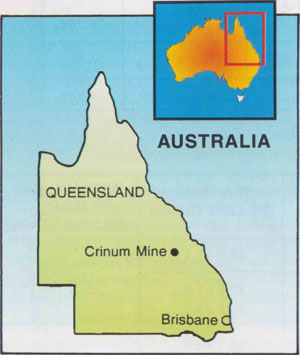
When miners were sinking a ventilation shaft for the new Crinum Coal Mine in Central Queensland in 1993 (see map below) they unearthed a rare find. After digging through the thin surface sands and clays, followed by basalt, 21 metres (almost 69 feet) down they found pieces of wood entombed in the bottom basalt flow.1 Below the basalt were layers of claystone, siltstone, and sandstone with interbedded coal seams.2

Fossil wood in ‘ancient’ basalt
The wood was in three states—ash, charred, and intact.1 Those on-site at the time speculated that there had been two distinct trees, partly standing, still organic in nature, and thus not petrified. The imprint of a leaf was also discovered within the basalt, which was also regarded as remarkable, remembering that the enclosing rock was once molten lava erupted at 1000–1200°C (about 1800–2200°F).

So how could these tree trunks have survived being engulfed by molten lava? At approximately four metres (13 feet) thick, the basalt flow is relatively thin,1,3 and thus cooling would have been rapid (perhaps days, but a few weeks at most4). This is verified by the observed internal structure of the basalt flow.1,5 Since the tree trunks were engulfed at the bottom of the flow, cooling may have been immediate, with any water present in the wood aiding extremely rapid encapsulation and thus preservation.
The local geological context makes the basalt flow approximately ‘30 million years old’,1,3 in keeping with other basalt flows in the region all regarded as of Tertiary age (in the conventional terminology). Since the tree trunks were entombed in the basalt lava, the wood is thus supposedly at least 30 million years old. Also, what looked like the tree roots were found in the siltstone below the basalt,3 suggesting the trees when alive were rooted into the siltstone and thus growing on a land surface that was then covered by basalt lava. This siltstone belongs to the Permian German Creek coal measures, conventionally believed to be around 255 million years old.6
Collection of samples
Small fragments of some of the wood samples were kindly sent to us, and a subsequent mine visit took place in late August 1994.7 The pieces of wood recovered by the miners were examined and photographed, as too was the leaf imprint, but access to the ventilation shaft was not possible, nor were samples of the enclosing basalt available, having long been dumped with all the other rubble and waste rock.

However, an exploratory hole had been drilled close to where the shaft was eventually dug. In the relevant drill core, at the bottom of the lowermost basalt flow, pieces of fossil wood still containing organic carbon were present encased in the basalt, right at the boundary of the basalt flow with the siltstone below. This drill core was subsequently sent to us once permission was granted by the mining company.7
After visiting the mine site, nearby outcrops of the same basalt flows were investigated and sampled. This was to make sure we at least had some samples of the basalt, just in case permission to have the drill core wasn’t forthcoming.
Laboratory work
Tiny portions of the same piece of fossil wood encased in the basalt in the drill core were sent for radiocarbon (14C) analyses to two reputable laboratories—Geochron Laboratories in Cambridge, Boston (USA), and the Antares Mass Spectrometry laboratory at the Australian Nuclear Science and Technology Organisation (ANSTO), Lucas Heights near Sydney (Australia). Neither laboratory was told exactly where the samples came from to ensure that there would be no resultant bias. Both laboratories use the more sensitive accelerator mass spectrometry (AMS) technique for radiocarbon analyses, Geochron being a commercial laboratory and Antares being a major research laboratory. Also, tiny fragments of the initial wood samples provided to us, from the pieces of wood that had been found during sinking of the ventilation shaft, were sent off for radiocarbon analyses—one set of different fragments to each laboratory.
Pieces of the basalt samples from the outcrop and the drill core were also sent to analytical laboratories, for major, minor, and trace element analyses to establish the character of these rocks, but mainly for radioactive ‘dating’ analyses. Potassium-argon (K-Ar) ‘dating’ was performed on the two outcrop samples by the AMDEL laboratory in Adelaide (Australia), while one of the two outcrop samples and two drill core samples, one being in contact with the fossil wood, were ‘dated’ by Geochron Laboratories.
Results
The radiocarbon (14C) results are listed in Table 1.8 It is immediately evident that there was detectable radiocarbon in all wood samples, so that the laboratories’ staff had neither hesitation nor difficulties in calculating 14C ‘ages’. When subsequently questioned regarding the limits of the analytical method for the radiocarbon and any possibility of contamination, staff at both laboratories (Ph.D. scientists) were readily insistent that the results, with one exception,9 were within the detection limits and therefore provided quotable finite ‘ages’!8 Furthermore, they pointed to the almost identical δ13C results (last column in Table 1), consistent with the carbon being organic carbon from wood, and indicating no possibility of contamination. So the results in Table 1 are staunchly defended by the laboratories as valid, indicating an ‘age’ of perhaps 44,000–45,500 years for the wood encased in the basalt retrieved from the drill core.
| Sample | Lab | Lab code | 14C ‘age’ (BP) years | δ13CPDB15 |
|---|---|---|---|---|
| Wood in Drill Core | Geochron | GX-20798-AMS | >35,620 | -25.7‰ |
| ANSTO | OZB472 | 44,700 ±950 | -25.78‰ | |
| Other Wood | Geochron | GX-20087-AMS | 29,544 ±759 | -25.1‰ |
| ANSTO | OZB473 | 37,800 ±3,450 | -26.16‰ |
Table 1. Radiocarbon (14C) analyses of fossil wood samples.
In stark contrast to the ‘age’ of the wood are the potassium-argon (K-AR) ‘ages’ of the basalt (see Table 2).8 It is readily apparent that there are significant variations in the results, as evident in the calculated ‘ages’ of the outcrop 2 sample provided by each laboratory. The problem of obtaining consistently ‘acceptable’ K-AR ‘ages’ is also highlighted by the observation that both outcrop and both drill core samples probably represent the same basalt flow in each respective location (hence the calculated average ‘ages’ in the last column of Table 2).10 The staff of both laboratories (again Ph.D. scientists) defended their analytical results,8,11 and did not hesitate to affirm that these basalt samples are, according to their radioactive K-AR ‘dating’, around 45 million years old.
| Sample | Lab | Lab code | K-Ar ‘age’ (million years) | Average K-Ar ‘age’ (million years) | |||
|---|---|---|---|---|---|---|---|
| Outcrop 1 | AMDEL | G878300G/95 | 44.9 ±1.1 |
|
|||
| Outcrop 2 | AMDEL | G878300G/95 | 47.9 ±1.6 | ||||
| Geochron | R-11800 | 39.1 ±1.5 | |||||
| Drill Core | Geochron | R-11798 | 58.3 ±2.0 | 47.5 ±10.8 | |||
| Drill Core Enclosing Wood | Geochron | R-11799 | 36.7 ±1.2 |
Table 2: Potassium-argon (K-AR) ‘dates’ on basalt samples.
Conclusions
While the quality and accuracy of the analytical work undertaken by all the laboratories involved is unquestionably respected, all the calculated ‘ages’ are mere interpretations based on unproven assumptions about constancy of radioactive decay rates, and on the geochemical behaviour of these elements (and their isotopes) in the unobservable past. To young-earth creationists the geological context of these fossil wood fragments in the basalt lava flow clearly indicates that these represent post-Flood trees overwhelmed by a post-Flood volcanic eruption nearby, and thus both the fossil wood and the basalt are less than 4,500 years old.12
Nevertheless, within the conventional (uniformitarian) framework of interpretation, a clear-cut conflict can be seen between these two radioactive ‘dating’ methods. Normally fossil wood found in such an ‘ancient’ basalt would not be radiocarbon ‘dated’, because the wood would be considered far too old for any radiocarbon to be left in it.13 Yet here these radioactive ‘dating’ methods are again demonstrated to be unreliable and clearly useless at determining the true age of the wood and basalt.14 Therefore, any published results from these ‘dating’ methods should not be seen as casting any doubts whatsoever on the reliability of the biblical chronology so carefully provided for us by the (always present) Creator Himself.
References and notes
- ‘Rare find unearthed at Crinum’, BHP Australia Coal Newsline, p. 1, December 1993–January 1994. Return to text.
- Copies of the relevant geological cross-section and drill-hole data were kindly supplied by the Crinum Mine Project staff. Return to text.
- Letter dated 27 April 1994 from Greg B. Chalmers, the Chief Project Engineer at the time for the Crinum Mine Project. Return to text.
- Snelling, A.A., The formation and cooling of dykes, J. Creation 5(1):81-90, 1991. Return to text.
- An upper section filled with vesicles (spherical holes left by gas bubbles), a coarse-grained middle section, and a hard, dense, fine-grained bottom section—indicative of rapid cooling from bottom up and top down simultaneously. Return to text.
- Falkner, ‘Sedimentological studies in the German Creek coal measures and their relevance to longwall mining’, New Developments in Coal Geology (A Symposium), J.W. Beetson (ed.), Coal Geology Group (Geological Society of Australia), pp. 143–148, 1993. Return to text.
- Greg B. Chalmers, then Chief Project Engineer, and BHP Australia Coal Pty Ltd, operators of the Crinum Mine, are thanked for allowing our visit to the mine and the photographing of their fossil wood and leaf specimens, and for providing pieces of their fossil wood samples and the several metres of drill core that were so crucial to this investigation. Return to text.
- Original copies of all the official laboratory analytical and ‘dating’ reports, and the correspondence with staff of the laboratories, have been kept on file. Return to text.
- The one exception was due to the small quantity of carbon extracted from the sample, but when repeated by the other lab, a finite ‘age’ was obtained. Return to text.
- However, other analytical results provide evidence that the outcrop does probably represent a younger, though closely related, basalt flow to that sampled in the drill core. Return to text.
- They did suggest the possibility of some variable contamination of the samples with atmospheric argon, but definitely not contamination introduced by their laboratory procedures. Return to text.
- It needs to be remembered that during the Flood and immediate post-Flood periods the earth’s stronger, but fluctuating, magnetic field affected the incoming cosmic ray influx, resulting thus in a lower radiocarbon production rate and therefore radiocarbon ‘ages’ much greater than the true ages. Return to text.
- The results of this investigation confirm that it is likely radiocarbon may also be detected in other fossil woods found at even deeper levels in the so-called geological column, even if the fossil wood was from pre-Flood trees buried during the Flood. Further investigations are in progress. Return to text.
- A fuller report with all technical and analytical details, including the results from other radioactive ‘dating’ methods and the attempted identification of the fossil wood, was later published, Conflicting ‘ages’ of Tertiary basalt and contained fossilised wood, Crinum, Central Queensland, Australia, J. Creation 14(2):99–122, August 2000. Return to text.
- δ13CPDB denotes the measured difference of the ratio of 13C/12C (both stable isotopes) in the sample compared to the PDB (Pee Dee Belemnite) standard—a fossil belemnite from the Cretaceous Pee Dee Formation in South Carolina, USA. The units used are parts per thousand, written as ‰ or per mil (compared with parts per hundred, written as % or per cent). Organic carbon from the different varieties of life gives different characteristic δ13CPDB values. Return to text.




Readers’ comments
Comments are automatically closed 14 days after publication.