

Skeptics challenge: a ‘God of love’ created a killer jellyfish?
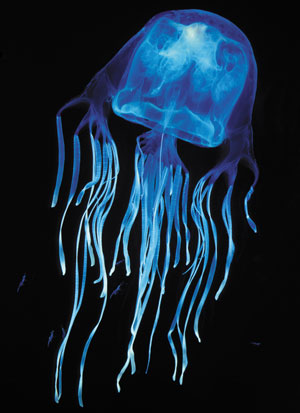
When Christians point to the complexity of living things as evidence for a Designer (i.e. God), scoffers love to object that many of these same ‘design features’ are used to hunt and capture prey, or alternatively, to incapacitate predators. Of the box jellyfish, for example, ‘that most venomous marine creature’, one anti-creationist (and non-scientist) asks that if God is good, and ‘if he is the originator of all species, governed by the law of Love’, why should he make them with ‘such gratuitous and ingenious cruelty’? And, ‘Who would want to be killed by a jellyfish, even a box jellyfish?’1 He concludes, ‘Better no god than this one.’
When answering similar challenges about defence-attack structures (DAS) in general, Christians should remember that the Bible teaches that the original diet of both humans and animals was vegetarian (Genesis 1:29–30). Thus there was no death of humans or vertebrate animals, which the Hebrew Bible calls nephesh chayyāh (נֶפֶשׁ חַיָּה). Plants and invertebrates are not described that way, so are not ‘living creatures’ in the same biblical sense. It was only the Fall of Adam that brought death and suffering into the world (Genesis 3:19, Romans 8:20–22) when God cursed the whole creation.
From this biblical framework, Christians can present a logical answer to any scoffer’s challenge. Any specific case is likely to fall into these general categories of explanation:2

Those things that are now used as DAS may not have been designed for this purpose, and had a different function before the Fall. They reached their present function by degeneration, e.g. mutations.
The design information for DAS was already present before the Fall, perhaps in latent or masked form. God foreknew the Fall, so it’s likely that He preprogrammed creatures for the information needed to survive in a fallen world.
Such is the spectacular efficiency of jellyfish stinging cells, with the triggering mechanism and venomous action being prey-specific in some instances, the first option seems unlikely. So God probably designed the complex information for these stinging cells, to be switched on at the Fall. But what did jellyfish eat before the Fall? Perhaps the following observations of jellyfish today give us an insight into the pre-Fall world:
Some jellyfish are said to get nourishment from phytoplankton (i.e. from plants, not animals). On the Scientific American website, a jellyfish expert writes:
‘Some jellyfish (like the upside-down jellyfish, Cassiopeia xamachana) are vegetarians that grow their own food and carry it with them. These jellyfish raise algae inside their belly, giving them a food source that they take along as they float through the oceans.’3
Many fish ‘shelter’ under the bells of jellyfish, swimming freely among the tentacles. Their contact does not trigger the firing of the nematocysts.
Note that the concept of ‘poison’ depends on amounts—most poisons have benefits in small amounts, e.g. the deadly botulinum toxin is used in modern beauty treatments (botox). Conversely, even ‘good’ things like oxygen can act as poisons in large amounts.4
Actually, it’s the evolutionists who have a problem! The difficulties confronting them are many, which is why they resort to pseudo-theological arguments1 rather than address scientific ones.
The evolutionary origin of jellyfish and their supposed evolutionary relationships with other animals is often described as being ‘still surrounded in much mystery’, and ‘one of the most interesting puzzles of biology’.5
Jellyfish are said to be ‘very simple’ and ‘usually regarded as being primitive’. But evolutionists admit that nematocysts are among the most complex animal structures, and ‘the firing of the dart is perhaps the most rapid biological motion known.’6
Different species of jellyfish vary greatly in the suite of toxins they inject—researchers often find it more meaningful to classify jellyfish according to nematocyst type and mode of action rather than according to phylogenetic relationships (a huge difficulty for evolutionists trying to explain the origin of such different, intricate and efficient stinging cell mechanisms).
The two main evolutionary theories as to why box jellyfish are toxic are (a) that they are fragile animals that must subdue their prey quickly to prevent damage to themselves; and (b) that they require such potent toxin in order to protect themselves from predators, such as turtles. But researchers admit that both of these theories appear to have little support, as more fragile species are less toxic than some of the more robust species, and turtles and various fish species are known to consume box jellyfish without being affected.7
If jellyfish have been around for as long as evolutionists say they have, what did they originally use their stinging cells for? As one evolutionist puts it, ‘it is inconceivable that large predatory organisms like jellyfish could have existed at a time when there was nothing else around for them to feed on!’8 And equally, jellyfish would not have needed stinging cells to deter predators, because, according to evolutionary theory, no predators had yet evolved! But the evidence is consistent with the Fall affecting all creatures at the same time.
Re-posted on homepage: 20 April 2024
References
- Davis, R.G., Killed by a jellyfish, Freethought Today, www.ffrf.org/fttoday/nov96/davis.html, 1 July 2003 (‘freethought’ is a pretentious self-description of some of the most dogmatic-thinking atheists). Return to text.
- See also Batten, D. (Ed.), Catchpoole, D., Sarfati, J. and Wieland, C., The Creation Answers Book, creation.com/cab; and Q&A: Genesis—Curse. Return to text.
- Scientific American www.sciam.com/print_version.cfm?articleID=00031A14-67F1-1C72-9EB7809EC588F2D7, 1 July 2003. Return to text.
- Bergman, J., Understanding Poisons from a Creationist Perspective, Journal of Creation 11(3):353–360, 1997. Return to text.
- FAQ—Where do the jellyfish come from? www.odc.ucla.edu/html/body_faq.html, 2 July 2003. Return to text.
- California Academy of Sciences—The Venoms Lecture Series, www.calacademy.org/publications/course_catalog/fall_winter_2000-2001/lectures.html, 1 July 2003. Return to text.
- Why are Box Jellyfish toxic? www.jcu.edu.au/interest/stingers/biology%204stings.htm, 30 June 2003. Return to text.
- Phylum Cnidaria, www.palaeos.com/Invertebrates/Coelenterates/Cnidaria.htm, 1 July 2003. Return to text.



Readers’ comments