
Feedback archive → Feedback 2010
Is the Bible our sole final authority?
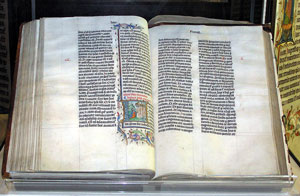
This week’s feedback from JA in the USA concerns the foundational Reformation doctrine of Sola scriptura:
For some time I have been using various internet message boards and contacting various ministries trying to get a better understanding of the doctrine of sola scriptura. So far I have gotten nothing but confusion accompanies by large amounts of hostility from people that say they are sola scriptura but who won’t make any effort to explain or defend it. I would appreciate any input you could offer.
How can the Bible be someone’s final or sole authority in all matters when:
- The Bible does not tell us what books it is supposed to have and what books it is supposed to leave out (include the Gospel of Matthew and exclude the Gospel of Judas);
- The Bible does not tell us what manuscripts we should use to prepare a translation and what manuscripts we are supposed to reject (use Textus Receptus but not Codex Sinaiticus);
- The Bible does not expressly tell us who is right when two people have different (and often mutually exclusive) ideas about what the Bible means?
BTW: I have a bachelor’s degree in biology, but I am a creationist. I place no importance on the age of the earth as a matter of doctrine or as a matter of science. Science cannot tell us how old the earth is, but science has documented that the earth’s 24 hour solar day is not constant (Indian Ocean Earthquake) and there is archaeological evidence and historical documentation to indicate that the earth once had solar days of less than 24 hours and solar years of less than the current 365.25 days. The most I will say as a matter of doctrine is that Satan had not yet rebelled against God when God created Adam and Eve and no living thing in creation died before Adam and Eve sinned against God.
Thank you,
JA
Our information officer Lita Sanders replies:
Dear Mr A,
I certainly believe that it is important to be able to explain and defend the doctrines which we hold to strongly. I recommend that you read the Chicago Statement on Inerrancy and the Chicago Statement on Biblical Hermeneutics for a good overview of what mainstream evangelicals believe. Also, our Bible Questions and Answers page has some articles which treat your questions in more depth.
1. The Bible does not itself have a list of books which are said to be part of Scripture, but I would argue that this isn’t necessary. The books of Scripture have always been recognized by Christians (and by Jews, for the books which are part of the Protestant canon of the Old Testament) to have special binding authority over matters of faith and practice. Protestant Christians accept the same Old Testament writings which make up the Jewish Bible (of course, there are some differences of ordering the books, but that hardly matters). For the New Testament, there are a few qualifications for a document to be considered part of the canon.
First, it had to be written by a first-or second-generation Christian. That is, someone who directly knew Christ, like John or Peter (Paul counts too, because of his Damascus road experience) or by someone who was directly taught by someone who knew Christ, like Mark, who wrote Peter’s account of Jesus’ ministry, or Luke, who used first-generation Christians as his sources.
Second, it has to be used as Scripture by the whole Church—something that was only used in Alexandria but not Antioch or Rome, for instance, wouldn’t qualify. This may seem circular—for something to be declared Scripture for the whole Church it has to be used that way by the whole Church. But it’s really not; it’s more of a formalization of what the Church had already recognized long before the concept of a formal canon was thought of.
Third, any candidate for the canon cannot contradict any part of previously accepted Scripture. For instance, a document which claimed that there was another way to salvation besides through Jesus’ atoning death and resurrection would not be considered for the canon.
If you read the apocryphal New Testament, you will notice substantial differences in their teaching and writing quality. Some are obviously Gnostic in character, and the apocryphal Acts of various apostles and biblical characters frequently cast the starring apostle in a role as a sort of Christ-figure. Most of the apocryphal books were never even meant to be considered for the canon; they were more like romance or adventure novels; cheap entertainment like today’s Christian novels.
Finally, no book which is currently part of Scripture was ever rejected by the Church at any point in history, and no document which is excluded was ever included by the majority of the Church. There are very early documents (like the Muratorian canon) which confirm this.
Leading New Testament Greek scholar Bruce Metzger (1914–2007) pointed out:
‘You have to understand that the canon was not the result of a series of contests involving church politics. … You see, the canon is a list of authoritative books more than it is an authoritative list of books. These documents didn’t derive their authority from being selected; each one was authoritative before anyone gathered them together.’1
Earlier, The NT scholar Frederick Fyvie Bruce (1910–1990), who even wrote a book on the Canon, pointed out:
‘The NT books did not become authoritative for the Church because they were formally included in a canonical list; on the contrary, the Church included them in her canon because she already regarded them as divinely inspired, recognising their innate worth and generally apostolic authority, direct or indirect. … [Church] councils [did] not impose something new upon the Christian communities but codif[ied] what was already the general practice of those communities.’2
2. First, the Bible’s originals preceded the manuscripts we now have by over a century for even the earliest ones, and the major ones are 3–4 centuries after the originals. Second, they didn’t get their names (like Sinaiticus, Alexandrinus, etc) until their modern discoveries. Third, we don’t believe that any of the manuscripts we now possess are inerrant; they all have copyists’ errors; the New Testament has quite a bit more than the Hebrew Old Testament because while the OT was copied by professional scribes, the NT was copied by amateurs; if someone wanted his own copy of Romans, he had to write it out himself or hire someone to do it for him.
The copies of the NT documents we have all have errors, but we have so many copies from so many different places, and which go back fairly early, that we can tell fairly certainly what the original text said. Although there are disagreements among scholars on various points, no single manuscript error affects a point of Christian doctrine or practice.
3. The Bible was written to be plain to its contemporary readers (this is called the doctrine of perspicuity), so at the time of writing, there was no need for a commentary on what the Bible meant on a certain point. The need for an explanation comes when the cultural information assumed by the text is lost. So it would be anachronistic, for example, for Paul to write that when he says “baptize”, he means “to immerse believers in a body of water” (to reflect one view of the practice), because the meaning of “baptize” would be known to his audience.
As for the age of the earth, even if I accept for the sake of argument that the length of days and years was not always constant, it stretches credulity to allow that the difference could stretch the biblical age of the earth (around 6,000 years) to billions. In my view, the archaeological evidence is more likely to show that earlier civilizations had less precise calendars than we do today, rather than the length of days and years actually changed.
As you say, no living thing died before the Fall. This is enough to rule out millions of years, because any scheme that adds vast eons to Earth history places most of the fossil record before man, and this is a record of death.
Sincerely,
Lita Sanders
Information Officer
Creation Ministries International
References
- Metzger, B., interviewed in Strobel, L., The Case for Christ, Zondervan, Grand Rapids, MI, 1998. Return to text.
- Bruce, F.F. The New Testament Documents, IVP, Downers Gr, Ill, IVP, 1960. Return to text.


Readers’ comments
Comments are automatically closed 14 days after publication.