

Spectacular spider stickiness
Geckos can stick to almost any surface, so they can even run upside down on a ceiling of polished glass.1 This is due to an amazingly fine structure that the researchers said was ‘beyond the limits of human technology’.2 However, we later reported3 how the adhesive structure was duplicated by ingenious inventors, making a powerful adhesive that supported large loads.4 These researchers speculated how it might equip a real ‘spiderman’, although at the time it seemed like ‘geckoman’ was more apt. But recent research has shown that ‘spiderman’ is appropriate after all—spiders use exactly the same principle.

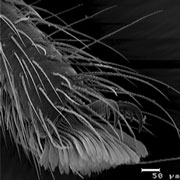
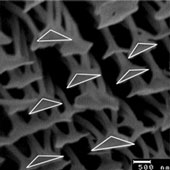
Antonia Kesel at the Institute for Technical Zoology and Bionics in Bremen and colleagues at the University of Zurich analyzed the feet of a jumping spider under a powerful electron microscope.5 The spiders cling to rough surfaces with claws on their feet. But on smooth surfaces, they attach with the claw tuft (scopula) on all eight legs. Like the gecko, this tuft has tiny hairs called setae. These are in turn covered by even tinier hairs called setules, whereas in the gecko the setae are subdivided into tiny spatulae.
Like gecko spatulae, the spider setules bond to almost any surface with tiny close-range attractions called van der Waals forces. The jumping spider has over 600,000 setules in contact with the surface, so there is a huge contact area.6 This means the total attractive force is strong enough to support 160 times its own weight.7
But this is not enough—it would do the spider no good to have this amazing foot if it could only stick—it must also unstick quickly. The gecko manages this with the ‘unusually complex behaviour’2 of uncurling its toes when attaching, and unpeeling while detaching. But the spider researchers said they planned further research on how the spider manages to detach quickly.5 A later suggestion is that the spider lifts its leg in a way that setules can detach in turn, not all at once, so the required force is not too great.8
Dr Kesel hopes that their research will help develop strong post-it notes that could stick even to wet or greasy surfaces, and allow astronauts to stick to the wall of a spacecraft.9
This is only one of a huge number of cases where the Creator’s ingenious designs are teaching good lessons to human designers.
| Below: A scanning electron micrograph (SEM) of the foot of the jumping spider Evarcha arcuata. In addition to the tarsal claws, a tuft of hair called a scopula is found at the tip of the foot, which is what the spider uses to attach itself to surfaces. The long hairs which are distributed over the entire foot are sensitive to touch. Magnification 200x.
|

References and notes
- Sarfati, J., Great gecko glue? Creation 23(1):54–55, 2000.
- Autumn, K. et al., Adhesive force of a single gecko foot hair, Nature 405(6787):681–685, 8 June 2000; perspective by Gee, H., Gripping feat, same issue, p. 631.
- Sarfati, J., Gecko foot design—could it lead to a real ‘spiderman’? Creation 26(1):54–55, 2003.
- Geim, A. et al., Microfabricated adhesive mimicking gecko foot-hair, Nature Materials 2:461–463, 2003.
- Kesel, A.B., Martin, A. and Seidl, T., Adhesion measurements on the attachment devices of the jumping spider Evarcha arcuata, Journal of Experimental Biology 206:2733–2738, 2003.
- A single setule has a mean contact area of 1.7 x 10⁵ nm2. E. arcuata has about 624,000 setules in all legs combined, so the contact area is 1.06 x 10¹¹ nm2.
- A single setule can produce an adhesive force (Fa) of 41 nN perpendicular to a surface. So the total Fa from all 624,000 setules is 25.6 mN. The spider’s body mass is 15.1 mg so its weight is only 0.148 mN, 1/173 of the force of all setules combined. See Kesel, A.B., Martin, T., and Seidl, T., Getting a grip on spider attachment: an AFM approach to microstructure adhesion in arthropods, Smart Materials and Structures 13:512–518, June 2004.
- Spiders make best ever Post-it notes, Institute of Physics, 19 April 2004.
- Dumé, B., Spiders get a grip, Physics Web 20 April 2004.
Readers’ comments
Comments are automatically closed 14 days after publication.