



After the island of Surtsey was born of a huge undersea volcanic eruption off Iceland in 1963,1 geologists were astonished at what they found.
As one wrote: ‘On Surtsey, only a few months sufficed for a landscape to be created which was so varied and mature that it was almost beyond belief.’2
There were wide sandy beaches, gravel banks, impressive cliffs, soft undulating land, faultscarps, gullies and channels and ‘boulders worn by the surf (see picture left), some of which were almost round, on an abrasion platform cut into the cliff.’2 And all of this despite the ‘extreme youth’3 of the island!
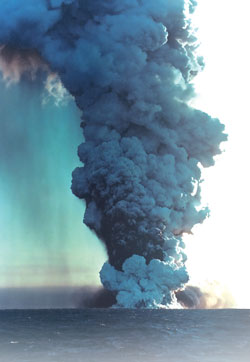
The geologists’ surprise is understandable, given the modern thinking that young Surtsey’s ‘varied and mature’ features ought to have needed long periods of time—millions of years—to form. But such ideas are a relatively modern phenomenon, a legacy of uniformitarian (long-age) theories gaining popular acceptance in the decades just before Darwin.4 Prior to that, great scientists understood the earth was young (around 6,000 years old) and had been dramatically re-shaped by upheavals associated with the global Flood of Noah’s day (around 4,500 years ago). Understanding the power of rushing water, and accepting that Genesis 7:11’s ‘fountains of the deep’ breaking open (with its implied associated volcanic activity) was a real event, gives one a whole different starting point when viewing the world’s geography, topography and geology.
However, in contrast, anyone with a millions-of-years starting point will be ‘astonished’ when viewing Surtsey.
And, according to a January 2006 article in New Scientist, Surtsey continues to surprise: ‘The island has excited geographers, who marvel that canyons, gullies and other land features that typically take tens of thousands or millions of years to form were created in less than a decade.’5
And biologists, too, have been surprised. ‘From the first, the speed, ingenuity and sheer unpredictability of nature’s colonisation of Surtsey wrong-footed them.’ For example, it was not the expected lichens and mosses which were the ‘early invaders’, but flowering plants.

Researchers clambering ashore in springtime of 1965 ‘were greeted on the high-tide line by the green shoots and pretty white flower of a sea rocket, its roots sunk into the ash and in full bloom.’ Lyme grass, sea sandwort, cotton grass and ferns soon followed. It was not until 1967 that mosses arrived, ‘and lichens only limped aboard in 1970’.
Why would anyone have expected mosses and lichens to be the first colonizers? Is it because the evolutionary history of our planet proposes mosses and lichens as the first greenery to colonize the earth as it cooled from its alleged molten beginning? But the Bible says that all plant kinds were created together, on Day 3 of Creation Week (and that the earth had a watery, not molten, beginning). And, from the account of the global Flood of Noah’s day, there’s no reason to expect that mosses and lichens would be the first to colonize newly-exposed terrain (Genesis 8:11).
In contrast, on Surtsey the evolutionary paradigm lacked any predictive value: ‘There was no complex evolutionary adaptation to the surroundings nor even a replication of ecosystems on neighbouring islands. What came, came.’5
What came, came. And come it did, to the great surprise of evolutionary biologists, who, despite the lessons they should have learned from the recolonization of Mt St Helens (USA) following its eruption in 1980,6 again greatly underestimated the innate resilience of the creation to re-seed denuded areas.
It seems that at Surtsey insects were the first to arrive. Just as the first helicopter crews to land in the Mt St Helens disaster zone reported that flies had preceded them, the first people to set foot on Surtsey in early 1964 were ‘welcomed’ by a fly on the shore. And, as at Mt St Helens, other aerial arrivals included the spiders ‘ballooning’ through the atmosphere on silken threads.
Other insects came to Surtsey by sea, riding on tussocks of grass. Some mites washed up on a floating gatepost.
Birds began nesting on Surtsey in 1970, producing chicks just three years after the lava stopped flowing. These early residents were seabirds such as fulmars and black guillemots, building nests of pebbles, and keeping to the cliffs. But in the summer of 1985, a pair of lesser black-backed gulls arrived and constructed a nest of plant materials on the lava flats. They returned the following year with others, and there is now a permanent gull colony of more than 300 pairs.
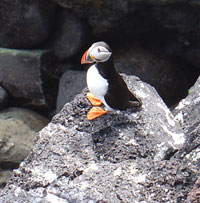
The birds have contributed to Surtsey’s ‘greening’. Snow buntings brought the seeds of bog rosemary from Britain in their gizzards. Combined with bird excreta, seeds grow rapidly—there is now a ‘bright green oasis’ spreading from the gull colony. Geese now graze the island’s vegetation. The cycle continues. The plants support insects which attract birds that bring more plants. Recent arrivals include willow bushes and puffins (see right). According to the Icelandic Institute of Natural History, ‘we now have a fully functioning ecosystem on Surtsey.’
The lessons of Surtsey
Sceptics try to counter Christianity by claiming that the Bible’s account of history can’t be true, e.g. by arguing that the earth’s geological features needed millions of years, and that biological recovery from the Flood would be impossible within the short biblical timeframe.
But Surtsey demonstrates that it is the sceptics who are wrong. It also gives a fascinating insight into how we got the (post-Flood) distribution of plants and animals we see in the world today. ‘What came, came.’ If only the sceptics could learn the lessons of Surtsey while there’s still time. For Surtsey is eroding by about a hectare (over two acres) a year.
In 1967, when the eruptions stopped, Surtsey’s surface area was 2.7 square kilometres. It’s now only half that size. While the hard basaltic core that forms the island’s 154-metre summit should prove more resilient, geologist Sveinn Jakobsson of the Surtsey Research Society estimates that Surtsey’s ash plains will be totally washed away within a century or so. And there’s a lesson in that, too—fast erosion means the world is young.7
References and notes
- Molten lava continued to flow from the crater for several years. Return to text.
- Sigurdur Thorarinsson (Sigurður Þórarinsson, 1912–1983), Surtsey: The New Island in the North Atlantic (English translation by Viking Press in 1967, now out of print), pp. 39–40, quoted in Wieland, C., Surtsey—The young island that ‘looks old’, Creation 17(2):10–12, 1995, <creation.com/surtsey>. Note that in Icelandic names, the last name is a patronymic, not a family name; this geologist is properly referred to by his given name Sigurður, although the West normally uses Thorarinsson. Return to text.
- Sigurdur Thorarinsson, Surtsey: island born of fire, National Geographic 127(5):712–726, 1965. Return to text.
- In fact, uniformitarianism paved the way for Darwin, because evolution not just assumed, but needed, long periods of time. See Mortenson, T., The great turning point: the Church’s catastrophic mistake on geology—before Darwin, Master Books, Arizona, USA, 2004. Return to text.
- Pearce, F., The fire-eater’s island, New Scientist 189(2536):48–49, 28 January 2006. Return to text.
- Swenson, K., and Catchpoole, D., After devastation, the recovery—An amazing bounce-back after catastrophe gives us insights into how the world recovered from the Flood, Creation 22(2):33–37, 2000, <creation.com/recovery>. Return to text.
- See Walker, T., Vanishing coastlines, Creation 29(2):19–21, 2007. Return to text.

Readers’ comments
Comments are automatically closed 14 days after publication.