Editor’s note: As Creation magazine has been continuously published since 1978, we
are publishing some of the articles from the archives for historical interest, such as this. For teaching and
sharing purposes, readers are advised to supplement these historic articles with more up-to-date ones suggested in the Related Articles below.
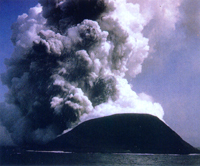
The new island of Surtsey builds through continuing eruptions.
Great minds of the past had no difficulty with the concept of a young earth shaped and reshaped by catastrophic forces, especially the upheavals associated with Noah’s Flood. Today, we have been so thoroughly saturated with the ‘slow and gradual’ philosophy that when we look at vast cliffs, landscapes and boulders we tend to immediately associate them with very long ages.
The pictures in this article are of Surtsey, an island which was born in only days from a huge undersea volcanic eruption off Iceland in the North Atlantic in 1963. It shows features which most people would think take much, much longer to form.
Of course, there never has been any logical (as opposed to psychological) barrier to the idea that large forces can do enormous amounts of geological work in a short time.1
The following quote is from the official Icelandic geologist Sigurdur Thorarinsson (Sigurður Þórarinsson, 1912–1983) writing in 1964:
‘An Icelander who has studied geology and geomorphology at foreign universities is later taught by experience in his own homeland that the time scale he had been trained to attach to geological developments is misleading when assessments are made of the forces—constructive and destructive—which have molded and are still molding the face of Iceland. What elsewhere may take thousands of years may be accomplished here in one century. All the same he is amazed whenever he comes to Surtsey, because the same development may take a few weeks or even days here.
An explosion of cinders and ash rains down on the island and surrounding areas.
‘On Surtsey, only a few months sufficed for a landscape to be created which was so varied and mature that it was almost beyond belief. During the summer of 1964 and the following winter we not only had a lava dome with a glowing lava lake in a summit crater and red-hot lava flows rushing down the slopes, increasing the height of the dome and transforming the configuration of the island from one day to another. Here we could also see wide sandy beaches and precipitous crags lashed by the breakers of the sea. There were gravel banks and lagoons, impressive cliffs … There were hollows, glens and soft undulating land. There were fractures and faultscarps, channels and screes … You might come to a beach covered with flowing lava on its way to the sea with white balls of smoke rising high up in the air. Three weeks later you might come back to the same place and be literally confounded by what met your eye. Now, there were precipitous lava cliffs of considerable height, and below them you would see boulders worn by the surf, some of which were almost round, on an abrasion platform cut into the cliff, and further out there was a sandy beach where you could walk at low tide without getting wet.’2
In a later, more popular account in National Geographic, Sigurdur Thorarinsson3 wrote:
‘ … in one week’s time we witness changes that elsewhere might take decades or even centuries … Despite the extreme youth of the growing island, we now encounter a landscape so varied that it is almost beyond belief.’4
Note the repeated incredulity in the author’s tone, as the observations of the real world conflict with deeply instilled dogma.
If you didn’t know otherwise, how long would you think Surtsey’s rounded basalt boulders, shown above, would take to form? Hundreds, maybe thousands, of years of rolling in the surf?
‘Surtsey reality’ shows that even much harder rock would have had ample time, in the thousands of post-Flood years, to exhibit all the erosional features we see today—especially considering that in the early stages of its formation, rock may still be softer and less consolidated.
References and footnotes
The Bible’s description of the breaking up of the ‘fountains of the great deep’ implies substantial volcanic activity associated with the largely subterranean sources of water for Noah’s Flood.
Sigurdur Thorarinsson, Surtsey: The New Island in the North Atlantic (English translation by Viking Press in 1967, now out of print), pp. 39–40.
Icelanders don’t normally have surnames; their second names are patronymics. I.e. Sigurdur Thorarinsson’s father’s first name was Þórarinn, but his son’s name would be Sigurðsson. In Iceland, he would be known by his first name, and telephone books list in order of first names.
Sigurdur Thorarinsson, ‘Surtsey, island born of fire’, National Geographic127(5):712–726, 1965.
Comments are automatically closed 14 days after publication.
Feedback Guidelines
Be constructive & courteous. Don't attack individuals, denominations, or other organizations.
Stay on-topic. We're not here to debate matters like eschatology, baptism, or Bible translation.
Links to external sites and articles will be removed from your submission.
Privacy & Content Ownership
Comments become the property of Creation Ministries International upon submission and may be edited for brevity and clarity.
CMI may choose not to publish your comment depending on how well it fits the guidelines outlined above.
By submitting your comment you are agreeing to receive email updates from Creation Ministries International. You may unsubscribe at any time.
CMI records your real name, email address, and country as a sign of good faith. Privacy Policy
If your comment is published, your name will be displayed as ""
Cancel
Accept & Continue
Close
You are leaving CREATION.com
We have supplied this link to an article on an external website in good faith. But we cannot assume responsibility for, nor be taken as endorsing in any way, any other content or links on any such site. Even the article we are directing you to could, in principle, change without notice on sites we do not control.




Readers’ comments
Comments are automatically closed 14 days after publication.