

Journal of Creation 18(3):70–75, December 2004
Browse our latest digital issue Subscribe
The carnivorous nature and suffering of animals
All evolutionists and virtually all old-earth creationists believe that animals were killing and eating one another for millions of years, long before the Fall of man. Young-earth creationists argue that this is incompatible with Scripture. Old-earthers dispute the young-earthers’ interpretation of Scripture and employ at least two other counterarguments. One is that carnivorous behaviour is actually very good, and the other is that animals in the wild do not suffer. There is very good reason to believe that they do suffer; but even if they do not, carnivorous activity before the Fall remains incompatible with Scripture.
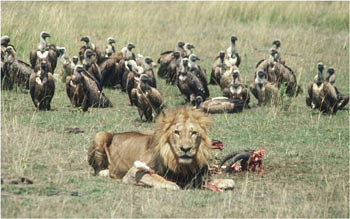
The carnivorous nature and suffering of animals before the Fall are two issues which old-earth creationists need to face. They believe that the earth is billions of years old, and this generally means believing that God’s method of creation involved millions of years of animals tearing each other to pieces, millions of years of mass extinction of species, and millions of years of natural disasters. For a loving God, who created a perfect world which He declared to be ‘very good’ (Genesis 1:31), it seems to be an amazingly cruel and wasteful method of creation. It was also totally unnecessary, as He is omnipotent and could easily have done it in six literal days without any kind of suffering and destruction—precisely as the book of Genesis appears to say He did do it.
The following is a typical statement of the problem made by apostate ex–mega-evangelist Charles Templeton:
‘The grim and inescapable reality is that all life is predicated on death. Every carnivorous creature must kill and devour another creature. It has no option. How could a loving and omnipotent God create such horrors? … Surely it would not be beyond the competence of an omniscient deity to create an animal world that could be sustained and perpetuated without suffering and death.’1
A fundamental part of the Bible’s message is that God’s original creation was perfect. All the evils in the world today, both moral and physical, came into the world as a consequence of man’s sin. This article reconsiders just two of those evils—the carnivorous nature and suffering of animals. I will take a fresh look at the relevant scriptural passages, and at the ways in which old-earth creationists try to deal with the problem. Animal death is a related issue; but I will only briefly touch on it in this article.
The main scriptural passages, the first in Genesis and the last in Revelation, tell an amazing story—the story of Paradise created, Paradise lost and then Paradise restored. In Genesis 1:31 we read, ‘And God saw all that He had made, and behold, it was very good.’ This is a statement of enormous significance. God is omnipotent, omniscient and absolutely good; so if He felt this way about His new creation, it must have been flawless—absolutely perfect. Nigel M. de. Cameron (then Warden of Rutherford House, Edinburgh) writes:
‘Six times individual elements in the creation are pronounced “good”, and the seventh time the whole creation receives the emphatic “very good”. It is difficult to see how the divine approbation could have been more strongly expressed. Evidently, the seven-fold pattern is deliberately given to the expressions of approval, culminating in the “very good” judgement on the whole work, since they do not follow the pattern of the seven days. We find them on days one, three, four, five and six; two on day three, and two—including the “very good”—on day six. The use therefore of the perfect number seven is intended to be emphatic and is not directly related to the seven-day character of the creative work. It reflects the absolute perfection of the work of God, and in the light of what follows in chapters 2 and 3, the stress on perfection takes on a dramatic and inescapable significance. As Keil and Delitzsch write in their great Old Testament Commentary, “By the application of the term ‘good’ to everything that God made, and the repetition of the word with the emphasis ‘very’ at the close of the whole creation, the existence of anything evil in the creation of God is absolutely denied.”’2
We are told, also, in Genesis 1:29–30, that in the beginning, vegetation was given as food for man, and also for every animal. Man and all animals were herbivorous—there was no carnivory. Genesis 9:3 confirms this point and drives it home, leaving very little room for doubt. This verse teaches that immediately after the Flood, God said to man that He was giving animals to him for food, just as He had given vegetation previously (at the time of creation). The clear and logical implication is that man and all animals were herbivorous at the time of creation.
Old-earth theologians dispute this interpretation. Derek Kidner (Warden of Tyndale House, Cambridge), for example, writes:
‘The assigning of every green plant for food (RSV) to all creatures must not be pressed to mean that all were once herbivorous, any more than to mean that all plants were equally edible to all. It is a generalization, that directly or indirectly all life depends on vegetation, and the concern of the verse is to show that all are fed from God’s hand. See also on 9:3.’3

I suggest that the old-earth creationists are the ones who are doing the pressing—they are trying to press these verses into an old-earth mould! The straightforward and obvious meaning of Genesis 1:30 is that before the Fall, every green plant was edible, and every animal ate green plants—although different animals may well have preferred different plants. According to the evangelical theologian Alec Motyer, Principal of Trinity College, Bristol, UK, Genesis 1:29–30 does indeed indicate that all animals were herbivorous before the Fall4 (see below).
Leaving aside, for the moment, the infliction of God’s Curse on creation, let us look at Isaiah 11:6–9; 65:17–25. These passages provide further confirmation that there was no carnivorous activity before the Fall. In one common eschatological view, agreeable to many old-earth creationists, they speak of a future restoration (Acts 3:21). The picture painted is one of peace and tranquillity. We are told that ‘the wolf will dwell with the lamb’ and ‘the lion will eat straw like the ox’, etc. ‘They will not hurt or destroy’ and ‘they shall do no evil or harm’.
Old-earthers object that the language here is the language of poetry or allegory;5 but even if that were true, would not these passages indicate at the very least that there is something wrong, unpleasant or imperfect about animals killing and eating each other? Would it be consistent for the God who inspired the writing of Isaiah 11 and 65 to use millions of years of carnivorous activity as a method of creation, and then declare it to be ‘very good’?
Actually, these passages indicate very specifically that carnivorous activity is an evil—that is, a physical rather than a moral evil. The Hebrew word translated ‘hurt’ in the KJV of Isaiah 11:9 and 65:25 is raa. Elsewhere in the Old Testament, the most frequent translation of this word is ‘do evil’. Other translations include ‘afflict’ and ‘do wickedly’. It is related to ra, the usual word for ‘evil’ in the Old Testament—and that includes both moral and physical evil. As for the word translated ‘destroy’ in the KJV in Isaiah 11:9 and 65:25 (shachath), the core meaning is ‘mar’ or ‘corrupt’. No wonder carnivorous activity has no place in the new creation!
Motyer has spent a lifetime studying the book of Isaiah. He is not involved in the young-earth/old-earth controversy; rather he is concerned simply with expounding the plain meaning of the text. In his commentary on Isaiah, he teaches that Isaiah 11:6–9 and 65:25 do indeed picture a return, in some sense, to the conditions which prevailed on Earth before God cursed the creation—and in doing so, he affirms the herbivorous nature of all animals before the Fall. Concerning 11:6–9, he writes:
‘There is an “Edenic” element in Isaiah’s thinking (see on [Isaiah] 2:4b) … the life of nature itself is transformed. Verses 6–8 offer three facets of the renewed creation and verse 9 is a concluding summary. First, in verse 6 there is the reconciliation of old hostilities, the allaying of old fears; predators (wolf, leopard, lion) and prey (lamb, goat, calf, yearling) are reconciled. So secure is this peace that a youngster can exercise the dominion originally given to humankind. Secondly, in verse 7 there is a change of nature within the beasts themselves: cow and bear eat the same food, as do lion and ox. There is also a change in the very order of things itself: the herbivoral nature of all the creatures points to Eden restored (Gn. 1:29–30). Thirdly, in verse 8 the curse is removed. The enmity between the woman’s seed and the serpent is gone (Gn. 3:15ab). Infant and “weaned child” have nothing to fear from cobraand viper. Finally, in verse 9 the coming Eden is Mount Zion—a Zion which fills the whole earth. Peace (9a), holiness (9b), and ‘knowing the Lord’ (9c) pervades all.’4
Isaiah 11:6–9 ends with the words, ‘They will not hurt or destroy in all my holy mountain, for the earth will be full of the knowledge of the Lord as the waters cover the sea.’ Summarizing this passage, Nigel Cameron writes:
‘Essentially it has two thrusts of teaching—it implies that there is, in fact, something fundamentally awry in the animal kingdom; that the predation and animosity which characterise it are not as they should be. And, secondly, it asserts that it is man’s religious condition that is responsible for this state of things; the absence from the earth of the “knowledge of the Lord”. Human sin and evil in nature are interconnected in a relation of cause and effect.’6
Isaiah 11:6–9 and 65:17–25 do not mean necessarily that life in this restoration will be exactly the same as life in the pre-Fall world. It will be on a higher plane of existence, and it may well be that Isaiah is using images, which we can understand and relate to, in order to describe the indescribable. He is trying to describe a state of existence which is beyond our capacity to understand fully as yet. In this sense, Isaiah’s language may be metaphorical. He is using as metaphors, images which we can understand and relate to. If this is so, it actually confirms the reality and historicity of the herbivorous nature of all animals in the pre-Fall world. To Isaiah and his readers, this was real history, and he was taking it and using it as a picture of life on the new earth.
Some of the verses in Isaiah 65:17–25 are rather puzzling at first sight; but, properly understood, they actually strengthen the case for a pre-Fall world in which there was no carnivorous activity. Verse 20, for example, says:
‘No longer will there be in it an infant who lives but a few days, or an old man who does not live out his days; for the youth will die at the age of one hundred and the one who does not reach the age of one hundred shall be thought accursed.’
At first reading this verse is difficult to understand, but Motyer explains it as follows:

‘Throughout this passage Isaiah uses aspects of present life to create impressions of the life that is yet to come. … Things we have no real capacity to understand can be expressed only through things we know and experience. So it is that in this present order of things death cuts life off before it has well begun or before it has fully matured. But it will not be so then. No infant will fail to enjoy life nor an elderly person come short of total fulfilment. Indeed, one would be but a youth were one to die aged a hundred! This does not imply that death will still be present (contradicting 25:7–8) but rather affirms that over the whole of life, as we should now say from infancy to old age, the power of death will be destroyed. … Thus verse 20 expresses a double thought: death will have no more power and sin no more presence.’7
Isaiah goes on to say in verse 25, ‘The wolf and the lamb shall graze together, and the lion shall eat straw like the ox; and dust shall be the serpent’s food. They shall do no evil or harm in all My holy mountain, says the Lord.’ Thus, just as great longevity was a known image, so the herbivorous nature of all animals in the pre-Fall world was a known image. To Isaiah and his readers, the tranquillity of Eden, with no carnivorous activity, was real history. It was used as a picture or metaphor to describe the indescribable wonders of the new heavens and the new earth.
We may feel that Isaiah should have said openly that there would be no death in the new creation. The fact is, however, that the Holy Spirit inspired him to choose instead the metaphor of great longevity. This emphasizes the fact that he used as metaphors things from the present creation which were within human experience. The pre-Fall world, with its lack of carnivorous activity, was part of human experience, whereas immortality was not part of that experience. Adam and Eve may have been immortal potentially, but in fact they did die.
We return now to the creation account in Genesis. Genesis 3:8–24 records a number of curses which God pronounced on creation after man rebelled against Him. To the serpent He said, ‘Cursed are you more than all cattle, and more than every beast of the field.’ This appears to say that all animals were cursed; but the serpent was cursed more than the others. There were other curses also, such as ‘Cursed is the ground.’ It appears, therefore, that because man had been put in charge of the earth, the whole earth, as well as man himself, came under a curse. In fact Romans 8:18–25 indicates that the whole creation was subjected to corruption and suffering, and the implication is that this was ‘the Curse’—the result of man’s rebellion against God. The phrases used include ‘subjected to futility’, ‘slavery to corruption’, ‘groans and suffers’ and ‘anxious longing’. The whole creation is groaning and looking forward to its liberation when we will receive our resurrection bodies, and the present corrupt and decaying universe will be transformed into a new heaven and a new earth. As we have seen, Isaiah 11 and 65 indicate (whether or not we think the descriptions are poetic) that the removal of the Curse will result in a world where animals do not harm each other. And this, in turn, indicates that before the Curse was inflicted, animals were not tearing each other to pieces and devouring each other.
Old-earth creationists believe that the Fall had a much more limited effect on creation, and they interpret Romans 8:18–25 in accordance with that belief. They believe that creation was essentially the same before and after the Fall. They limit the effect of the Fall to man’s failure to accept responsibility for the world, and his abuse of it. R.J. Berry (Professor of Genetics at University College, London, and a theistic evolutionist), for example, writes:
‘The message of Romans 8:18–23 is thus one of hope—hope not looking to the distant future but to the time when the redeemed accept their reunion with God, and therefore their responsibility for nature. Paul’s argument is that as long as man refuses (or is unable through sin) to play the role God created for him, the world of nature is dislocated and frustrated.’8
This falls far short of what the passage actually says, as shown, for example, by F.F. Bruce (then Professor of Biblical Criticism and Exegesis at Manchester University). Like Alec Motyer, he was an evangelical theologian who was not involved in the young-earth/old-earth controversy. In his commentary on Romans, he was concerned simply with expounding the plain meaning of the text. I would like to quote him at length, but lack of space forbids. Concerning Romans 8:18–25, he has no doubt that this passage is indeed speaking of the Curse which fell on the whole creation—the entire universe—as a result of the Fall. He assumes that Isaiah 11:6–9 is in the language of poetry; but he makes it quite clear that Romans 8 looks forward to ‘the transformation of the present universe’ on the day of resurrection.9
Thus, Romans 8:18–25 makes it perfectly clear that the extent of the Curse, and of the transformation needed to put creation right again, are far greater than Berry would have us believe. The changes in creation after the Fall were far greater than anything admitted by old-earthers. It should be emphasized also that it was God who subjected the whole creation—the entire universe—to ‘futility’ or ‘frustration’ and its bondage to decay. This indicates that neither decay nor other imperfections in creation can be attributed solely to man’s misuse of the natural world. Some interpreters have suggested that it was Adam or Satan who subjected the creation to futility; but this is hardly likely. The whole creation was affected, and it was subjected ‘in hope that the creation itself also will be set free from slavery to corruption into the freedom of the glory of the children of God.’ F.F. Bruce agrees that the latter interpretations (concerning Adam and Satan) are unlikely—it was ‘most probably God’ who subjected the creation to futility.10
Moving on towards the end of the Bible, we find that the new heavens and the new earth are mentioned in 2 Peter 3:13, and then again in Revelation 21:1. We are told that ‘there shall no longer be any death; there shall no longer be any mourning, or crying, or pain … and there shall no longer be any curse’ (Revelation 21:4; 22:3).
Old-earth creationist answers
I have alluded already to certain ways in which old-earth creationists deal with the above scriptural passages. Another way is, amazingly, to agree with the young-earth creationists about these passages! One example is the prominent old-earth creationist apologist Norman Geisler, who answered Templeton’s question on p. 1 (through Lee Strobel):
‘[Y]es, God can create those kind [sic] of animals. And the fact is, He did. The original paradise had those kind [sic] of animals and the paradise to come—the paradise restored—is going to have those kind [sic] of animals. In fact, we are told that God originally created animals and human beings to be herbivorous. … [Reads from Genesis 1:29–30, then continues] …
‘God did not create animals to be eaten in paradise, and animals weren’t eating each other. The prophet Isaiah said someday God will “create a new heavens and a new earth” where “the wolf and the lamb will feed together and the lion will eat straw like an ox”. In other words, there’s not going to be the same kind of killing that goes on now.
‘In sum, everything God created was good. What changed things was the Fall. When God was told, in effect, to shove off, he partially did. Romans 8 says all creation was affected—that includes plant life, human beings, animals, everything. There were fundamental genetic changes; we see, for instance, how life spans rapidly decreased after the Fall [sic: Flood]. God’s plan was not designed to be this way; it’s only this way because of sin. Ultimately it will be remedied.’11
Of course, this is just not logical for an old-earther, because there are many fossils showing carnivory, and all old-earth dating methods place the fossils as well before Adam. To be consistent, Geisler must place these fossils after Adam, but that would have to mean the rock layers that contain them were also after Adam.
Apart from these, I think there are two main ways in which old-earthers deal with the problem of the carnivorous nature and suffering before the Fall. The first is to say that the carnivorous nature is actually very good, and the second is to say that animals in the wild do not suffer.
Reasons for believing that the carnivorous nature is good can be subdivided into ‘biblical’ and ‘common-sense’ reasons. Henri Blocher (Professor of Systematic Theology at the Faculté Libre de Théologie Evangélique, Vaux-sur-Seine, France), a leading advocate of the ‘framework hypothesis’,12 provides one example of the former.13 He wrote, ‘… the speeches of God in the book of Job exalt the terrifying beauty of the beasts of prey as God’s work’. That is true, but it does not prove that such beasts (in their present form) were part of the original creation. Is it likely that ‘terror’ was part of the original creation? The present creation is God’s work, and is utterly awesome; but it is a creation which has been subjected to ‘futility’ or ‘frustration’ (Romans 8:20). In this fallen creation, God instituted capital punishment for murder as well (Genesis 9:6), but even Blocher would not claim that there was murder in the original creation.
These comments apply also to verses like Psalm 104:21, 24, which say, ‘The young lions roar after their prey, and seek their food from God … O Lord, how many are Your works! In wisdom You have made them all; the earth is full of Your possessions.’
A ‘common-sense’ reason for saying that carnivorous behaviour is good is the fact that many animals are marvellously designed for a carnivorous way of life. Another is the fact that predators maintain the balance of nature. Without predatory activity and animal death, the world would become overcrowded very rapidly, resulting in mass starvation.14
In today’s fallen world, that makes obvious sense. But we are not thinking about the world as it is today. We are thinking about a different kind of world—the world as it was before the Fall.

Also, we are dealing with an omnipotent Creator, whose power and wisdom are infinitely greater than ours, and whose Word can be trusted. I think we can trust that God was quite capable of devising a way to avoid the problem of overcrowding, and then of modifying His designs! Even today, animals such as rats can limit their population growth to prevent overcrowding. Also, we should consider the reason for the command to multiply: to fill the earth. Once its purpose had been fulfilled, the command would no longer be in force.
The second way of dealing with the problem of carnivorous behaviour and suffering before the Fall is to say that animals in the wild do not really suffer. It is said that because they are not rational beings like us—they have a lower level of consciousness—they do not experience pain, fear and mental anguish in the way that we do.
John Wenham (Warden of Latimer House, Oxford) deals with the problem of animal suffering in his book The Goodness of God, in a section entitled ‘Evil in the World of Nature’.15 He is not addressing the young-earth/old-earth controversy specifically. But old-earth creationists use the same kind of arguments to justify the existence of carnivorous behaviour before the Fall. Wenham argues that ‘there is reason to think that extreme sensations of pain and experiences of suffering may be rare or even non-existent among animals’ in the wild state. In spite of this statement, he does appear to accept that there is some pain and suffering in the wild state. However, he believes that where there is animal suffering, most of it is caused by man’s misuse and exploitation of the natural world.
I am sure there is a lot of truth in what Wenham says; but he is unable to say that no pain and suffering is experienced by wild animals in an environment untouched by man. Furthermore, I think Wenham is downplaying the psychic faculties of animals too much. Animals do not possess a spiritual faculty; but they do have a psyche—especially the higher mammals. Common-sense tells us that animals do suffer, and in fact the scientific evidence points to this very clearly. This was the conclusion reached by, for example, the Brambell Committee set up by the British government.16 Although this committee looked into the suffering of ‘factory farm’ animals, rather than wild animals, much of the evidence it produced (such as the anatomy and physiology of animal nervous systems) is relevant to all animals.
This kind of evidence is compelling; but by itself, it does not prove that animals suffer in the wild. It needs to be supplemented by direct observation of animal behaviour in the wild. As it happens, my son Matthew is a conservation biologist, wildlife consultant and safari guide who has worked for many years in Southern and Eastern Africa, closely observing animals in the wild. I discussed this question with him, and he was emphatic in his dismissal of the idea that animals in the wild do not suffer. To be precise, he said, ‘That is absolute rubbish!’ He has no doubt at all that animals in the wild do indeed suffer. He says, for example, that adult elephants are intelligent animals who show signs of severe grief and distress when their young are killed by predators.
But however much, or little, pain and suffering there is in nature, the Bible indicates that the present state of things is not the ideal—God did not make it this way originally. Also, it was God who subjected the whole creation to ‘futility’ and its bondage to decay. Imperfections in creation cannot be attributed solely to man’s misuse of the natural world—although all of them are consequences of his rebellion against God.
Conclusion
Young-earth creationists believe that the biblical account of creation is incompatible with an earth history of billions of years. One reason is that if the fossil record represents millions of years of Earth history, it has to be said that God’s method of creation was both cruel and wasteful. It was a long, drawn-out process of violence and carnage, involving the suffering and death of billions of animals over millions of years. The scriptures we have looked at make it quite clear that this could not have been the method God used in creating what he pronounced to be a ‘very good’ creation.
For further reading, I recommend Evolution and the Authority of the Bible, by Nigel M. de. Cameron. He shows that the Bible teaches very clearly that God’s original creation was perfect. It teaches also, equally clearly, that ‘all evils, both moral and physical, which affect this earth’—including the carnivorous nature and suffering of animals—came into the world after Adam and Eve disobeyed God. This teaching is completely incompatible with theistic evolution—and I would add that it is incompatible with most old-earth creationist theories also. According to nearly all these theories, many physical evils were present in the world long before the Fall. But since this book is out of print, and Cameron has since compromised on the young-earth view (without adequately trying to refute his own arguments), I would recommend Refuting Compromise, as it covers many of these points in ch. 6.17
References and notes
- Templeton, C., Farewell to God, McLelland and Stewart, Toronto, pp. 197–199, 1996. Return to text.
- Cameron, N.M.de., Evolution and the Authority of the Bible, Paternoster Press, Exeter, UK, pp. 49–50, 1983. Return to text.
- Kidner, D., Genesis; in: Wiseman, D.J. (Ed.), Tyndale Old Testament Commentaries, IVP, Leicester, UK, p. 52, 1967. Return to text.
- Motyer, A., The Prophecy of Isaiah, IVP, Leicester, UK, p. 124, 1993. Return to text.
- Berry, R.J., God and Evolution, Hodder and Stoughton, London, p. 74, 1988. Return to text.
- Cameron, ref. 2, pp. 58–59. Return to text.
- Motyer, ref. 4, p. 530. Return to text.
- Berry, ref. 5, p. 73. Return to text.
- Bruce, F.F., Romans; in: Tasker, R.V.G., (Ed.), Tyndale New Testament Commentaries, IVP, Leicester, UK, pp. 168–174, 1963. Return to text.
- Bruce, ref. 9, pp. 172–173. Return to text.
- Geisler, N.; cited in: Strobel, L., The Case for Faith, Zondervan, Grand Rapids, MI, pp. 176–177, 2000. Return to text.
- Weeks, N., lecture Futile Compromises: Let the Bible Speak, CMI conference, Sydney, Australia, 2001. Return to text.
- Blocher, H., In the Beginning, IVP, Leicester, UK, p. 42, 1984. Return to text.
- Berry, ref. 5, pp. 74, 149–150. Return to text.
- Wenham, J.W. The Goodness of God, pp. 196–205, IVP, Leicester, UK, 1974. Return to text.
- Cmnd. 2836; cited in: Cameron, ref. 2, pp. 68–70. Return to text.
- Sarfati, J., Refuting Compromise, Master Books, Green Forest, AR, 2004. Return to text.




Readers’ comments
Comments are automatically closed 14 days after publication.