

The large ships of antiquity
Each generation produces a fresh crop of sceptics who are legends in their own minds. C. H. Spurgeon wryly said about such men in his day:
‘It is but the shallowness of his mind that permits him to see the bottom of his knowledge.’1

We should not be surprised that we are awash today with such experts, falsely so called. The Apostle Peter warned us this would be the case (2 Peter 3:3 ff.). It has become fashionable to scoff at anything biblical.
Noah’s Ark has never failed to be the target of sceptics and the butt of many jokes.2 ‘Everyone knows’, for instance, that you cannot build a boat as large as Noah did from wood, even using today’s advanced technology. Only when ships were made of steel, in the last hundred years or so, we are told, has man been able to build a ship approaching the biblical dimensions of Noah’s Ark, (137m (450 feet) long, 23m (75 feet) wide, and 14m (45 feet) high).
But these so-called experts display their ignorance of history in making such statements. Let’s look at what ships the ancients actually built, some of which were almost as large as the Ark.
Rise in technology of the ancients
In the writings of Pliny the Elder (AD 23–79), I discovered the table (below) about ships of antiquity. This documents the rapid advances the ancients made in ship-building technology in just a few centuries. The time period in the table is from about the seventh century BC to the end of the third century BC.3
When we think of warships of antiquity, we think of the tiny ships that were shown in a movie like Ben Hur. They had about fifty or so men, and a single tier of oars. This was the best Hollywood could do on a limited budget. It may reflect our evolutionary thinking, that the ancients were primitive compared to us. While we may flatter ourselves with our supposed knowledge of ancient history, the actual facts that come down to us tell us another story. From this table in Pliny, we can see a rapid rise in technology over a few hundred years which culminated in a ship of forty tiers of oars (when we say forty tiers we mean forty levels of rowers!).
Now the question is, do we have any descriptions of these ships so we can comprehend how large they really were? Fortunately, we have a good description of one of the early third-century ships and an excellent description of the largest ship Pliny lists.4
The Leontifera
There was a naval battle in the Aegean Sea in 280 BC. The following is Ussher’s description of what happened:
‘When Antigonus, surnamed Gonatas, the son of Demetrius Poliorcetes, heard how Seleucus was murdered, he made an expedition into Macedonia. He planned to get there before Ceraunus could, with his army and naval forces. However, Ceraunus had all Lysimachus’ fleet in readiness, and set out and met him in a good battle formation at sea. In his navy, ships were sent from Heraclea in Pontus, some of six, some of five tiers of oars. These kinds of ships were called “Aphracta”. The largest ship of all had eight tiers of oars and was called the Leontifera. She was admired by all for her large size and exquisite construction. In her were a hundred oars per tier, so that on each side there were eight hundred rowers which made 1600 in all. On the upper deck or hatches there were 1200 fighting men who were under two special commanders. When the battle began, Ceraunus won and Antigonus was forced to flee with all his navy. In this fight, the ships from Heraclea performed the best and among them the Leontifera did the best of all. …’5

We are not given the dimensions of this ship. However, the oarsmen on each tier would have to be at least three feet apart, the approximate distance between airline seats. (Has anyone ever complained of having too much space between airline seats?!)
For 100 rowers per tier, allowing for a bow and a stern, this ship could easily have been 120–150 metres (400–500 feet) long. (The next ship I describe had 50 oars in a tier and was over 120 m [400 feet] long.) If I was in that battle in a ship, I definitely would not want to be in the path of the Leontifera’s ramming prow.
Also consider that these battles were not fought in an afternoon! This ship could have been at sea for a few days before and after this battle. With a crew of over 3,000 men, think of the provisions it would have had to carry!
Other large ships
Plutarch briefly describes the fleet which Demetrius built around 294 BC. These were the largest ships built at that time. Although Plutarch gives no dimensions, he does state the following:
‘Up until this time, no man had seen a ship of 15 or 16 banks of oars. … However, in the ships of Demetrius their beauty did not mar their fighting qualities, nor did the magnificence of their equipment rob them of their usefulness, but they had a speed and effectiveness which was more remarkable than their great size.’6
The grand-daddy of ancient warships
Athenaeus gives us a detailed description of a very large warship, built by Ptolemy Philopator (c. 244–205 BC).7 It was 130m (420 feet) long, 18m (57 feet) wide, and 22m (72 feet) high to the top of her gunwale. From the top of its sternpost to the water line was 24 metres (79.5 feet). It had four steering oars 14m (45 feet) long. It had 40 tiers of oars. The oars on the uppermost tier were 18m (57 feet) long. The oars were counter-balanced with lead to make them easier to handle. It had a double bow and a double stern and carried seven rams, of which one was the leader and the others were of gradually reducing size. It had 12 under-girders 275m (900 feet) long. The ship was manned by 400 sailors to handle the rigging and the sails, 4,000 rowers and 2,850 men in arms for a total of 7,250 men. This ship was too large to be of much practical use.8
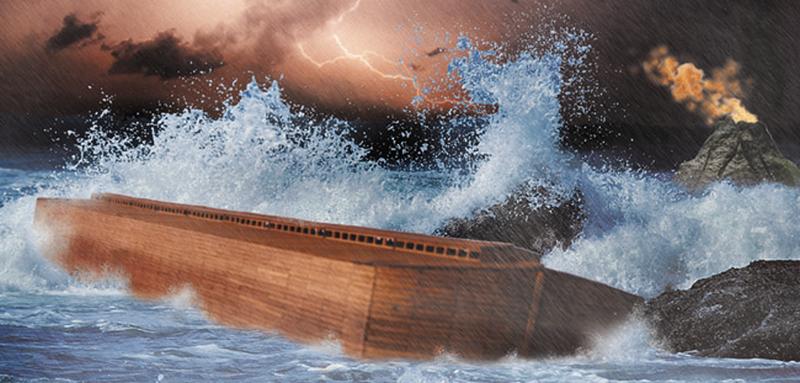
Some things of interest about this ship. First, there are no forests worth mentioning in Egypt. All the lumber had to be imported from elsewhere, likely Lebanon. This ship had a crew that was almost twice as large as that of the largest aircraft carrier we have ever built! The size of the ship approximated the size of Noah’s Ark. Like Noah’s Ark, it would have had to carry provisions for all on board. Oh, for a time machine to go back and capture this ship on film!
Athenaeus describes other very large ships and boats of antiquity. One ship had a catapult designed by Archimedes that could hurl a 55 kg (120 pound) stone over 180 m (600 feet).9
Conclusion
What should we learn from this? Firstly, we are not as smart as we think we are! Just because we cannot duplicate something that was done thousands of years ago, it does not mean the ancients could not do it either!
Secondly, we should learn from history. We have nothing to fear from the study of true history, which supports the Bible. In fact, we have much to learn. From these accounts we have given, it is obvious mankind was able to build huge ships that rivalled Noah’s Ark in size. We do not know how it was done, but they did it!
| Vessel | Inventor | Authority | Approx. Time |
|---|---|---|---|
| Double-banked galley | The Erythraeans | Damastes | 7th C. BC |
| Trireme (three banks of oars) | Aminocles of Corinth | Thucydides | 6th C. BC |
| Quadrireme (four banks) | The Carthaginians | Aristotle | 5th C. BC |
| Quinquereme (five) | The Salaminians | Mnesigiton | 4th C. BC |
| Galleys with six banks of oars | The Syracusans | Xenagoras | 4th C. BC |
| Up to ten banks | Alexander the Great | Mnesigiton | 4th C. BC |
| Up to twelve banks | Ptolemy Soter | Philostephanus | 3rd C. BC |
| Up to fifteen banks | Demetrius, son of Antigonus | Philostephanus | 3rd C. BC |
| Up to thirty banks | Ptolemy Philadelphus | Philostephanus | 3rd C. BC |
| Up to forty banks | Ptolemy Philopator, surname Tryphon | Philostephanus | 3rd C. BC |
References and notes
- Spurgeon, C.H., Sermon No. 239, New Park Street Pulpit, Pilgrim Publications, Pasadena, TX, USA, 5:113, 1991. Return to text.
- For powerful answers to the most common sceptical attacks on the Ark account, see Woodmorappe, J., Noah’s Ark: A feasiblity study, ICR, CA, USA, 1996. This book also gives other examples of huge ancient boats. For an expert study on the seaworthiness and stability of the Ark, see Safety investigation of Noah’s Ark in a seaway, CEN Tech. J., 8(1):26–36, 1994. Return to text.
- Pliny, Natural History, Book 7, Chapter 56 in the original work (Pliny, 2:645–647, Loeb Classical Library No. 352, Harvard University Press, 1989.) Return to text.
- Of course, we can never be 100% certain of the accuracy of any ancient document. But as with standard historical research, whenever a document purports to be giving sober history, one trusts the document in the absence of reasons to believe it is a fabrication. In the case of these ancient ships in the Pliny table, there is a consistency to the pattern, and no suggestion of exaggeration. Return to text.
- Ussher, J., Annales Veteris Testamenti, Flesher and Sadler, London, pp. 475–476, 1654. (This work is in Latin. I am preparing a new English translation which is scheduled to be published in January, 2001. The paragraph number for this footnote in that revised work is 2750.) Return to text.
- Plutarch, Lives — Demetrius, Book 1, chapter 43 in the original work. (9:107–109, Loeb Classical Library No. 101, Harvard University Press, 1996.) Return to text.
- Athenaeus, The Deipnosophists, Book 5, Section 203f–204b (2:421–425, Loeb Classical Library No. 208, Harvard University Press, 1987). Return to text.
- It is hard to visualize how such a massive number of banks (tiers) would have been arrayed in practice, and enthusiasts still debate the issue on the internet. It has been suggested that the vessel was really twin-hulled, so that the 40 banks represented two banks of 20 each side. Some diagrams of smaller vessels show that oar openings were sometimes arrayed diagonally, this offset allowing a greater number of banks for a given hull height. Whatever the solutions, it would be a mistake to underestimate the ingenuity of the ancients. Return to text.
- Ref. 7, Book 5, Sec. 204c–209e. (2:425–447) Return to text.


Readers’ comments
Comments are automatically closed 14 days after publication.