
Feedback archive → Feedback 2009
Did CMI ‘lie’ in making The Voyage?
The flak begins as CMI’s Darwin movie starts making an impact

Creation Ministries International (Australia) set up a separate company, Fathom Media Ltd, to produce its groundbreaking Darwin movie, The Voyage that Shook the World.
Following a BBC radio session featuring expert Darwin historian Peter Bowler (one of several evolutionists interviewed for The Voyage) and CMI-UK CEO Philip Bell,1 the Internet exploded with accusations about CMI having been engaged in “deceit”, “lying by omission”, even “bearing false witness”.2
For any fair-minded persons the following three statements should clarify the matter—one by CMI, one by the film’s non-CMI director and the third is the written proposal put to potential interviewees when seeking their involvement.
1. Statement by Creation Ministries International
In March 2009 we wrote an article about the film in Creation magazine (subscribers in over 100 countries) in which we stated openly that Fathom Media was a subsidiary production company we set up. In a footnote, we explained: “This allowed us more freedom to approach the places we wanted to film and be judged on the merits and the aims of the project, without being discriminated against on the basis of our name.”
The reactions of the evolutionist establishment, including some of the experts interviewed, have indeed confirmed our caution and our fears about the prejudice that exists. One of the interviewees even wrote including a cheque, trying to return the money that Fathom Media paid for the interview. The interviewee said the film appeared to be different from what the interviewee had been led to believe. The person did this based on seeing a short trailer on the CMI website, and before seeing the film.
In short, we wanted the film to be judged on its content, not its associations. We did not want people to be “scared off” by our advertising a link to CMI, but at the same time we were determined not to bear false witness. If people had asked us, we determined from the outset that the team would answer honestly, and we instructed the film crew that went to get the interviews along those lines. Of course, we hoped and prayed (literally, and earnestly) that such questions simply would not be asked—e.g. whether creationists were driving it.3 We wanted straight answers to the questions on these important matters from all, whether creationist or evolutionist—unhampered by prejudice and all the other ‘baggage’ that has accumulated, much of it quite unfairly, around the issue.
“Lying by omission”?
We do not believe that we framed the invitations or the interviews in such a way that, due to the omission of information, a false impression would be formed about where we were coming from. Such would indeed risk breaching the commandment against false witness—the classic ‘half-truth’ deliberately intended to deceive. We were and are under an obligation to speak the truth, but not to provide exhaustive information where it was not sought. The Bible says of Jesus that “no deceit was in his mouth” (1 Peter 2:22), yet he withheld information from those who were not ready to receive it, including the Pharisees (Matt. 21:23–27) and even his own disciples (John 16:12).4
Our desire to “walk in the light as He is in the light”, however imperfectly we might do that, contrasts with many of the atheists who are so vehement in their accusations against us. Under atheism there is no compunction to be truthful at all. For example, an American academic boasted about how he deliberately deceives students in his efforts to get them to accept evolution.
If our critics were consistent, they would be raging at the BBC and other investigative documentary producers, since this is their accepted practice. For example, reporters didn’t reveal everything to Communist officials when making an undercover documentary of repression behind the Iron Curtain.
If one reads (see following) what was written about the film to the interviewees, which was quite open about the intent of the film, it is amazing that people did not ask the relevant questions about creationist backing.
Nor did we make statements that were designed to make people conclude that this was a film by evolutionists. To the contrary, would an evolutionist film crew talk about exploring the origins controversy or even any words to that effect, as this one did? There is no controversy as far as dyed-in-the-wool evolutionists are concerned.
Further, and perhaps most importantly, we were determined to deal fairly with the material that the interviewees provided. There was not to be the sort of sneaky editorial cut-and-paste that ends up with someone being seen to say “black” when they actually said “white”. Indeed, in an email response to a query, one interviewee said, “They didn’t actually distort what we said, but did cherry-pick the comments.” (emphasis added)
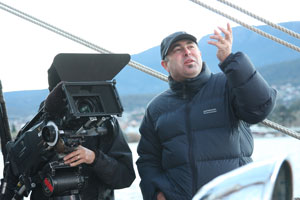
To help ensure that fairness reigned, we hired key industry personnel who were not a part of CMI and we took a largely “hands off” approach in the interview process, as will be clear in the statement below by the Director, Steve Murray. Even the most fanatical evolutionist would have to admit that the film included some very pro-Darwin statements.
Cherry-picked comments?
The interviewee cited above said that the film “cherry-picked” which of his statements to include. But that is completely normal in a documentary with hundreds of pages of interview transcripts to choose from, with re-enactments as well as different interviews all to be squeezed into 52 minutes. But he was not misrepresented; that is the point: “They didn’t actually distort what we said”, he admitted (above). This contrasts with the usual BBC and ABC (Australia) “mockumentaries” of creation or Christianity in general, even including self-confessed and proud lying to creationists (see ‘Origins questions’—evolutionists puzzled, creationists muzzled for documentation).
Does the film have a viewpoint? Of course. So does every documentary. Does that influence which cherry gets picked? Of course. What counts is whether that has been fairly done in terms of the way that “cherry” is used and presented, not whether it suits the ideology of any particular interviewee.
What we wanted was to break down this blanket of prejudice that prevents rational discourse about the evolution issue, to get people thinking and asking the sorts of questions that many have just stopped asking. And it seems that this, and the fact that the film is getting tremendous acceptance in circles that have hitherto had a jaundiced and caricatured view of biblical creation and those scientists who believe it, is the cause of much of the irrational ranting. It is very much a case of the informal fallacy of “shoot the messenger”5—perhaps in an attempt to discourage people from actually seeing the documentary for themselves.
Note added, 22 July, 2009:
Three of the interviewees featured in The Voyage, Professors Janet Browne, Sandra Herbert and Peter Bowler, wrote the following in the July 2009 Newsletter of the History of Science Society: “Had we known the true origins of Fathom Media, we probably would not have contributed, but the producers do have a point: if academic historians refuse to participate when movements they don’t approve of seek historical information, these historians can hardly complain if less reputable sources are used instead.”
2. Statement by Steve Murray6, director of The Voyage That Shook the World.
The following is adapted and expanded from what I wrote to one of the interviewees who expressed concern.
Fathom Media was set up as a legal entity to produce and market a documentary that was aimed squarely at a secular broadcast audience. This is entirely consistent with industry practice. While it may have been commissioned by a creationist organization, it was not primarily designed for creationists. Thus, producing and marketing a film under the banner of CMI would simply not work for the world of secular television. For the film to be successful it needed authoritative and wide-ranging views on Darwin.
For this reason, I and other independent media professionals were engaged to produce the documentary. Yes, I was commissioned by CMI, but I have to say that if anything, CMI’s influence was one of moderation, ensuring that all sides were fairly represented. And as I explained to one of the interviewees, it was my responsibility alone to select the interview segments and to “tell the story”—stuff that I thought would be interesting to people who don’t know much about Darwin.
I wanted the audience to get some understanding of why Darwin’s life and writing does generate debate. I find it extraordinary that after 150 years people are still fiercely debating what Darwin began. And I believe it’s because he touched on the core of what it means to be human, and that’s a profound question that most people struggle with (and indeed a question that occupied much of Darwin’s thinking). Yet—and I hope all would agree—to do that question justice requires more than just one (creationist) perspective!
Above all, we wanted a film that would generate discussion on the issue of origins and Darwin’s role in influencing those ideas. But a discussion based on real history and science—not myths and half-truths. After all, would this not be one of the goals of any Professor of Science History in teaching their students?
I have to say that all of our interviewees were extremely gracious in the giving of their time and thoroughly pleasant to interview. I count it a privilege to have met them. One academic who has published widely on Darwin, did comment on how much they enjoyed the interview and that they really appreciated the questions that we asked.
However, I am aware that some of these academics have been getting flak for appearing in the film, which in itself is a sad indictment on academic freedom of expression and association. I had hoped that an objective look at what the evolutionist interviewees contributed to the film (especially from the historians) would be seen as fairly neutral in an ideological sense. I believe that our interviewees contributed important and fascinating insights and facts about Darwin and his work. And that the film deals with their views fairly. I would urge everyone, especially the critics, to watch the actual doco before jumping to conclusions based on the identity of the commissioning organization (i.e. prejudice).
3. Document sent to all interviewees prior to their interview
FATHOM MEDIA – DOCUMENTARY ON CHARLES DARWIN
Copyright 2008
Documentary Purpose & Intent
Our aim is to dig a bit deeper into the life and science of Charles Darwin and the development of his ideas. We are particularly interested in exploring the role of a person’s worldview and how that impacts on scientific discovery and analysis.
We plan to explain how the Beagle voyage came about, look at a number of his influences and show some of the subsequent years that lead up to the publication of Origin of Species. We will include nature footage, some excerpts from his diaries, and some historic drama re-enactment.
However the key anchor for the documentary will be the interviews, of which you are a part! These will really give us our story. We are approaching various authors and scientists to help paint a picture of Darwin’s observations, the conclusions he reached, and how they correlate with the understanding of science today.
As mentioned, we are keen to hear and present a wide variety of perspectives on these issues. We would hope the spectrum will include scientific views on Classical Darwinism through to Neo-Darwinism, punctuated equilibrium, design from intelligence and creationism; together with historical reflections on Darwin’s social era, views on his life and the impact of his work. We would also canvas opinions on his motivations, the scientific ideas of the time, and of course, his legacy.
We recognise that when it comes to discussions on Darwin and the impact of his ideas, there can be a high degree of emotional response. However, our intention as film-makers is to facilitate a balanced discussion between people who won’t necessarily share the same views. While it is not practically possible to offer interviewees any form of editorial control, it is our sincere intention to accurately represent the views of all participants and to employ an extremely high-standard of journalistic integrity in editing the interview content.
Finally, we are looking to craft a quality documentary that will sell to international broadcast networks. A documentary that will help viewers to comprehend and understand the seismic paradigm shift that resulted from Darwin’s writing.
Steve Murray, Director
References
- On the BBC website, a write-up by the interviewer, BBC Northern Ireland presenter William Crawley, 21 June 2009, prompted a huge response. Creationists defend Darwin film. Return to text
- For example: Lynch, J., Creationists lie to historians and deny subterfuge.; RichardDawkins.net, Comment on William Crawley’s blog; Lippard, J., CMI makes Darwin docu-drama. Return to text
- The closest anyone came was a question by one interviewee as to who was funding the project. The answer was “private investors”. Indeed, hundreds of individuals invested in the project with no expectation of a financial return. Further questioning from the interviewee would have led to CMI as the project’s facilitator, as the private investor support was obtained via CMI’s mailing list. This project was too big for the resources of CMI to fund. Return to text.
- After this article was first posted, a commenter on a well-known atheopathic blog tried to attack this, ludicrously citing the discredited Skeptics Annotated Bible, and responding:
We were and are under an obligation to speak the truth, but not to provide exhaustive information where it was not sought. The Bible says of Jesus that “no deceit was in his mouth” (1 Peter 2:22), yet he withheld information from those who were not ready to receive it, including the Pharisees (Matt. 21:23–27)
Doesn’t that sound fishy?
I thought it does. So I decided to look it up and read the rest of Matt 21. Jesus immediately, starting in 21:28, goes on to tell the Pharisees not one, but two parables that contain the information he didn’t directly tell them,
No they don’t! The question was about Jesus’ authority, which Jesus did not answer. Instead, He continued with the Parable of the Two Sons and the Parable of the TenantsNot at all. All they realized was that Jesus was referring to them. They most certainly did not understand that Jesus Himself was God the Son, and “the way, the truth and the life” (John 14:6).and the end of the chapter makes clear that the Pharisees understood them both.
They quote-mine the very (alleged) words of Jesus!!! …
Atheopaths (and agnostopaths) and their churchian allies have a fetish about alleged quote-mining. Of course, there is nothing of the sort. As we’ve pointed out before, the Gospels specifically state that Jesus spoke in parables to hide the truth from the masses (Matt. 13:10 ff., Mark 4:11–12 and Luke 8:10) — (and this is one reason that it’s absurd to claim that Genesis is a parable). Thus contrary to this incompetent eisegete’s claim, these next two parables were not revealing the truth to these unrepentant critics.
and even his own disciples (John 16:12).
And in 16:13 he promises them “the Spirit of truth” which “will guide you into all truth” — “all”, mind you. I think that’s a reference to Pentecost.
Yes it is, as well as to the future inspiration of the New Testament. And it doesn’t change the fact that Jesus didn’t reveal everything at the time, but would make sure more is revealed later. This actually bears out what we say about our film: by not revealing everything to our interviewees, they were more likely to tell the whole truth about Darwin, warts and all, so our film would be an overall more truthful project.
Intelligent Design theorist Bill Dembski also relates in Boo-Hoo: Documentary Makers Didn’t Tell Us They Think Darwinism Is a Crock:Lynch is outraged: the documentary makers are guilty of “lies” and “deception”. Would a charge of fraud hold up in court? I suspect the documentary makers simply withheld information. Is that wrong? The BBC, for instance, didn’t inform me that a documentary they were making about ID was to be called “A War on Science”, and that I would be portrayed as one of the “bad people” trying to “destroy science.” I was, to be sure, displeased with this outcome, but I recognize that this is the way the game is played. The other side has been dishing it out for a long time, but has a hard time of it when the tables are turned.
See our response to that program, Intelligent Design—‘A War on Science’ says the BBC. Of course, CMI denies playing any sort of “game”, because the film was true to the statements given to interviewees, and did not make them (or Darwin) look silly. Citing these examples of atheopathic distortion was thus not a tu quoque (you too) but an a fortiori (how much more) argument. I.e. apparently many evolutionists think that the above underhand tricks are ethical, so how much more should they regard CMI’s mere withholding of unsolicited information as ethical.
Return to text. - From “no-one delights in the bearer of bad news,” Sophocles, Antigone, 442 BC. Return to text.
- Steve Murray runs his own independent media production company in New Zealand, producing programs for a wide-range of clients—both corporate and not-for-profit. Return to text.
Readers’ comments
Comments are automatically closed 14 days after publication.