
Atheism
For many other articles on this topic, see Atheism, agnosticism and humanism: godless religions—Questions and Answers
1. Definition of “Atheism”
There is confusion and debate about the term “atheism” and its definition.
The term “atheism” finds its etymology in the Greek combination of “a” and “theos”. What “atheos” means is, as with any term, subject to context (and perhaps personal interpretation). Note that if an atheist states, “I do not believe in God”, this is technically not a statement about God’s existence or lack thereof. Does atheos mean “no God”, “without God”, “lack God belief” or “God does not exist”?
Table of contents
- Definition of “Atheism”
1.1 Variations of Atheism - Atheism as nature worship or neo-paganism
2.1 Atheist religion - Why Atheism is chosen
3.1 Natural born Atheist - Atheism and ethics/morality
4.1 Atheism and the “problem of evil”
4.2 Atheism and the “Euthyphro Dilemma”
4.3 Atheism’s “problem of evil”
4.4 Atheism’s Euthyphro Dilemma
4.5 Theism’s reward and punishment versus Atheism’s pure motives - Religion as child abuse
- Atheism’s arguments against theism, or Atheism’s “atheology”
6.1 Who made God? - Arguments for God’s existence
7.1 Forms of the cosmological argument
7.2 Argument from cosmological natural theology
7.3 Forms of the teleological argument
7.4 Forms of the ontological argument
7.5 Forms of the moral law argument
7.6 Dostoevsky’s argument from the consequences of positive Atheism
7.7 The argument from joy
7.8 Ronald Nash’s argument from numbers - Atheism and science
8.1 Atheism and miracles
8.2 Origins - Atheism in the public school classrooms
- Atheism as “scientific” story telling
- Atheism and physical, mental, emotional, spiritual and societal health
11.1 Atheism and charity
11.2 Atheism and suicide
11.3 Atheism and adult mortality
11.4 Cause of death
11.5 Attitudes towards abortion
11.6 Christmas and happiness
11.7 Atheism and superstition
11.8 Society
11.9 Atheism and honesty
11.10 Incarceration
11.11 Atheism, marriage and divorce - Atheism and Communism
- G. K. Chesterton’s Conclusion
Early Christians were referred to as “atheists” because they did not believe in the Greek or Roman gods. Yet, while they positively affirmed the non-existence of those gods they likely believed that those gods were deceptive demons whom they did believe existed (1 Corinthians 8:4–6).
Let us consider other Greek-derived “a” words:
- “Amusement”—no, without, or lack of musing, but does this mean that musing does not exist, that the person is merely not musing at the moment, that there is merely no musing upon a particular topic, etc.?
- “Agnostic”—no, without, or lack of gnosis (knowledge), but does this mean that knowledge does not exist, or merely that none exists with regards to a particular topic, or merely that it may exist but we lack it?
Generally, as popularized by the New Atheist movement, atheists prefer the definition of “atheism” as “lacking belief in god(s)”. Thus, by applying the term “atheist” to themselves, such atheists are not technically making a statement about God’s existence or lack thereof.
This definition has been popularized, at least, since Charles Bradlaugh (circa 1876). It appears to be preferred so as to escape the philosophic difficulty of proving a negative—God does not exist—and in order to shift the burden of proof to the theist, since the theist is making the positive affirmation that God exists.
On a polemical note there are two things to consider:
- Meeting atheists on their own ground: if they want to define atheism as a mere lack of God belief, grant it and continue the discussion.
- Making them see whence their position comes and where it leads.
In reference to the above mentioned term “agnostic”, note that Thomas Henry Huxley coined this term in 1869.1 He explained that he noted two extremes: one was the atheist who positively affirmed God’s non-existence (claiming to know that God did not exist) and the other was the theists who positively affirmed God’s existence (claiming to know that God exists). Huxley said that he did not possess enough evidence to affirm positively either position. Thus, he coined a term which he saw as a middle position, which was that of lacking knowledge to decide either way (whether such knowledge actually exists outside of his personal knowledge or may someday be discovered is another issue).
As we will see next, there are various sects of atheism. There is a vast difference between the friendly atheist next door and the activists. Generally, even the activist types who are typified by the New Atheist movement will define “atheism” as a mere lack of belief in God. However, it is important to note that their activism demonstrates that their atheism is anything but mere lack: it is an anti-“religion”, anti-“faith” and anti-“God” movement.
1.1 Variations of Atheism
Atheists may be categorized under various technical terms as well as sociopolitical and cultural ones, which may overlap depending on the individual atheist’s preferences:
- Strong atheism, positive atheism, explicit atheism or critical atheism: generally refers to those who positively affirm God’s non-existence. Some current atheists, perhaps influenced by the deleterious effects of the New Atheist movement, actually think that this definition of atheism is a hoax concocted by theists in order to make atheists appear foolish. Yet, this is a traditional definition and one found in various dictionaries, encyclopedias, philosophical textbooks.2
- Weak atheism, negative atheism or implicit atheism: generally refers to those who would claim merely to lack a God belief. They would generally claim that they do not believe in God because God’s existence has not been proven (or evidenced). It may or may not be in the future. This sect is similar to agnosticism.
- Militant atheism or antitheism: generally refers to atheists who consider belief in God as dangerous superstitious ignorance and seek to abolish it or, at the very least, remove it from the public sphere (public meaning from politics, culture at large, etc.).
Some atheists claim that atheism is a religion3 and others have attempted to establish secular/civic/atheistic religions which we will elucidate below.
Michael Shermer, editor of The Skeptic magazine, draws a distinction between the atheist who claims, “there is no God” and the non-theist who claims to have “no belief in God”.4
As to the sociopolitical and/or cultural terms, these abound and some are: Brights, Freethinkers, Humanists, Naturalists, Rationalists, Skeptics, Secular Humanists and Materialists.
Some atheists squabble about terminology. For example, “American Atheists” webmaster wrote, “Atheists are NOT ‘secular humanists’, ‘freethinkers’, ‘rationalists’ or ‘ethical culturalists’ … Often, people who are Atheists find it useful to masquerade behind such labels”5 while the “Freedom from Religion Foundation”, claims that, “Freethinkers include atheists, agnostics and rationalists”.6
2. Atheism as nature worship or neo-paganism
By “nature worship” and “neo-paganism” I refer to the atheist’s tendency to replace a sense of awe of God and seeking transcendence by relating to God with seeking awe and transcendence in nature. This natural high, as it were, is not merely enjoyed but it is enjoined and said to be holier than theism.
Referring to our ability to “step off the Earth and look back at ourselves,” as was done in Voyager 2, Carl Sagan stated,
“I find that a chilling, spine-tingling, exciting, perspective-raising, consciousness-raising experience. It’s said that astronomy is a humbling and character-building experience.”7
The very first episode of his televised series entitled Cosmos, began with Carl Sagan stating,
“The Cosmos is all that is or ever was or ever will be. Our feeblest contemplations of the Cosmos stir us—there is a tingling in the spine, a catch in the voice, a faint sensation, as of a distant memory, of falling from a height. We know we are approaching the greatest of mysteries.”
Presupposing a God-free reality, why atheists seek transcendent experiences remains unanswered.
Michael Shermer stated that his study of evolution was, “far more enlightening and transcendent, spiritual, than anything I had experienced in seven years of being a born again Christian.”8
Michael Shermer made reference to “the spiritual side of science”, which he referred to as “sciensuality”:
“If religion and spirituality are supposed to generate awe and humility in the fact of the creator, what could be more awesome and humbling than the deep space discovered by Hubble and the cosmologists and the deep time discovered by Darwin and the evolutionists? Darwin matters because evolution matters. Evolution matters because science matters. And Science matters because it is the preeminent story of our age, an epic saga about who we are, where we came from, and where we are going.”9
Michael Ruse; philosophy professor (University of Guelph), ardent evolutionist and professedly an ex-Christian who has argued for the ACLU against the “balanced treatment” (of creation and evolution in schools) bill in the USA, wrote:
“Evolution is promoted by its practitioners as more than mere science. Evolution is promulgated as an ideology, a secular religion—a full-fledged alternative to Christianity, with meaning and morality … This was true of evolution in the beginning, and it is true of evolution still today …
“As a social reformer therefore, Huxley, known in the papers as ‘Pope Huxley’, was determined to find a substitute for Christianity. Evolution, with its stress on unbroken law—which could be used to reflect messages of social progress—was the perfect candidate. Life is on an upwardly moving escalator …
“Indeed, recognizing that a good religion needs a moral message as well as a history and promise of future reward, Huxley increasingly turned from Darwin (who was not very good at providing these things) toward another English evolutionist. Herbert Spencer—prolific writer and immensely popular philosopher to the masses—shared Huxley’s vision of evolution as a kind of metaphysics rather than a straight science …
“Evolution now has its mystical visionary, its Saint John of the Cross. Harvard entomologist and sociobiologist Edward O. Wilson tells us that we now have an ‘alternative mythology’ to defeat traditional religion … If people want to make a religion of evolution, that is their business … The important point is that we should recognize when people are going beyond the strict science, moving into moral and social claims, thinking of their theory as an all-embracing world picture.”10
Addressing fellow atheist Jonathan Miller, Richard Dawkins stated:
“you and I probably do have … feelings that may very well be akin to a kind of mystical wonder when we contemplate the stars, when we contemplate the galaxies, when we contemplate life, the sheer expanse of geological time. I experience, and I expect you experience, internal feelings which sound pretty much like um, what mystics feel, and they call it God. If—and I’ve been called a very religious person for that reason—if I am called a religious person, then my retort to that is, ‘Well, you’re playing with words’, because what the vast majority of people mean by religious is something utterly different from this sort of transcendent, mystical experience [ … ]
“The transcendent sense … the transcendent, mystic sense, that people who are both religious and non-religious in my usage of the term, is something very very different. In that sense, I probably am a religious person. You probably are a religious person. But that doesn’t mean we think that there is a supernatural being that interferes with the world, that does anything, that manipulates anything, or by the way, that it’s worth praying to or asking forgiveness of sins from, etc. [ … ]
“I prefer to use words like religion, like God, in the way that the vast majority of people in the world would understand them, and to reserve a different kind of language for the feeling that we share with possibly your clergyman [ … ] the sense of wonder that one gets as a scientist contemplating the cosmos, or contemplating mitochondria is actually much grander than anything that you will get by contemplating the traditional objects of religious mysticism.”11
[the un-bracketed ellipses appear in the original transcript denoting Richard Dawkins’ halting way of speaking, the bracketed ones were added]
Richard Dawkins, in Is Science a Religion? said,
“science does have some of religion’s virtues … All the great religions have a place for awe, for ecstatic transport at the wonder and beauty of creation. And it’s exactly this feeling of spine-shivering, breath-catching awe—almost worship—this flooding of the chest with ecstatic wonder, that modern science can provide. And it does so beyond the wildest dreams of saints and mystics …
“Science can offer a vision of life and the universe which, as I’ve already remarked, for humbling poetic inspiration far outclasses any of the mutually contradictory faiths and disappointingly recent traditions of the world’s religions …
“The universe at large couldn’t possibly be anything other than indifferent to Christ, his birth, his passion, and his death … I want to return now to the charge that science is just a faith. The more extreme version of that charge—and one that I often encounter as both a scientist and a rationalist—is an accusation of zealotry and bigotry in scientists themselves as great as that found in religious people. Sometimes there may be a little bit of justice in this accusation; but as zealous bigots, we scientists are mere amateurs at the game. We’re content to argue with those who disagree with us. We don’t kill them.”
Stephen S. Hall, in Darwin’s Rottweiler Sir Richard Dawkins: Evolution’s Fiercest Champion, Far Too Fierce, said:
“‘Einsteinian religion is a kind of spirituality which is nonsupernatural … And that doesn’t mean that it’s somehow less than supernatural religion. Quite the contrary … Einstein was adamant in rejecting all ideas of a personal god. It is something bigger, something grander, something that I believe any scientist can subscribe to, including those scientists whom I would call atheists. Einstein, in my terms, was an atheist, although Einstein of course was very fond of using the word God. When Einstein would use the word God, he was using it as a kind of figure of speech. When he said things like ‘God is subtle but he’s not malicious’, or ‘He does not play dice’, or ‘Did God have a choice in creating the universe?’ what he meant was things like randomness do not lie at the heart of all things. Could the universe have been any other way than the way it is? Einstein chose to use the word God to phrase such profound, deep questions. That, it seems to me, is the good part of religion which we can all subscribe to …
“What I can’t understand is why we are expected to show respect for good scientists, even great scientists, who at the same time believe in a god who does things like listen to our prayers, forgive our sins, perform cheap miracles … which go against, presumably, everything that the god of the physicist, the divine cosmologist, set up when he set up his great laws of nature. So I don’t understand a scientist who says, ‘I am a Roman Catholic’ or ‘I am a Baptist’ …
“I suppose my hope would be that science—the best kind of science, the sort of science which approaches the best sort of religion, the Einsteinian spirituality that I was talking about—is so inspiring, so exciting that it should be sellable to everybody …
“We have something far better to offer … Why are we freethinking secular scientists not getting into that same marketplace … and selling what we’ve got to sell? Because it’s a far better product, and all we’ve got to do is hone our salesmanship to the level that they are already doing it.” [italics in original]
Such sentiments appear to be fulfillments of the Apostle Paul’s reference to:
“ … men, who by their unrighteousness suppress the truth. For what can be known about God is plain to them, because God has shown it to them. For his invisible attributes, namely, his eternal power and divine nature, have been clearly perceived, ever since the creation of the world, in the things that have been made. So they are without excuse. For although they knew God, they did not honor him as God or give thanks to him, but they became futile in their thinking, and their foolish hearts were darkened. Claiming to be wise, they became fools, and exchanged the glory of the immortal God for images resembling mortal man … Therefore God gave them up in the lusts of their hearts to impurity … because they exchanged the truth about God for a lie And since they did not see fit to acknowledge God, God gave them up to a debased mind …” (Romans 1:18b–28, ESV).
2.1 Atheist religion
Let us consider the atheists from the 18th to the 21st centuries who express desires to establish an atheistic religion. Perhaps we should begin with Jean-Jacques Rousseau (1712–1778), who conceived of a civil religion:
“There is therefore a purely civil profession of faith of which the Sovereign should fix the articles, not exactly as religious dogmas, but as social sentiments without which a man cannot be a good citizen or a faithful subject. While it can compel no one to believe them, it can banish from the State whoever does not believe them. It can banish him, not for impiety, but as an anti-social being, incapable of truly loving the laws and justice, and of sacrificing, at need, his life to his duty. If any one, after publicly recognizing these dogmas, behaves as if he does not believe them, let him be punished by death: he has committed the worst of all crimes, that of lying before the law.”12
Two other notable 18th century attempts are Claude Henri de Rouvroy, Comte de Saint-Simon (1760–1825) who conceived of a new “Christianity” which would be founded upon Humanism and scientific socialism. The secular priesthood would consist of scientists, philosophers and engineers. Lastly, Auguste Comte (1798–1857) conceived of a religion of humanity.

Forwarding to the 21st century we will consider Gary Wolf’s interview with Sam Harris:
“We discuss what it might look like, this world without God. ‘There would be a religion of reason’, Harris says. ‘We would have realized the rational means to maximize human happiness. We may all agree that we want to have a Sabbath that we take really seriously—a lot more seriously than most religious people take it. But it would be a rational decision, and it would not be just because it’s in the Bible. We would be able to invoke the power of poetry and ritual and silent contemplation and all the variables of happiness so that we could exploit them. Call it prayer, but we would have prayer without bull**** … At some point, there is going to be enough pressure that it is just going to be too embarrassing to believe in God.’”13 [italics in original]
Gary Wolf’s interview with Daniel Dennett:
“Dennett tells me that he takes very seriously the risk of over reliance on thought … It interests me that, though Dennett is an atheist, he does not see faith merely as a useless vestige of our primitive nature, something we can, with effort, intellectualize away. No rational creature, he says, would be able to do without unexamined, sacred things … This sounds to me a little like the religion of reason that Harris foresees. ‘Yes, there could be a rational religion’, Dennett says. ‘We could have a rational policy not even to think about certain things.’ He understands that this would create constant tension between prohibition and curiosity. But the borders of our sacred beliefs could be well guarded simply by acknowledging that it is pragmatic to refuse to change them. I ask Dennett if there might not be a contradiction in his scheme. On the one hand, he aggressively confronts the faithful, attacking their sacred beliefs. On the other hand, he proposes that our inherited defaults be put outside the limits of dispute. But this would make our defaults into a religion, unimpeachable and implacable gods. And besides, are we not atheists? Sacred prohibitions are anathema to us. Dennett replies that exceptions can be made. ‘Philosophers are the ones who refuse to accept the sacred values’, he says. For instance, Socrates. I find this answer supremely odd. The image of an atheist religion whose sacred objects, called defaults, are taboo for all except philosophers—this is the material of the cruelest parody. But that’s not what Dennett means. In his scenario, the philosophers are not revered authorities but mental risk-takers and scouts. Their adventures invite ridicule, or worse. ‘Philosophers should expect to be hooted at and reviled,’ Dennett says.”13
Sam Harris, Selfless Consciousness without Faith:
“As I sat and gazed upon the surrounding hills gently sloping to an inland sea, a feeling of peace came over me. It soon grew to a blissful stillness that silenced my thoughts. In an instant, the sense of being a separate self—an ‘I’ or a ‘me’—vanished. Everything was as it had been—the cloudless sky, the pilgrims clutching their bottles of water—but I no longer felt like I was separate from the scene, peering out at the world from behind my eyes. Only the world remained. As someone who is simply making his best effort to be a rational human being, I am very slow to draw metaphysical conclusions from experiences of this sort … There is no question that people have ‘spiritual’ experiences (I use words like ‘spiritual’ and ‘mystical’ in scare quotes, because they come to us trailing a long tail of metaphysical debris) … While most of us go through life feeling like we are the thinker of our thoughts and the experiencer of our experience, from the perspective of science we know that this is a false view. There is no discrete self or ego lurking like a minotaur in the labyrinth of the brain. There is no region of cortex or stream of neural processing that occupies a privileged position with respect to our personhood. There is no unchanging ‘center of narrative gravity’ … As a critic of religious faith, I am often asked what will replace organized religion. The answer is: many things and nothing … But what about ethics and spiritual experience? For many, religion still appears the only vehicle for what is most important in life—love, compassion, morality, and self-transcendence. To change this, we need a way of talking about human well-being that is as unconstrained by religious dogma as science is … I believe that most people are interested in spiritual life, whether they realize it or not. Every one of us has been born to seek happiness in a condition that is fundamentally unreliable … On the question of how to be most happy, the contemplative life has some important insights to offer.”
Sam Harris, A Contemplative Science:
“I recently spent a week with one hundred fellow scientists at a retreat center in rural Massachusetts. The meeting attracted a diverse group: physicists, neuroscientists, psychologists, clinicians, and a philosopher or two; all devoted to the study of the human mind … We were on a silent meditation retreat at the Insight Meditation Society, engaged in a Buddhist practice known as vipassana (the Pali word for ‘seeing clearly’) … Of critical importance for the purposes of science: there are no unjustified beliefs or metaphysics that need be adopted at all … Research on the functional effects of meditation is still in its infancy, but there seems to be little question that the practice changes the brain.”
ABC Radio National, Stephen Crittenden interviews Sam Harris:
“ … mysticism is a real psychological phenomenon, that I have no doubt it genuinely transforms people. But it seems to me that we can promulgate that knowledge and pursue those experiences very much in a spirit of science, without presupposing anything on insufficient evidence.”
Sam Harris, Science Must Destroy Religion:
“Faith is nothing more than the license that religious people give one another to believe such propositions when reasons fail … scientists and other rational people will need to find new ways of talking about ethics and spiritual experience. The distinction between science and religion is not a matter of excluding our ethical intuitions and non-ordinary states of consciousness from our conversation about the world; it is a matter of our being rigorous about what is reasonable to conclude on their basis. We must find ways of meeting our emotional needs that do not require the abject embrace of the preposterous. We must learn to invoke the power of ritual and to mark those transitions in every human life that demand profundity—birth, marriage, death, etc.—without lying to ourselves about the nature of reality. I am hopeful that the necessary transformation in our thinking will come about as our scientific understanding of ourselves matures. When we find reliable ways to make human beings more loving, less fearful, and genuinely enraptured by the fact of our appearance in the cosmos, we will have no need for divisive religious myths.”
Sam Harris, Rational Mysticism:
[In The End of Faith] “I used the words spirituality and mysticism affirmatively, in an attempt to put the range of human experience signified by these terms on a rational footing … this enterprise is not a problem with my book, or merely with Flynn, but a larger problem with secularism itself … secularism, being nothing more than the totality of such criticism, can lead its practitioners to reject important features of human experience simply because they have been traditionally associated with religious practice. … Our conventional sense of ‘self’ is, in fact, nothing more than a cognitive illusion, and dispelling this illusion opens the mind to extraordinary experiences of happiness. This is not a proposition to be accepted on faith; it is an empirical observation … The only ‘faith’ required to get such a project off the ground is the faith of scientific hypothesis. The hypothesis is this: if I use my attention in the prescribed way, it may have a specific, reproducible effect. Needless to say, what happens (or fails to happen) along any path of ‘spiritual’ practice has to be interpreted in light of some conceptual scheme, and everything must remain open to rational discussion. How this discussion proceeds will ultimately be decided by contemplative scientists … [who will] develop a mature science of the mind … The problem, however, is that there is a kernel of truth in the grandiosity and otherworldly language of religion … Most atheists appear to be certain that consciousness is entirely dependent upon (and reducible to) the workings of the brain. In the last chapter of the book, I briefly argue that this certainty is unwarranted … the truth is that scientists still do not know what the relationship between consciousness and matter is. I am not in the least suggesting that we make a religion out of this uncertainty, or do anything else with it.”
Humanist Manifesto I (1933) states,
“In order that religious humanism may be better understood we, the undersigned, desire to make certain affirmations which we believe the facts of our contemporary life demonstrate … which requires a new statement of the means and purposes of religion. Such a vital, fearless, and frank religion capable of furnishing adequate social goals and personal satisfactions may appear to many people as a complete break with the past … To establish such a religion is a major necessity of the present. It is a responsibility which rests upon this generation.”14
3. Why Atheism is chosen
There may be as many reasons that people choose atheism as there are individuals who make that choice. These range from philosophy or science to emotion or rebellion and various combinations of such factors.
Prominent Argentinean hyperrealism artist, Helmut Ditsch, retells part of his upbringing:
“Until my twenties, I was an atheist. Although I felt the spiritual world, I used atheism as a reaction to a very difficult childhood. My mother died when I was 8 years old. Although my father was concerned with giving us a comfortable childhood, it was … sad.”15 [emphasis added]
Joe Orso, writing on the origin of beliefs, interviewed atheist Ira Glass, who said:
“I find that I don’t seem to have a choice over whether or not I believe in God, I simply find that I do not. Either you have faith or you don’t. Either you believe or you don’t.”
Orso: “I was once talking with a Chinese friend. She asked whether I believed in God. I told her I did. I returned the question. She said ‘no,’ and I asked her why not. Her father, she explained, had told her there was no God when she was a child. She hadn’t really thought about it much since then.”16 [emphasis added]
Note carefully the words of Thomas Nagel (B.Phil., Oxford; Ph.D., Harvard), Professor of Philosophy and Law, University Professor, and Fiorello La Guardia Professor of Law. He specializes in Political Philosophy, Ethics, Epistemology, and Philosophy of Mind. He is a Fellow of the American Academy of Arts and Sciences and a Fellow of the British Academy, and has held fellowships from the Guggenheim Foundation, the National Science Foundation, and the National Endowment for the Humanities:
“I want atheism to be true and am made uneasy by the fact that some of the most intelligent and well-informed people I know are religious believers. It isn’t just that I don’t believe in God and, naturally, hope that I’m right in my belief. It’s that I hope there is no God! I don’t want there to be a God; I don’t want the universe to be like that.”17 [emphasis added]
Consider the following words of Isaac Asimov, one of the most prolific scientific writers of the last century:
“I am an atheist, out and out. It took me a long time to say it. I’ve been an atheist for years and years, but somehow I felt it was intellectually unrespectable to say one was an atheist, because it assumed knowledge that one didn’t have. Somehow it was better to say one was a humanist or an agnostic. I finally decided that I’m a creature of emotion as well as of reason. Emotionally I am an atheist. I don’t have the evidence to prove that God doesn’t exist, but I so strongly suspect he doesn’t that I don’t want to waste my time.”18 [emphasis added]
Gary Wolf, contributing editor to Wired magazine, includes himself in the following description: “we lax agnostics, we noncommittal nonbelievers, we vague deists who would be embarrassed to defend antique absurdities like the Virgin Birth or the notion that Mary rose into heaven without dying, or any other blatant myth.” He wrote:
“At dinner parties or over drinks, I ask people to declare themselves. ‘Who here is an atheist?’ I ask.
Usually, the first response is silence, accompanied by glances all around in the hope that somebody else will speak first. Then, after a moment, somebody does, almost always a man, almost always with a defiant smile and a tone of enthusiasm. He says happily, ‘I am!’
“But it is the next comment that is telling. Somebody turns to him and says: ‘You would be.’
‘Why?’ ‘Because you enjoy [irritating] people ….’ ‘Well, that’s true.’
“This type of conversation takes place not in central Ohio, where I was born, or in Utah, where I was a teenager, but on the West Coast, among technical and scientific people, possibly the social group that is least likely among all Americans to be religious.”13
Thus, we find various motivating factors which lead to atheism and have absolutely nothing to do with science or intellect.
Paul Vitz, Professor of Psychology at New York University, made a fascinating study of the lives of some of the most influential atheists. In his book Faith of the Fatherless: the Psychology of Atheism he concluded that these persons rejected God because they rejected their own fathers. This was due to their poor relationships with their fathers, or due to their father’s absence, or due to their rebellion against their fathers.20 Along this line of research, it would be interesting to consider the effect that the death of friends and family has had on the rejection of God. From Charles Darwin to Ted Turner the death of friends and family has played a part.
Gary Wolf noted,
“contrary to myth, Darwin did not become an atheist because of evolution. Instead, his growing resistance to Christianity came from his moral criticism of 19th-century doctrine, compounded by the tragedy of his daughter’s death.”13,21
The Associated Press reported on an interview with Ted Turner published in The New Yorker:
“CNN founder Ted Turner was suicidal after the breakup of his marriage to Jane Fonda and his loss of control of Turner Broadcasting … his marriage to Fonda broke up partly because of her decision to become a practicing Christian …
“Turner is a strident non-believer, having lost his faith after his sister, Mary Jane, died of a painful disease called systemic lupus erythematosus. ‘I was taught that God was love and God was powerful’, Turner said. ‘And I couldn’t understand how someone so innocent should be made or allowed to suffer so.’ …
“He told The New Yorker ‘his father was often drunk, beat him and sent him to military school’ and committed suicide when Turner was 24 years of age.”22
Tony Snow, who was the White House Press Secretary in 2006/2007, and was a Christian, died of cancer in July 2008. He wrote an essay entitled, “Cancer’s Unexpected Blessings.”23 Consider, in contrast, how a God-centered person dealt with his own impending death:
“ … we shouldn’t spend too much time trying to answer the ‘why’ questions: Why me? Why must people suffer? Why can’t someone else get sick? We can’t answer such things, and the questions themselves often are designed more to express our anguish than to solicit an answer. The natural reaction is to turn to God and ask him to serve as a cosmic Santa. ‘Dear God, make it all go away. Make everything simpler.’ But another voice whispers: ‘You have been called.’ Your quandary has drawn you closer to God, closer to those you love, closer to the issues that matter, —and has dragged into insignificance the banal concerns that occupy our ‘normal time’. There’s another kind of response, although usually short-lived an inexplicable shudder of excitement, as if a clarifying moment of calamity has swept away everything trivial and tiny, and placed before us the challenge of important questions … even though God doesn’t promise us tomorrow, he does promise us eternity … This is love of a very special order. But so is the ability to sit back and appreciate the wonder of every created thing. The mere thought of death somehow makes every blessing vivid, every happiness more luminous and intense. We may not know how our contest with sickness will end, but we have felt the ineluctable touch of God.”
In contrast, consider the words of atheist William Provine, professor of the history of science at Cornell University:
“Let me summarize my views on what modern evolutionary biology tells us, loud and clear, and I must say that these are basically Darwin’s views: there are no gods, no purposive forces of any kind, no life after death (when I die I am absolutely certain that I’m gonna be completely dead, that’s just all, that’s gonna be the end of me), there is no ultimate foundation for ethics, no ultimate meaning in life, and no free will for humans either … The question is, ‘Can atheistic humanism offer us very much?’ Well sure, it can give you intellectual satisfaction, and I’m a heck of a lot more intellectually satisfied now that I don’t have to cling to the fairytales that I believed when I was a kid. So life may have no ultimate meaning but I sure think it can have lots of proximate meaning.”24
With regards to his own cancer, a brain tumor, Provine has stated that he would shoot himself in the head if his brain tumor returned.25 Apparently, one less bio-organism is irrelevant in an absolutely materialistic world.
3.1 Natural born Atheist
Satanic and self-deception
Another reason for rejecting God (choosing atheism), is a willing acceptance of satanic deception.
The angel Lucifer (“luminous one”) fell and became Satan (“adversary”) due to his desire to supplant God. This was Lucifer’s single-minded obsession.
He not only rejected God by attempting to supplant Him, but he urged humans to do likewise. Satan urged Eve to choose against God for her own self-fulfilment:
He said to the woman, “Did God actually say, ‘You shall not eat of any tree in the garden’?” And the woman said to the serpent, “We may eat of the fruit of the trees in the garden, but God said, ‘You shall not eat of the fruit of the tree that is in the midst of the garden, neither shall you touch it, lest you die.’” But the serpent said to the woman, “You will not surely die. For God knows that when you eat of it your eyes will be opened, and you will be like God, knowing good and evil.” (Genesis 3:1-5 ESV).
The tactic is clear: firstly, question God’s statements, then, contradict God’s statements and, finally, urge rebellion in seeking equality with God.
This manifests in atheists as
- Questioning whether there is a God to make statements in the first place, so God did not say anything.
- Contradicting the statements said to have been spoken by God.
- Seeking equality with God by replacing God with the self.
This satanic deception appeals strongly to atheists as it bolsters two of their desired delusions: 1) absolute autonomy—being free to do as they please, and 2) the lack of ultimate accountability—there are no eternal consequences for doing as they please.
A subset of the question of why some people choose atheism is the atheist claim that we are all natural born atheists. In part this is incumbent upon which definition of atheism we are employing. Obviously, we are not born positively asserting God’s non-existence. Thus, the claim is that we are all born lacking a belief in God. Logically, this claim is accurate only at this point and is actually not successfully applicable beyond this point.
Atheists who make this argument claim that this argument demonstrates that man is not God-made but that God is man-made. In other words, they claim that we only believe in God because someone taught us to believe in God, often during childhood before we were able to consider the claim rationally. Yet, this claim is faulty on many levels, for example:
We are born knowing nothing at all and must be taught, and later take it upon ourselves to learn, anything and everything that we will ever know or believe, including atheism.
We are natural-born bed wetters but that does not mean that we should remain that way.
This is ultimately a form of the logically fallacious ad hominem (“to the man”). This fallacy occurs when what is supposed to be a counterargument attacks the person, the source of the original argument, while leaving the argument unanswered. Thus, just because belief in God is something that is taught does not discredit belief in God. It would be fallacious to claim that God does not exist because human beings invented the idea of God’s existence—God wants us to discover His existence: “you will seek Me and find Me, when you search for Me with all your heart” (Jeremiah 29:13).
Furthermore, this claim does not consider that many people came to believe in God in adulthood and having come from a completely secular (atheistic) upbringing.
Although, perhaps we could grant the claim: if atheists want to argue that atheism requires no more intellect than that which an infant can muster, why should we argue?
4. Atheism and ethics/morality
Here is a video debate between an atheist and the author of this article: Morality: natural or supernatural?
Technically, ethics refers to what should be and morals to what is or; prescription and description. Atheists differ on the issue of ethics and morality; some claim that there are absolutes and some do not. As to the question of whether atheists can make absolute moral statements, this is tantamount to the first year theology student who, when asked, “Do you believe in infant baptism?” responded, “Sure I do; I’ve seen it done.” Yes, atheists can make any statements about anything at all—the question is: are the statements viable?
Atheists make epistemic statements about morality but do not provide an ontological premise for ethics.26 That is to say that they can muse upon issues of morality and come to any conclusion that they please. However, these turn out to be arbitrary personal preferences that are expressed as dogmatic assertions.
Some atheists do make attempts at providing an ontological basis for ethics. These range quite widely—from considering the behavior of apes to Game Theory.
In the first case, it is, of course, being presupposed that we share a common evolutionary lineage with apes and that their behavior tells us something about ours. Even when such observations successfully correlate their behaviors to ours, it is merely a description. Moreover, from such correlations it is inferred that morality is part of our overall evolution. This amounts to intuition or urges which we are free to act upon or disregard.
In the second case investigators concoct games that they claim dissect human behavior. With regards to Game Theory, Benjamin Wiker notes,
“By using games with fewer rules than Candy Land, the Darwinian game theorists are claiming ‘to uncover the fundamental principles governing our decision-making mechanisms.’ We’d better take a closer look, starting with their presuppositions … The answer seems to be that whatever has survived must be the most fit; therefore whatever exists must have been the result of natural selection. Fairness exists; therefore, it must be the result of natural selection. Q.E.D. It is always convenient to have a theory that cannot possibly be proved wrong.”27
Another supposed basis for ethics is that “an action is unethical/immoral if it causes harm to others.” Thus, it is the nature of the consequence caused by the action that determines whether an action is ethical or unethical. The fundamental problem with this definition of ethical behavior is that an action ceases to be unethical if no adverse consequences are experienced. As such, nothing is inherently wrong; an action is only wrong if it causes harm to another.
Consider the example of adulterous behavior: under the “do no harm” definition of ethical behavior, adultery is wrong because it harms the other party in the marriage (i.e., the faithful spouse). This harm can include mental anguish, the spread of disease to the faithful party and the loss of affection from the adulterous party. An additional adverse consequence includes unwanted pregnancies outside of the marriage. However, what if an adulterous act did not lead to those outcomes (e.g., a husband, who has had a vasectomy, occasionally has sexual relations with women free from sexually transmitted diseases while on trips to foreign cities)? In such an instance would adultery cease being unethical? Would the husband’s behavior turn from ethically neutral to unethical only if he were to confess his adultery to his wife, or if he was otherwise caught, thus causing her mental anguish?
It seems that there is something else behind, or beyond, the consideration of causing harm. In fact, there must be something else. Why must there be something else? Because it is precisely by knowing that which causes others harm that I may come to know how to push their buttons, how to manipulate them, how to take advantage of them, how to suppress them, etc. I may find that I can assist my survival by causing such harm to others and so, on this view, their harm is for my benefit. There must be something beyond that which makes causing harm itself unethical.
An ethical code based on God is determined by God’s communication to man of what is ethical and unethical. This is because God’s ethical code to us is derived from God’s very triune, relational, ethical nature. This nature is ethical and relational as it is unified by virtue of God consisting of one in being and yet, diverse as it is experienced and enjoyed amongst the three persons of the Trinity. Under such an ethical code, and in contrast to any Godless moral code, a given action such as adultery is still wrong even in absence of adverse consequences to another party. Thus, under a God-authored ethical code some actions are inherently wrong.
Furthermore, the atheist has no basis for saying that it is wrong to harm others anyway. Why should it be wrong to harm others? This supposed basis for ethics fails at this very point.
Let us consider some atheist’s statements about morality:
Dan Barker, co-founder of the Freedom from Religion Foundation, claims that, “Darwin has bequeathed what is good” and refers to Jesus as “a moral monster”.28 He includes the following within his understanding of Darwinian goodness,
“I support a woman’s right to choose an abortion. I think it’s a good thing. I think abortion is actually a good thing for society. If I can borrow a religious word, a word that my mother-in-law uses, I think abortion is a blessing for many, many, many women.”29
This appears to be in keeping with his general view on human worth, value and dignity, “a fetus that’s the size of a thumb that has—what? What? Would you put it in a little locket and hang it around your neck?”30
Dan Barker has also stated, “There is no moral interpreter in the cosmos, nothing cares and nobody cares” and he bases his humanistic morality upon his reasoning whether, it will ultimately matter what happens to us or a vegetable: “ … what happens to me or a piece of broccoli, it won’t. The Sun is going to explode, we’re all gonna be gone. No one’s gonna care.”31
He does not seem to consider that the concept which holds that “There is no moral interpreter in the cosmos, nothing cares and nobody cares … we’re all gonna be gone. No one’s gonna care”, quite logically and easily, leads to inhumane immorality.
Dan Barker has further stated:
“Atheism and Freethought and true humanistic morality are, are so much more clear, so much more useful, so much more reasonable so, you know, without all the negative baggage of theology and judgment and hell and, and you know, and the supernatural. My goodness, you know, I used to believe in the supernatural and, and now to realize I don’t have to try to prop up this phony supernatural system in, in reality it’s very freeing, very relaxing. I’m not afraid of being judged and going to hell anymore. I’m responsible for my own actions, the consequences are natural and I live with them and, and it actually turns out that most atheists and agnostics are more accountable; they are more moral they, they have more responsibility in their lives because they realize that it, it’s what matters is this world not an imaginary supernatural world … true humanistic morality which is much superior to Christian morality.”32
Dan Barker has also offered motivating factors for moral actions that are quite common within atheist thought—these are self-serving motivations, whereby one should be good not for goodness’ sake but in order to benefit oneself, for example,
“if you wish to be … a healthy person” (meaning mentally healthy).
“if you wish to be labeled ‘ethical’ by other people.”
“if you wish to be viewed by your society as ‘a good person’.”
“if that’s something you wish.”33
Likewise, examples include the following statement by The Humanist Society of Scotland:
“It’s best to be honest because … I’m happier and feel better about myself if I’m honest.”34 [emphasis and ellipses in original]
However, why being honest should make us happy remains a mystery.
Reginald Finley (aka The Infidel Guy) and Matthew Davis put forth the following reason for moral behavior:
“if one does horrible things to people, that person will eventually have horrible things happen to him.”35
This is hip My Name Is Earl36 watered-down karma, but is obviously pseudo-morality based on self-preservation (perhaps aptly Darwinian).
With regards to Dan Barker, let us lastly note that he also argues that rape is not absolutely immoral. His “reasoning” involves a hypothetical scenario in which malevolent aliens from outer space attack Earth.37 He and other atheists have made some very troubling statements about rape. Further examples include Sam Harris:
“If I could wave a magic wand and get rid of either rape or religion, Harris explains, I would not hesitate to get rid of religion.”38
He also believes that rape is not only perfectly natural (contrary to contemporary morality) but that rape played a beneficial role in our evolution,
“there are many things about us for which we are naturally selected, which we repudiate in moral terms. For instance, there’s nothing more natural than rape. Human beings rape, chimpanzees rape, orangutans rape, rape clearly is part of an evolutionary strategy to get your genes into the next generation if you’re a male. You can’t move from that Darwinian fact about us to defend rape as a good practice. I mean no-one would be tempted to do that; we have transcended that part of our evolutionary history in repudiating it.”39
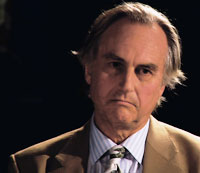
Richard Dawkins was asked about rape during an interview:
Justin Brierley (JB): If we had evolved into a society where rape was considered fine, would that mean that rape is fine?
Richard Dawkins (RD): I, I wouldn’t, I don’t want to answer that question. It, it, it’s enough for me to say that we live in a society where it’s not considered fine. We live in a society where uhm, selfishness, where failure to pay your debts, failure to reciprocate favors is, is, is regarded askance. That is the society in which we live. I’m very glad, that’s a value judgment, I’m very glad that I live in such a society.
JB: When you make a value judgment don’t you immediately step yourself outside of this evolutionary process and say that the reason this is good is that it’s good. And you don’t have any way to stand on that statement.
RD: My value judgment itself could come from my evolutionary past.
JB: So therefore it’s just as random in a sense as any product of evolution.
RD: You could say that, it doesn’t in any case, nothing about it makes it more probable that there is anything supernatural.
JB: Ultimately, your belief that rape is wrong is as arbitrary as the fact that we’ve evolved five fingers rather than six.
RD: You could say that, yeah.40
Professor of the philosophy of science, Michael Ruse, makes similar statements:
“Morality is a biological adaptation, no less than are hands and feet and teeth … Morality is just an aid to survival and reproduction.”41
Apparently, having feet and hands was not predetermined, nor that we have five fingers rather than six, nor that rape is immoral versus it being moral.
Furthermore, two evolutionists wrote a book claiming that rape was a device for men to perpetuate their genes42—one of the authors tied himself in knots trying to explain why rape was still wrong under his own philosophy.43
Richard Dawkins urges us to rebel against Darwinism with regards to morality, based upon his personal and societal preferences. His premise for prescribing rebellion is that,
“nature is not cruel, only pitilessly indifferent. This is one of the hardest lessons for humans to learn. We cannot admit that things might be neither good nor evil, neither cruel nor kind, but simply callous—indifferent to all suffering, lacking all purpose.”44
Overall, the atheist really does not have much of a basis for moral decisions, other than the atheist’s own preferences, which “should” go against the Darwinist conception of nature because … well, because it is morally better to do so!
4.1 Atheism and the “problem of evil”
The first “problem of evil,” as far as atheist/theist debates are concerned is the fact that atheists define “evil” based on personal preferences. This means that they cannot logically formulate an argument for the problem of evil without first providing an absolute definition of evil. Some make appeals to the fact that evil, let us refer to it in the form of suffering, is a tangible, physical sensation. Yet, this amounts to a bio-organism’s subjective interpretation of sensory input.
Two pop-culture musical groups had something to say in this area: Jane’s Addiction sang, “Ain’t no wrong now, ain’t no right. Only pleasure and pain” (from the song “Ain’t no Right”). The Red Hot Chili Peppers followed this up by singing, “I like pleasure spiked with pain” (from the song “Aeroplane”). Thus, these modern day philosophers took us from morality based on sensory input to the recognition that we are, in reality, speaking of interpretation of said input.
The Greek philosopher Epicurus (341–270 BC) stated the classic form of the problem of evil. His syllogism may be stated:
- If a perfectly good God exists, then there is no evil in the world.
- There is evil in the world.
- Therefore, a perfectly good God does not exist.
The logic behind the argument, again attributed to Epicurus, runs thus:
- “Either God wants to abolish evil, and cannot; or he can, but does not want to.
- If he wants to, but cannot, he is impotent.
- If he can, but does not want to, he is wicked.
- If God can abolish evil, and God really wants to do it, why is there evil in the world?”
Evil is indeed a very difficult problem. This is not because it is philosophically or theologically difficult but because it is emotionally difficult. In seeking to respond to the problem of evil we are pitting real pain versus abstract concepts. Emotion versus intellect makes for an uneven fight—how do you argue against an emotion? Thus, responses to the problem of evil are generally seen as heartless or dry-as-dust academic theorizing.
Biblically and philosophically, Epicurus’ first syllogistic point is false since a perfectly good God who allows free will can exist and thus, his syllogism fails.
Epicurus’ logic behind the argument fails because he proposes a restricted number of options—it is a false dichotomy.
- Either God wants to abolish evil, and cannot;
- or He can, but does not want to.
Yet, biblically and philosophically a third option is that God wants to abolish evil and can, yet He functions on his own timing and He has not done it yet because He has a higher purpose in allowing evil to persist for a time.
Note also, as we point out on this site, God did not create the world with evil; it is the result of sin, and is a privation of good. See the discussion under No actual evil in the finished creation and this refutation of an atheist.
4.2 Atheism and the “Euthyphro Dilemma”
The “Euthyphro Dilemma” calls into question the very basis, foundation, grounding or premise upon which theistic morality is built. Its name comes from Plato’s work Euthyphro (written in 380 BC) wherein Socrates proposes the dilemma which states:
- Is something good because God proclaims it to be good?
- Or, does God proclaim something to be good, because it is good?
Translations vary such as gods for God, virtuous or moral for good, etc.
Socrates’ question to Euthyphro caught him on the horns of a dilemma:
- Is something good because God proclaims it to be good?
Which is to ask whether something is good merely because God proclaims it to be —in which case goodness is an arbitrary construct and at a whim God could change that which is good into that which is bad and vice versa.
- Or, does God proclaim something to be good, because it is good?
Which is to ask whether there is something up, above, beyond and separate from God to which God must adhere—does God have to act according to a moral standard which is outside of Himself in which case God is not all sufficient and in fact, obeys a higher standard than Himself.
While many theologies fail to answer the Euthyphro Dilemma, biblical Trinitarian theology does not fail. Let us briefly consider how various theologies fare:
Generally stated, in dualism we have in view two co-eternal gods. Two separate and distinct beings, two separate and distinct “persons”. This concept consists of one “good” god and one “evil” god. In such cases the goodness of the one is measured against the evil of the other and vice versa. Moreover, the one considers itself to be good and the other evil. Thus, theological dualism presents arbitrary morality in that which one is good and which one is evil is purely subjective.
Generally stated, in strict monotheism we have in view one single being, one single person. Since such a god lacked companionship or relationship, it had to create beings with whom to enjoy that which it lacked and may therefore be considered imperfect or incomplete. Regardless of the reason for creation, the strictly monotheistic god existed alone from eternity and so companionship or relationship are simply not a part of its nature so that such a God generally treats its creations as a dictator whose will is absolute and unrestrained. Such a god is typically not personal or, perhaps more accurately, not personable. This is because both their personal morality and their moral prescriptions for their creation are arbitrary since it had to concoct them upon having other beings with which to deal.
Generally stated, in pantheons, polytheism and henotheism we have in view more than two gods who are either eternal or were created by one or two previously existing gods (sometimes a male god and a female god, such as in Mormonism). They were not lacking in eternal relationships since they did enjoy them with each other. Yet, being distinct gods (distinct being, distinct persons) they are not exactly famous for conducting moral relationships with each other, but are rather infamous for their quarrels and warring. Since these supernatural beings could enjoy good or bad relationships with other supernatural beings, other gods, they were not generally interested in relationships with humans. They generally considered humans to be play things—they may manipulate our fates, they may take human form and fornicate with us, but there is little, if anything, that they did that they could have considered moral relationships. Since Euthyphro worshipped such a pantheon, it was perfectly reasonable for Socrates to think there was a standard of goodness to which the gods were beholden.
Lastly, generally stated, in Trinitarian monotheism we have in view one God and yet, three “persons” each of whom is God, each of whom is eternal, each of whom is distinct and yet, each of whom are the one God; one coeternal, coexisting, coequal being consisting of three “persons”. The God of the Bible has been referred to as “one what and three who’s”.45 This God is not alone in eternity and yet is not in relation to separate eternal beings. Since each member of the Trinity is eternal, each has enjoyed eternal relationships. This God is not lacking in relationship. God enjoys a relationship that is both unified in purpose and diverse amongst the persons.46
Thus, is something good because God proclaims it to be good or, does God proclaim something to be good, because it is good? Ethics is based upon the Triune God’s nature. God’s nature is relational and benevolent. This relationship is eternal and free from conflict. God enjoys relationships and encourages His creation to enjoy like relationships. In this view, an afterlife is conceived of as the enjoyment of relationships with other humans grounded upon the mutual enjoyment of an eternal relationship with God.
God does not merely exhibit attributes; God is the attributes, “God is love” (1 John 4:8,16). Thus, God did not have arbitrarily to invent ethics; God’s very nature is the ethos.
So the solution is that it is a false dilemma—perfect goodness is an essential part of His character, not something outside Him. God indeed commands things which are good, but the reason they are good is because they reflect God’s own nature. So the goodness does not come ultimately from God’s commandments, but from His nature, which then results in good commandments.47
4.3 Atheism’s “problem of evil”
Imagine considering the problem of evil and (illogically) concluding that God does not exist—what happens next? Well, you look around the world again and notice that evil still exists and now you do not even have God to blame. Rejecting God does nothing about evil. Thus, atheism does nothing about evil. Of course it does nothing—it cannot do anything and is not supposed to do anything. Atheism is merely an idea and thus, has no volition by which to do anything at all. Indeed, and that is just the point: atheism is an idea, but God is a being who can and does various things about evil: God can condemn it absolutely, God can make provision for redeeming evil, God can abolish evil.
Atheism not only does nothing about evil; atheism actually makes evil even worse. Atheism guarantees that evil is for nothing, it has no greater purpose or meaning; it guarantees no redemption of evil.
However, it is inaccurate to state that atheism guarantees that evil is for nothing and has no greater purpose or meaning. This is because in the absolute materialism that atheism implies, evil is very purposeful in that it benefits the evildoer. The evildoer commits evil acts, and as long as they are not caught they evade the judicial systems of this world and simply get away with it, the victim suffers and may suffer for decades while the evildoer enjoyed committing evil deeds.
Also it is inaccurate to state that atheism does nothing about evil; it actually makes it go away by pretending that it does not exist. A tsunami that drowns thousands of people is not “evil”; it is a large wave. A hurricane that destroys cities and kills people is not “evil”; it is high winds. An animal, whether human or otherwise, that kills another animal is not “evil”; it is acting according to all that there is; its own will. It may be inconvenient, we may not like it, we may attempt to do something about it, against it, but it is not evil; it just is.
The fact of evil in the world is one of the very best reasons for rejecting atheism.
4.4 Atheism’s Euthyphro Dilemma
Let us propose an atheist’s version of the Euthyphro Dilemma:
- Is something good because atheists proclaim it to be good?
- Or, do atheists proclaim something to be good, because it is good?
If something is good merely because an atheist proclaims it to be good, then goodness is an arbitrary construct and at the whim of atheists who could change that which is good into that which is bad and vice versa.
Atheists tend to claim that we somehow intuit the ever-evolving morality, or as Richard Dawkins puts it, the “shifting zeitgeist” (German for “spirit of the age”). As to how we discern the zeitgeist’s latest maneuver, “one can almost use phrases like ‘it’s in the air’.”48
Do not think that this means that Richard Dawkins has no absolute standards by which to determine what is evil. He has stated, “What’s to prevent us from saying Hitler wasn’t right? I mean, that is a genuinely difficult question.”48 Yet, he has made a definitive statement about what he sees as absolutely evil, “It is evil to describe a child as a Muslim child or a Christian child. I think labelling children is child abuse and I think there is a very heavy issue”49 (more on this below in the Religion as Child Abuse section).
Back to the atheists’ Euthyphro Dilemma; the question is whether something is good merely because the atheist proclaims it to be good. Or is there something up, above, beyond and separate from the atheist to which the atheist must adhere—does the atheist have to act according to an ethical standard that is outside of the individual, in which case the atheist is not all sufficient and in fact, obeys a higher standard than the individual (or a group of individuals known as a society).
If something is good merely because the atheist proclaims it to be good, then if two atheists disagree, the same action could be both good and evil, which conflicts with the law of non-contradiction.50 At this point a common objection is raised to the effect that two people disagreeing proves that there is no absolute ethic (standard, moral law, moral code, etc.).
Yet, this is tantamount to arguing thus:
Claim: “In the USA it is absolutely illegal to run a red light in a non-emergency response vehicle.”
Response: “If that is the case, then why do some people operating non-emergency response vehicles run red lights? It must not be true that there is such an absolute law.”
All this shows is that there is a hierarchy of morality, also called graded absolutism. That is, there are higher and lower laws, and if there is a conflict, one should obey the higher law and is exempt from the lower law. In the above case, the duty of an emergency vehicle to arrive as quickly as possible to help in an emergency makes them exempt from the duty to stop at a red light. In general, the hierarchy is duty to God > duty to man > duty to property.
George F. R. Ellis (a theist) noted the following:
“The foundational line of true ethical behavior, its main guiding principle valid across all times and cultures, is the degree of freedom from self-centeredness of thought and behavior, and willingness freely to give up one’s own self-interest on behalf of others.”51
Moreover, if something is good merely because an individual, or a society, proclaims it to be so, then Nazism was good for the majority of Germans who outnumbered those whom they persecuted, but it then became evil when the fitter and more numerous Allied Forces defeated them.
It seems apparent that there is something up, above, beyond, separate and transcendent from the atheist to which the atheists must appeal to for their moral declarations. During his debate with William Lane Craig entitled “Does God Exist?”52 James Robert Brown, an atheist, stated,
“you can’t just make up facts, including moral facts; you’re under obligation, moral obligation without God, you don’t need God for this, you have a moral obligation to not murder, not rob people … All I ask you to do is believe there’s no God but still murder is wrong. There are moral facts, as well as physical facts, as well as mathematical facts, that’s all I’m asking … It’s just a basic fact, a basic moral fact, that murder is wrong.”
This is what I pointed out in the “Atheism and Ethics/Morality” section about atheists making epistemic (knowing) statements about morality but not providing an ontological premise (origin/source) for ethics. Brown merely asserts the immorality of murder by referring to himself as a “moral realist”, which, at least in his case, appears to mean that he can just make any statement he wishes with regards to morality and moreover, dogmatically assert “you’re under obligation, moral obligation … moral obligation … moral facts … moral fact.”
Yes, atheists can think through moral issues and come to a conclusion. They may even consider these conclusions to be absolutes or obligations, but these are merely impotent claims that only carry force of obligation when the governmental/societal iron fist is behind them, and then are only potent if the moral-obligation-breaker is caught. But what about being moral for the simple and pure motive of being moral without expectation of reward and punishment? This will be considered below in the section entitled, “Theism’s reward and punishment versus Atheism’s pure motives”.
Succinctly stated: atheism discredits condemnation and condemnation discredits atheism:
Atheism discredits condemnation because their condemnation is merely an expression of personal moral preferences, arguments from outrage, or impotent epistemic assertions.
Condemnation discredits atheism because atheists’ deep and heartfelt urges to condemn immorality demonstrate that they are appealing to a moral standard that is outside of the individual.
4.5 Theism’s reward and punishment versus Atheism’s pure motives
Theism’s reward and punishment
An argument against Christian claims of God-ordained ethics that has become ubiquitous in atheist circles is that Christian morality is actually immoral since, so the claim goes, it depends upon threats of punishment and enticements to receive rewards (this applies to various religions).
The first thing to point out is that Christianity does not hold to a works-based salvation doctrine and thus, good deeds do not “buy” Heaven. Yet, to the charge that, even so, Christian morality is based on the expectation of reward in Heaven or punishment in Hell, let us secondly note the intolerance: if you are the sort of person who is perfectly moral but you are moral due to fear of punishment, atheists condemn you—you are not allowed to disagree with them; or you can disagree and suffer their looking down their collective noses at you.
Atheists presume that they can read the minds and/or discern the motivations of those whom they condemn. How do they know who is behaving morally because of reward and punishment? Apparently, they merely consider whether someone adheres to such a presumed belief system. Yet, even then; how do they know? Let us consider Christianity, for example. Christians would likely answer “Why be moral?” by referencing “For the love of God and the love of humans who were made in God’s image.”
Consider this scenario: a soldier receives the honor of a Purple Heart. During the ceremony an atheist stands up and shouts that the soldier is undeserving since they were merely acting out of fear of punishment and expectation of reward: “If they deserted they would fear charges of treason and they were heroic merely due to expectation of being rewarded with a Purple Heart!”
Let us consider another scenario in light of the fact that all secular, atheistic, “non-religious” countries/nations/governments/societies premise their laws upon reward/punishment:
You are driving your car with an atheist as a passenger. You come to a red light and stop. The atheist asks you, “Why did you stop?” You answer, “Because I do not want to cause an accident whereby someone could get hurt or killed. I am empathetic and compassionate and do not want to harm anyone.” Yet, the atheist protests, “Oh, please! You know very well that if you run that red light you could get a ticket and you are merely stopping in order to not suffer the law’s punishment for lawbreakers!”
But does the fact that it is also illegal mean that I am not truly compassionate? Does it mean that my compassion is a façade for my true motivation which is avoiding punishment? Not at all. Thus, this argument may be ubiquitous but it is narrow, unrighteously judgmental and fallacious.53
Atheism’s pure motives?
The twin fallacy to the “Theism’s Reward and Punishment” claim is the claim that, sans divine reward and punishment, only atheists have pure motives for morality, or “doing good”, since they are doing so merely for its own sake. This was the assertion behind the American Humanist Association’s bus ad campaign which stated, “Why believe in God? Be good for goodness’ sake.”
Yet, just as with any twins this fallacy shares its sister’s unfounded presuppositions:
It is presupposing to know the atheist’s minds and/or discerning their motivations.
But what else could be motivating the atheist? Surely it is pure goodness? Perhaps.
However, that would be a utopian and unskeptical, narrow view. The atheist could be motivated by multitudinous impure factors, such as those which I already noted in the “Dan Barker on Morality” subsection to the main section on “Atheism and Ethics / Morality”:
“if you wish to be … a healthy person … if you wish to be labeled ‘ethical’ by other people … if you wish to be viewed by your society as ‘a good person’ … if that’s something you wish”33 “I’m happier and feel better about myself if I’m honest.”34 “if one does horrible things to people, that person will eventually have horrible things happen to him.”54
Thus, the atheist may be seeking public approval, may seek to give in order to get, may even be seeking to be thought of as a purely motivated atheist, etc.
5. Religion as child abuse

There is a disturbing trend amongst many atheists, particularly the New Atheist sect, whereby they define parents raising their children according to their own faith as “child abuse”.
Daniel Dennett wrote,
“ … many declare, there is the sacred and inviolable right of life … On the other hand, many of the same people declare that, once born, the child loses its right not to be indoctrinated or brainwashed or otherwise psychologically abused by those parents.”55
Richard Dawkins stated,
“It’s one thing to say people should be free to believe whatever they like, but should they be free to impose their beliefs on their children? Is there something to be said for society stepping in?”56
Also,
“A phrase like ‘Catholic child’ or ‘Muslim child’ should clang furious bells of protest in the mind … Catholic child? Flinch. Protestant child? Squirm. Muslim child? Shudder.”
Also,
“‘How much do we regard children as being the property of their parents?’ Dawkins asks. ‘It’s one thing to say people should be free to believe whatever they like, but should they be free to impose their beliefs on their children? Is there something to be said for society stepping in? What about bringing up children to believe manifest falsehoods?’”57
Also,
“It is evil to describe a child as a Muslim child or a Christian child. I think labelling children is child abuse and I think there is a very heavy issue.”58
As I just noted above, Richard Dawkins stated that ascertaining whether Hitler was right, “is a genuinely difficult question.”59 Yet, he does, most assuredly, state that, “It is evil” to label children with their parents’ religion—at least he has standards.
The ultimate goal is, of course, that this, “might lead children to choose no religion at all.”60
These militant, society stepping in, tactics seem to overlook the fact that children are referred to as such due to cultural and social consideration and not primarily theological. For instance, Judaism has Bar Mitzvahs when a child becomes an adult and makes a commitment to the faith. Likewise, various forms of Christianity have confirmation. Etc.61
What is the logical conclusion of this atheistic agenda? Apparently it is “evil” (“child abuse”) for parents who believe in God to teach their children to believe in God, but it is “good” (not child abuse) for atheists (or government-paid teachers?) to inculcate atheism (disbelief in God) into all children. This is the same twisted thinking that drove Stalin, Hitler and Mao et al., and resulted in the deaths of 100 million people.62
So, atheists have circumvented parental authority and have indoctrinated children into atheism and Darwinism via public schools. But Christians are fighting back. One of the great mission fields that is gaining momentum today is child evangelism. Missionologists are increasingly focusing on the 4/14 Window, which refers to the demographic group from age four to fourteen years old. This group is being reached in public schools through Bible clubs, for example. Specialized and innovative tracts for children have been developed. Much more needs to be done. Scripture declares, “Train a child up in the way he should go and he is old he will not depart from it” (Proverbs 22:6). It is imperative for Christians to reach children before secularists do, and not after.
6. Atheism’s arguments against theism, or Atheism’s “atheology”
This section will not reflect what one would expect in considering the particular arguments that atheists raise against the existence of God. The reason for not focusing on particular arguments is that they all have something in common. Thus, it seemed most important to focus on the commonality so that it may be detected within any of their arguments. The only argument that we will consider directly is, “Who made God?”
It is not hyperbolic language to state that every one of atheism’s arguments against God’s existence is premised upon the atheology of the individual atheist making the argument. While “atheology” would technically mean “lack of” or “no” theology I am employing the term in order to bring attention to the fact that atheists are some of the most theologically minded, often quite dogmatically, people—thus, the “a” for “atheism” and “theology” for the study of God or systemization of doctrines about God.
Atheism’s arguments against God’s existence are peppered with statements such as, “Why would God … ” or “Why wouldn’t God … ” or “Why does God … ” or “Why doesn’t God … ” or “If God was, then God would … ” or “should … ” or “surely could … ”, etc. These are all theological statements because they are premised upon presupposed attributes of God.
For example, if God was, then God would be omnipotent and loving; loving means not allowing any pain, evil, or suffering and so either God is not loving or is not omnipotent and if God is neither loving and/or omnipotent then God is not (various likewise examples could be concocted).
Yet, this statement, though admittedly fictional, is based upon typical atheist statements. And it is premised upon various theological assertions: God is, would or should be omnipotent. God is, would or should be loving. Loving means not allowing pain, evil, or suffering. God would or should either not allow it or would or should eradicate it based on our preferred schedules, etc.
Also, note that atheism’s arguments against God’s existence do not exist in a vacuum. That is to say, the atheist does not exist in a realm of utter ignorance of the world, then come to certain conclusions as to what would constitute evidences of God’s existence, only then emerge from the vacuum and look around the world and conclude, “Therefore, God does not exist.”
Rather, the atheist considers what is and what is not, what does and does not occur and only then makes statements as to what God would or should do, knowing that those things do not occur (this is all generally speaking since, for example, the atheist would claim that God does not perform miracles even though God does so).
Thus, rather than seeking to instantly answer the atheist’s argument, the first response should be to ask the atheist to substantiate their premise, their atheology. Following are some examples of relevant questions:
- How did you arrive at your atheological positions?
- Why should we confine our understanding of God to your atheology?
- Why do you define love the way you do?
- Why do you set certain restrictions on God?
- Why do you demand that God do as you dictate?
Therefore, the atheist’s argument should first be dissected and inspected for atheology.
6.1 Who made God?
This atheist argument has been very popularly restated as, “Who designed the designer?” This is, by his own admission, the very central argument of Richard Dawkins’ book, The God Delusion.63
The following quotations demonstrate the ubiquity of the argument:
Richard Dawkins (in The Blind Watchmaker) wrote, “To explain the origin of the DNA/protein machine by invoking a supernatural Designer is to explain precisely nothing, for it leaves unexplained the origin of the Designer.”
Christopher Hitchens (in God Is Not Great) wrote, “who designed the designer or created the creator? Religion and theology have consistently failed to overcome this objection.”
Daniel Dennett (in Darwin’s Dangerous Idea) references Richard Dawkins and declares that it is an “unrebuttable refutation, as devastating today as when Philo used it to trounce Cleanthes in Hume’s Dialogues two centuries earlier.”
And of course, Richard Dawkins (in The God Delusion) quotes Daniel Dennett who is quoting Richard Dawkins and proclaims that Daniel Dennett is correct in approving of Richard Dawkins!
This argument, although very popular and promulgated by atheist scientists and even atheist philosophers, is a premier example of what is generally termed “Sunday School Atheism”. It is called this because it is a Sunday School level question and one that Sunday School children are able to answer before achieving puberty.
God is eternal and thus does not need a cause.
To elucidate a bit, in the next section we will consider the cosmological argument which makes clear that everything that begins to exist has a sufficient cause. Since God never began to exist, God did not have a cause.
But is not claiming that God is eternal a mere way out of the problem of who made God? No.
Since time began to exist, time had a cause. Since time began to exist, whatever caused time is timeless (aka infinite or eternal). It is the linear time that we experience that makes cause and effect relationships possible: an effect follows a cause. Yet, since God exists outside of, or without, time, cause and effect relationships are impossible and thus God is the uncaused/uncausable first cause. It was God’s first action of creation that brought the space-time continuum into being and set cause and effect relationships into motion. Therefore, in God’s timeless realm there is no such question as “Who made God?” since this is a time space domain based question which simply does not apply. It is like asking “To whom is the bachelor married?”64
Note, however, that atheists have no problem believing in an uncaused first cause, at least when it is not supernatural, but Nature, as they promulgate the following assertions:
- It is ignorant and superstitious to believe that God made everything out of nothing.
- It is rational and scientific to believe that nothing made everything out of nothing.
- It is ignorant and superstitious to believe that God is eternal.
- It is rational and scientific to believe that matter (or energy) is eternal.
- God is an effect and must have had a cause.
- Matter/energy is the uncaused first cause.
- If God made everything, then who made God?
- Matter made everything and nothing made matter.
7. Arguments for God’s existence
This section will be as irregular as the previous in that it provides the most basic sketch of various arguments.
This is for three reasons:
- In an article meant to criticize atheism, substantiating theism is not necessarily required.
- Elucidating each argument and seeking to defend it against attempts to topple it would be an undertaking which, as per 1), is not necessary and would expand this article beyond its present, and already hefty, size.
- It is important to note that these arguments function most effectively when considered together since individually they tend to be specific to a particular point. Therefore, it seems necessary to present various specific arguments and recommend how they may work together to form a more encompassing argument.
Let us consider these arguments, some of which are presented in various forms.
7.1 Forms of the cosmological argument
- The universe had a beginning
- Anything that had a beginning must have been caused by something else
- Therefore, the universe was caused by something else (a creator)
- Every part of the universe is dependent
- If every part is dependent, then the whole universe must also be dependent
- Therefore, the whole universe is dependent for existence right now on some Independent Being
- Every event that had a beginning had a sufficient cause
- The universe had a beginning
- Therefore, the universe had a sufficient Cause
- Every effect has a cause
- The universe is an effect
- Therefore, the universe has a Cause
- An infinite number of moments cannot be traversed
- If an infinite number of moments had to elapse before today, then today would never have come
- But today has come
- Therefore, an infinite number of moments have not elapsed before today (i.e., the universe had a beginning)
- But whatever has a beginning is caused by something else
- Hence, there must be a Cause (Creator) of the universe
- An actual infinite cannot exist
- An infinite temporal regress of events is an actual infinite
- Therefore an infinite temporal regress of events cannot exist
- The temporal series of events is a collection formed by successive addition
- A collection formed by successive addition cannot be an actual infinite
- Therefore the temporal series of events cannot be an actual infinite
- Some things undeniably exist (e.g., I cannot deny my own existence)
- My nonexistence is possible
- Whatever has the possibility not to exist is currently caused to exist by another
- There cannot be an infinite regress of current causes of existence
- Therefore, a first uncaused cause of my current existence exists
- This uncaused cause must be infinite, unchanging, all-powerful, all-knowing, and all-perfect
- This infinitely perfect Being is appropriately called “God”
- Therefore, God exists
- This God who exists is identical to the God described in the Christian Scriptures
- Therefore, the God described in the Bible exists
7.2 Argument from cosmological natural theology
- Time, space and matter came into existence at a certain point in the finite past.
- Since time, space and matter began to exist they had a cause.
- Therefore, whatever caused them was time-less (or eternal), space-less (not subject to locality, or omnipresent) and matter-less (immaterial, non-physical, or spirit).
7.3 Forms of the teleological argument
- All designs imply a designer
- There is great design in the universe
- Therefore, there must be a Great Designer of the universe
7.4 Forms of the ontological argument
- God is defined as a being than which no greater can be conceived.
- Such a being can be conceived.
- If there were no such being in reality, then a greater being—namely, a being than which no greater can be conceived, and which exists—can be conceived.
- Yet nothing can be greater than a being than which no greater can be conceived.
- Therefore a being than which no greater can be conceived—i.e., God—must exist.
- God is the entity of which nothing greater can be thought.
- It is greater to be necessary than not.
- God must therefore be necessary.
- Hence, God exists necessarily.
7.5 Forms of the moral law argument
- Moral laws imply a Moral Law Giver
- There is an objective moral law
- Therefore, there is a Moral Law Giver
- There are objective moral laws
- Moral laws come from a moral lawgiver
- Therefore, a moral lawgiver exists
7.6 Dostoevsky’s argument from the consequences of positive Atheism
- If atheism is true then man is “the chief of the earth”
- If man is “the chief of the earth” then he can abandon absolute standards (i.e., morality)
- If man can abandon the absolute standards then “everything is permissible”
- Therefore, if atheism is true, everything is permissible
7.7 The argument from joy
- Every natural innate desire has a real object that can fulfill it
- Human beings have a natural, innate desire for immortality
- Therefore, there must be an immortal life after death
7.8 Ronald Nash’s argument from numbers
An argument proposed by Ronald Nash is known as the argument from numbers. This is how Ronald Nash explained it:
“ … when I used to teach philosophy to undergraduate college students, I would sometimes ask them to tell me what the number one is. They would usually reply by writing some of the many symbols we use such as ‘1’ or ‘I’. I would then explain that such symbols are not really the number we are seeking but are only convenient ways we use to refer to the real number one. No wise person should ever confuse a symbol for something with the thing itself.
So what then is the number one? The first step is to recognize that the number one is a concept.
What is a concept? The short answer is that it is an idea.
The next step is to ask where the concept of oneness exists. The idea of oneness, like all ideas, exists in minds.
The third step is to note that the number one is eternal. If someone has trouble with this claim, ask when the number one began to exist.
Not only has the number one always existed, it is impossible for the number one ever to change. If the number one were ever changed, it would cease to be the number one. After all, if the idea of oneness changed, let us say, into the number two, then it would no longer be the number one.
So where are we? I believe we can show many people that the concept of oneness is an eternal and unchanging idea that exists in some mind. And, the only kind of mind in which this kind of eternal and unchanging idea could exist must be an eternal and unchanging mind. When I reach this point in my little example, some student in the back of the classroom usually raises his hand and asks if I am talking about God.”65
This argument is very interesting in that it can be employed in the service of various considerations. For example, you may replace the term “the number one” with “the laws of logic” and produce a similar argument.
Let us now consider these as a whole and note how they demonstrate some of God’s attributes:
- The cosmological argument demonstrates God’s omnipotence—that God is infinitely powerful.
- The teleological argument demonstrates that God is an intelligent being—a purposeful Creator.
- The ontological argument demonstrates that God is a necessary being—the uncausable first cause.
- The moral law argument demonstrates that God is a moral being—He will never act against His moral nature.
- Dostoevsky’s argument demonstrates that without God as the premise for ethics, subjective, individual, relative morals are all we have.
- The religious need and joy argument demonstrates that God is the fulfillment of the ultimate human need—nothing but God will fill the void in a human soul.
8. Atheism and science
Although the scientific endeavor has nothing to offer atheism, atheists have co-opted it and employed it as a façade which they wrap around atheism in order to make it appear as if it is deserving of the merits of scientific respectability.
The contradiction in the atheist’s attempt to employ science towards their end is:
- They claim that science only deals with the material and therefore, has nothing to say about the immaterial or supernatural.
- They claim that science has disproved the immaterial or supernatural.
Despite this, some atheists claim that the way that science disproves the immaterial or supernatural is by increasingly finding material causes for material effects. However, this does not trouble the Christian because God created the material realm and it follows logically that material effects will have material causes and such causes and effects do not exclude the immaterial or supernatural such as God, or miracles.
Such atheists have restricted their thought processes and thus, would have to deny a miracle or appearance of God even if it took place before their very eyes. These atheists would opt for a “faith”-based belief that someday someone will find a materialistic explanation; or the fallacy of expected future human omniscience. Or they may, also without evidence, appeal to hallucination even if numerous people witnessed the same event, such as the Resurrection of Jesus,66 (hallucinations occur within the brain and thus, are not shared). Or they might simply be satisfied with thinking that they will never know.
In any event, for those atheists who have their minds made up as to God’s non-existence, it follows that there is no evidence for God’s existence. This restricts their thinking because their chosen worldview would not allow them to see reality for what it is, would not allow them to follow the evidence but would numb their cognitive faculties67 as they stare into the corner of absolute materialism—atheism is the Valium® of the people.
It is a bit like the different approaches of two people to understanding a magician’s trick. Both attempt to understand the manner in which the trick was performed. One will go beyond that and seek to ascertain the characteristics of the magician by considering the method of the trick. However, the other says, “I now understand how the trick works, but there was no conceiver of the trick, the trick was not designed, the trick is just there and that’s all.”
Science gives satisfaction to the curious because of its explanatory scope. If a Christian claims that God created life, the scientifically-minded atheist would ask, “How?” Certainly, the Christian is likewise curious, but the Christian’s inability to explain how God did it makes the atheist disinterested. Yet, it is important to note that this amounts to the atheist’s attempt, or pseudo-attempt, to place all things within the purview of science, which is an unscientific (philosophical/religious) position (how can all that is knowable be known to be knowable through science?).
When it comes to atheism’s co-option of science and their self-proclaimed reliance upon evolution, Greg Koukl has made a very telling and succinct statement,
“the point of evolution: mother nature without father God.”68
In other words, evolution is the atheists’ origins myth, designed to do away with God the Creator; creation without a Creator.
Let us note the words of P. E. Hodgson:
“Although we seldom recognize it, scientific research requires certain basic beliefs about the order and rationality of matter, and its accessibility to the human mind . . . they came to us in their full force through the Judeo-Christian belief in an omnipotent God, creator and sustainer of all things. In such a world view it becomes sensible to try and understand the world, and this is the fundamental reason science developed as it did in the Middle Ages in Christian Europe, culminating in the brilliant achievements of the seventeenth century.”69
Peter Harrison, Andreas Idreos Professor of Science and Religion at the University of Oxford, pointed out:
“It is commonly supposed that when in the early modern period individuals began to look at the world in a different way, they could no longer believe what they read in the Bible. In this book I shall suggest that the reverse is the case: that when in the sixteenth century people began to read the Bible in a different way, they found themselves forced to jettison traditional conceptions of the world.70
“Had it not been for the rise of the literal interpretation of the Bible and the subsequent appropriation of biblical narratives by early modern scientists, modern science may not have arisen at all. In sum, the Bible and its literal interpretation have played a vital role in the development of Western science.”71
So it is rather ironic today that many connect science with atheism. It is really a Christian enterprise.
8.1 Atheism and miracles
Atheists often argue that miracles cannot occur because the laws of nature, or natural laws, are immutable. By a conveniently self-serving inference they further argue that since miracles do not occur, the supernatural, God, must not exist.
What are the laws of nature?
Here our interest is not necessarily to list and describe them but to point out that what we term “the laws of nature” are our generalizations about how the natural world normally works, which are inferred from observations of the natural world. One question to keep in mind is whether we have discovered all of the laws of nature. That is, is our knowledge complete?
Are they immutable?
In order to answer in the affirmative we must first presuppose that we know all of the laws. Assuming that we do, we must further assume that we know of every possible action and interaction of these laws in every possible scenario and in every possible combination.
What if they are not immutable?
In such a case, God, who not only invented them but who lives outside of their influence, can manipulate them.
What if they are immutable?
In such a case, God can still “break” or “bend” them. According to such a scenario, God would have created what we understand to be immutable laws for the very purpose of displaying His ability to break or bend them and thereby alert us to the miraculous. In fact, without such laws we would be unable to detect miracles. An even better understanding is that miracles are an addition to the laws: a man sinks in the sea if his weight is greater than his buoyancy (Archimedes’ Principle). A rope and a helicopter do not violate this principle, but add another force to the system. Similarly, the Son of God could likewise add another force to enable Himself to walk on water, without violating Archimedes’ Principle. The materialist argument against miracles decrees that the universe is a closed system, with “no divine foot in the door”.
Can God break, bend, or manipulate, the laws of nature?
Some atheists claim that God cannot exist for the very reason that the laws of nature cannot be broken/bent/manipulated. However, since God created the laws of nature, God holds the patent on them, has the template of them, God put them into place and can manipulate them—like a guitarist who strings the guitar can place them in any order, can tighten or loosen them as he pleases and can thereby make the strings produce whatever pitch he pleases.
One-time atheist, C. S. Lewis, offered a classic response to David Hume’s arguments against miracles:
“Now of course we must agree with Hume that if there is absolutely ‘uniform experience’ against miracles, if in other words they have never happened, why then they never have. Unfortunately we know the experience against them to be uniform only if we know that all the reports of them are false. And we can know all the reports to be false only if we know already that miracles have never occurred. In fact, we are arguing in a circle.”72

The basic atheist opinion on miracles is certainly that they do not occur. But beyond dismissing all miracle claims out of hand, atheists are likely to, without evidence, claim that what are thought to be miracles are, in reality, merely the outworking of natural laws in rare and unexpected ways. Therefore, they place their “faith” in expecting that in future, science will find material explanations for unexplained miracles (the science of the gaps). Considering this view, one can only wonder how or why any atheist would deny any miracle claim. Why would they not state something to the likes of, “Jesus did, in fact, resurrect from the dead but it was due to a genetic mutation, a coincidental intermingling of natural laws,” etc.?
For more, see: Miracles and science
8.2 Origins
As to the issue of how life began on earth, various theories have been proposed and various experiments have been carried out.
John Horgan, Scientific American’s senior writer from 1986 to 1997, wrote an article that surveyed a multitude of abiogenesis theories which have all failed. He begins the article by stating, “Scientists are having a hard time agreeing on when, where and—most important—how life first emerged on the earth.”73
Let us take a quick look at some of the comments of John Horgan and others,
“Some investigators concluded that the first organisms consisted of RNA … Although this scenario is already ensconced in textbooks, it has been seriously challenged of late … molecule cannot easily generate copies of itself …
“Many investigators now consider nucleic acids to be much more plausible candidates for the first self-replicating molecules … there is a hitch. DNA cannot do its work, including forming more DNA, without the help of catalytic proteins, or enzymes. In short, proteins cannot form without DNA, but neither can DNA form without proteins. To those pondering the origin of life, it is a classic chicken-and-egg problem: Which came first, proteins or DNA? …
“RNA might be the first self-replicating molecule … But as researchers continue to examine the RNA-world concept closely, more problems emerge … Once RNA is synthesized, it can make new copies of itself only with a great deal of help from the scientist, says Joyce of the Scripps Clinic, an RNA specialist. ‘It is an inept molecule’ …
“Julius Rebek, Jr. … created a synthetic organic molecule that could replicate itself … Rebek’s experiments have two drawbacks, according to Joyce [Gerald F. Joyce of the Research Institute of Scripps Clinic]: they only replicate in highly artificial, unnatural conditions, and, even more important, they reproduce too accurately. Without mutation, the molecules cannot evolve in the Darwinian sense. Orgel agrees. ‘What Rebek has done is very clever,’ he says, ‘but I don’t see its relevance to the origin of life’ …
“‘The simplest bacterium is so damn complicated from the point of view of a chemist that it is almost impossible to imagine how it happened’, says Harold P. Klein of Santa Clara University, chairman of a National Academy of Sciences committee …
“Even if scientists do create something with lifelike properties in the laboratory, they must still wonder: Is that how it happened in the first place? …
“It was Urey’s work that inspired Miller … Yet over the past decade or so, doubts have grown about Urey and Miller’s assumptions regarding the atmosphere … ultraviolet radiation from the sun, which today is blocked by atmospheric ozone, would have destroyed hydrogen-based molecules in the atmosphere. Free hydrogen would have escaped into space …
“Miller … notes that modern [deep ocean] vents seem to be short-lived … superheated water inside the vents … would destroy rather than create complex organic compounds. If the surface of the earth is a frying pan, Miller says, a hydrothermal vent is the fire …
“Gunter Wächtershäuser[‘s theory] … calls for a very specific solid surface: one made of pyrite, or fool’s gold, a metallic mineral consisting of one iron and two sulfur molecules … The first cell, he conjectures, might have been a grain of pyrite enclosed in a membrane of organic compounds …
“A. G. Cairns-Smith … proposes that life arose on a solid substrate that occurs in vents and almost everywhere else, but he prefers crystalline clays to pyrite … Unlike some origin-of-life theorists, Cairns-Smith cheerfully admits the failings of his pet hypothesis: no one has been able to coax clay into something resembling evolution in a laboratory; nor has anyone found anything resembling a clay-based organism in nature. Yet he argues that no theory requiring organic compounds to organize and replicate without assistance is likely to fare any better. ‘Organic molecules are too wiggly to work’, he says …
“If neither the atmosphere nor vents provide a likely locale for the synthesis of complex organic compounds, maybe they were imported from somewhere else: outer space …
“Christopher F. Chyba … and others suggested that any extraterrestrial object large enough to supply significant amounts of organic material to the earth would generate so much heat during its impact that most of the material would be incinerated … ‘It’s too much like manna from heaven’, says Sherwood Chang of NASA Ames, an authority on extraterrestrial organic compounds …
“Svante A. Arrhenius, who asserted that microbes floating throughout the universe served as the ‘seeds of life’ on earth. In modern times Hoyle and … Sri Lankan astronomer N. Chandra Wickramasinghe … continue to promulgate this notion … About a decade ago Orgel and Crick … speculating that the seeds of life were sent to the earth in a spaceship by intelligent beings living on another planet … intent: to point out the inadequacy of all explanations of terrestrial genesis. As Crick once wrote: ‘The origin of life appears to be almost a miracle, so many are the conditions which would have had to be satisfied to get it going’ …
“Stuart A. Kauffman … [proposes that] simulations demonstrate that a system supplied with a sufficient number of such [“generic”] polymers will undergo a ‘phase transition’ that causes it to become ‘auto-catalytic’ … Kauffman says he is absolutely convinced … Asked if he has any test-tube results to back up his computer simulations, Kauffman replies: ‘No one has done this in post, but I’m sure I’m right’ … ”
Note that one year after the publication of this article, Scientific American (February 1992, pp. 16–17) published “The Mephistopheles of Neurobiology” which featured Francis Crick in the “Profile” section which stated,
“Crick insists that given the weaknesses of all theories of terrestrial genesis, directed panspermia should still be considered ‘a serious possibility’.”
Stanley Miller, of the Miller–Urey experiment fame (or infamy—see Why the Miller Urey research argues against abiogenesis), seems to have a succinct and colorful manner by which to categorize each proposed theory:
- He refers to the deep ocean vent hypothesis as “garbage”.
- As for the first cell developing on fool’s gold, he states, “I’d love to see the experimental evidence.”
- He calls the “pyrite theory ‘paper chemistry’.”
- He also “calls the organic-matter-from-space concept ‘a loser’.”
- As to the “auto-catalytic” theory he states, “Running equations through a computer does not constitute an experiment.”
- As to the whole endeavor of abiogenesis research, he thinks, “that the field needs a dramatic finding to constrain the rampant speculation … ‘I think we just haven’t learned the right tricks yet.’”74
In the “Atheism as scientific story telling” section below we will see that Richard Dawkins’ explains the origins of life by appealing to “luck”.
Some points to ponder, points which will ultimately refute any successful abiogenesis experiments were actually expressed within the article, did you notice them? [My emphases]
- “Once RNA is synthesized, it can make new copies of itself only with a great deal of help from the scientist.”
- “Julius Rebek, Jr. … created a synthetic organic molecule that could replicate itself.”
- Gerald F. Joyce stated that these created molecules, “only replicate in highly artificial, unnatural conditions.”
- “Even if scientists do create something with lifelike properties in the laboratory, they must still wonder: Is that how it happened in the first place?”75
Indeed, just like any and all experiments that have ever taken place, successful abiogenesis experiments would only prove purposeful creation. Experiments are conceived of in the minds of highly trained and intelligent scientists who entertain the thought, conceive of the experiment, carry out experiments utilizing equipment produced by highly trained and intelligent engineers for a preconceived purpose, they manipulate conditions, etc. Thus, the end result of any and every experiment is the product of the handiwork of preexisting beings who created their results.
However, if an experiment could be conceived where the conditions realistically reproduced possible conditions on Earth during the origin of life, and this experiment produced a self-reproducing entity (life), then this would be impressive. No one has done such experiment and nor is anyone likely to.
Computer simulations also suffer from programmers pre-ordaining the outcomes. The computer is programmed, infused with information and (as with Richard Dawkins’ Biomorphs and his “METHINKS IT IS LIKE A WEASEL” exercise) the programmer acts in the capacity of divine intervention by guiding the process, and finally the end results are said to be akin to life and self-occurring when they were, in reality, created by an intelligent programmer. A program that truly simulated abiogenesis needs to operate without intelligent oversight from the programmer to direct it towards a desired outcome. Sometimes this influence is subtle, but it is still there. See: Genetic algorithms do they show that evolution works?
Evolutionists, when candid about abiogenesis admit that the prospects for demonstrating that it could have happened are not good, to say the least. Prof. Paul Davies, while at the Australian Centre for Astrobiology, remarked, “Nobody knows how a mixture of lifeless chemicals spontaneously organised themselves into the first living cell.”76 Another evolutionist, Robert Matthews, stated in 2009:
“What’s truly amazing is that creationists aren’t giving scientists a harder time over all this … they could cause some real aggro by pointing out that science can’t explain how life exists in the first place. Come on guys, get stuck in.”77
Of course, creationists who are scientists (despite Matthews’ well-poisoning) have been doing so for decades. For much more on the impossibility of the naturalistic origin of life, see: Origin of Life Questions and Answers.
Of course we could also show that evolution (neo-Darwinism, viz. mutations and natural selection) does not explain the diversity of life on earth, but it is a sufficient challenge for the atheist that life could not even get started without a (super-intelligent) Creator.
9. Atheism in the public school classrooms
Many atheist activists use science as a façade by which to smuggle atheism into our public classrooms (science and otherwise).
This is accomplished by various methods; from making atheistic statements in textbooks that have nothing to do with science, to attempts to dictate the rules of academia, including the blacklisting of those who disagree with certain theories which are considered orthodox, to co-opting the entire educational apparatus in order to infuse atheism (in the form of humanism or … —a rose by any other name).
Member of the National Academy of Sciences and Emeritus Evan Pugh Professor at Pennsylvania State University, Philip S. Skell, warns students not to voice their doubts about Darwinism due to fear of being blacklisted and risking their grades and/or careers.78
Let us consider a few examples:
In their textbook Biology: Discovering Life (2nd ed., Heath & Co., 1994, p. 161) Joseph Levine and Kenneth Miller wrote (incidentally this is the same Kenneth Miller79 who in 1994 could not find any embryological images more recent than the fraudulent 1866 drawings of Ernst Haeckel—128 years of unnoticed scientific progress):
“Darwin knew that accepting his theory required believing in philosophical materialism, the conviction that matter is the stuff of all existence and that all mental and spiritual phenomenon are its by-products … In Darwin’s world we are not helpless prisoners of a static world order, but, rather, masters of our own fate … And from a strictly scientific point of view rejecting biological evolution is no different from rejecting other natural phenomenon [sic] such as electricity and gravity.”
How, exactly, does this have anything to do with students learning biology?
Neil Campbell and Jane Reece made the following logical blunder whilst, for some odd reason, arguing against design in their textbook Biology (6th ed., San Francisco, CA: Pearson Education, Inc., 2002, pp. 438-439):
“Surely, the best way to construct the infrastructure of a bat’s wing is not also the best way to build a whale’s flipper. Such anatomical peculiarities make no sense if the structures are uniquely engineered and unrelated … . A more likely explanation is that … all mammals [descended] from a common ancestor … The historical constraints of this retrofitting are evident in anatomical imperfections. For example, the human knee joint and spine were derived from ancestral structures that supported four-legged mammals. Almost none of us will reach old age without experiencing knee or back problems. If these structures had first taken form specifically to support our bipedal posture, we would expect them to be less subject to injury.”
Is my car really not intelligently engineered because it requires maintenance and it falls apart as it ages? Ironically, the human knee is actually a wonderful example of intelligent design,80 as is the human spine, and evolutionary ideas about back pain resulted in treatments that made problems worse.81
In his textbook Evolutionary Biology (3rd ed., Sunderland, MA: Sinauer Associates, 1998, p. 5), Douglas Futuyma wrote,
“By coupling undirected, purposeless variation to the blind, uncaring process of natural selection, Darwin made theological or spiritual explanations of the life processes superfluous.”
Thus according to this worldview philosophy masquerading as biology, studying bio-organisms logically and scientifically leads to the conclusion that God is irrelevant.
PZ Myers (atheist, biologist and Associate Professor at the University of Minnesota) was asked, “What’s most important to you: advancing atheism or advancing the public understanding of science—or are they kind of one and the same to you?” His answer was, “They are inseparable.”82 What might this tell us about the manner in which he teaches biology? Indeed, one evolutionist, Bora Zivkovic, has even explicitly declared that it’s OK to deceive students as long as they end up believing in evolution.83,84
Neil deGrasse Tyson (director of the Hayden Planetarium) appears to consider science to be a missionary field whereby he seeks converts,
“I want to put on the table, not why 85% of the members of the National Academy of Sciences reject God, I want to know why 15% of the National Academy don’t. That’s really what we’ve got to address here … if you can’t convert our colleagues, why do you have any hope that you’re going to convert the public?”85
In Humanism: A New Religion, Charles Francis Potter wrote,
“Education is thus a most powerful ally of humanism, and every American school is a school of humanism. What can a theistic Sunday school’s meeting for an hour once a week and teaching only a fraction of the children do to stem the tide of the five-day program of humanistic teaching?”86
In A Religion for a New Age, John J. Dunphy wrote:
“I am convinced that the battle for humankind’s future must be waged and won in the public school classroom by teachers who correctly perceive their role as the proselytizers of a new faith: a religion of humanity that recognizes and respects what theologians call divinity in every human being.
“These teachers must embody the same selfless dedication as the most rabid fundamentalist preachers, for they will be ministers of another sort, utilizing a classroom instead of a pulpit to convey humanist values in whatever subject they teach, regardless of the educational level—preschool day care center or large state university.
“The classroom must and will become an arena of conflict between the old and the new—the rotting corpse of Christianity, together with its adjacent evils and misery, and the new faith of humanism.
It will undoubtedly be a long, arduous, painful struggle replete with much sorrow and many tears, but humanism will emerge triumphant. It must if the family of humankind is to survive.”87
G. Richard Bozarth wrote,
“And how does a god die? Quite simply because all his religionists have been converted to another religion, and there is no one left to make children believe they need him. Finally, it is irresistible—we must ask how we can kill the god of Christianity. We need only insure that our schools teach only secular knowledge; that they teach children to constantly examine and question all theories and truths put before them in any form … If we could achieve this, God would indeed be shortly due for a funeral service.”88
The Sunday Times reported the following proselytizing attempts:
“RICHARD DAWKINS, the Oxford University professor and campaigning atheist, is planning to take his fight against God into the classroom by flooding schools with anti-religious literature. He is setting up a charity that will subsidise books, pamphlets and DVDs attacking the ‘educational scandal’ of theories such as creationism while promoting rational and scientific thought. The foundation will also attempt to divert donations from the hands of ‘missionaries’ and church-based charities.”89
Richard Dawkins favors “charities free of ‘church contamination’.”
Since any successful proselytizing crusade needs an evil against which to rail, Richard Dawkins has identified the evil ones as non-atheist scientists and creationists. He correlates creationism with Nazism and any evolutionist who is not as zealous as he for Darwinism, he sees as creationist appeasers, whom he correlates with Adolf Hitler. He refers to these evolutionary heretics as “the Neville Chamberlain school of evolutionists”90 (Neville Chamberlain had attempted to appease Hitler). This is again ironic, because historians recognize that evolution inspired Hitler’s views and Hitler sought to destroy the Christian church.91 It’s also ironic because the Church has tried to appease evolutionists with the same dismal results.92
Some have even co-opted science and evolution so that it is not merely method and theory but that which seeks to answer deep philosophical questions. When Stephen Jay Gould (the late teacher of biology, geology and history of science at Harvard University) was asked, “Why is your work so popular?” he responded by stating,
“Evolution is one of those subjects. It attempts, insofar as science can, to answer the questions of what our life means, and why we are here, and where we came from, and who we are related to, and what has happened through time, and what has been the history of this planet. These are questions that all thinking people have to ponder.”93
Michael Shermer stated,
“Darwin matters because evolution matters. Evolution matters because science matters. And Science matters because it is the preeminent story of our age, an epic saga about who we are, where we came from, and where we are going.”94
Richard Dawkins made similar claims whilst lecturing to children during his “Royal Institution Christmas Lectures” aka “The Royal Institution Lectures for Children” Episode 1, “Waking up in the Universe” (video) when he stated:
“So where does life come from? What is it? Why are we here? What are we for? What is the meaning of life? There’s a conventional wisdom which says that science has nothing to say about such questions. Well all I can say is that if science has nothing to say, it’s certain that no other discipline can say anything at all. But in fact, of course, science has a great deal to say about such questions. And that’s what these five lectures are going to be about. Life grows up in the Universe by gradual degrees: evolution. And we grow up in our understanding of our origins and our meaning.”
During his 1991 “Christmas Lectures for Young People”, which one may imagine was occasion to speak of the glories of Christ’s birth, Richard Dawkins told the young people:
“We are machines built by DNA whose purpose is to make more copies of the same DNA … It is every living object’s sole reason for living.”95
With regards to this and various other considerations; is it any wonder that Stephen Jay Gould wrote,
“ … our ways of learning about the world are strongly influenced by the social preconceptions and biased modes of thinking that each scientist must apply to any problem. The stereotype of a fully rational and objective ‘scientific method’, with individual scientists as logical (and interchangeable) robots, is self-serving mythology … The myth of a separate mode based on rigorous objectivity and arcane, largely mathematical knowledge, vouchsafed only to the initiated, may provide some immediate benefits in bamboozling a public to regard us as a new priesthood … the myth of an arcane and enlightened priesthood of scientists … ”96
Is it any wonder that Michael Denton has observed:
“Ultimately the Darwinian theory of evolution is no more nor less than the great cosmogenic myth of the twentieth century. Like the Genesis based cosmology which it replaced, and like the creation myths of ancient man, it satisfies the same deep psychological need for an all embracing explanation for the origin of the world which has motivated all the cosmogenic myth makers of the past, from the shamans of primitive peoples to the ideologues of the medieval church.”97
In light of these grand perceptions, perhaps the greatest oddity in considering atheism’s attempts to co-opt science is that atheists take science, a methodology which is meant to dissect the functions of nature, often by reductionist means, and somehow turn this into a worldview. Thus, atheists end up viewing humans, life in general, the earth, the galaxy and—the entire universe and everything in it—as the results of a long sequence of accidents. Yet, this is because they have chosen to view the universe and everything in it through a lens (science) that was never meant to be used for the purpose of worldview formation. Science is not a worldview; it is a method of discovering things about the natural world. It is no wonder that their worldview is myopic.
10. Atheism as “scientific” story telling
Richard Dawkins claimed that “Darwin made it possible to be an intellectually fulfilled atheist”.98
The way that he, and many others, seem to apply this sentiment is that as long as he can make up stories about how things may have, could have, or (perhaps according to his worldview) should have, happened which are materialistic and make no reference to God whatsoever, he is satisfied. As will be shown below, by “story telling” I mean both the concept of narrative and also employing wild guesses as theory.
Whilst interviewing Richard Dawkins, Jonathan Miller asked him, “to give a summary of the most persuasive version”. The response was, in part,
“Um, there’s got to be a series of advantages all the way in the feather. If you can’t think of one then that’s your problem, not natural selection’s problem. Natural selection, um, well, I suppose that is a sort of matter of faith on my, on my part since the theory is so coherent and so powerful.”99
He explains miracle claims as “luck” and then applies luck to the origin of life,
“Chance, luck, coincidence, miracle … events that we commonly call miracles are not supernatural, but are part of a spectrum of more-or-less improbable natural events. A miracle, in other words, if it occurs at all, is a tremendous stroke of luck.”100
“It is as though, in our theory of how we came to exist, we are allowed to postulate a certain ration of luck.”101
While discussing theories of how bats and birds evolved flight, Richard Dawkins employs the following terms, “ … guess … might have … could be … guess … Perhaps … perhaps … The beauty of this theory is … the evolutionary story.”102
As to how the bee evolved the “dance” that it performs when it communicates to other bees that food has been found (and in which direction and how far it is), Richard Dawkins employs the terms, “plausible … suggests … would have … Perhaps … plausible … plausibility … plausible … might have … would have … It is not difficult to imagine … probably … plausible … plausible … plausible.”103
And concludes, “The story as I have told it … may not actually be the right one. But something a bit like it surely did happen.”104
In discussing his computer generated Biomorphs, Richard Dawkins concluded,
“ … when we are prevented from making a journey in reality, the imagination is not a bad substitute. For those, like me, who are not mathematicians, the computer can be a powerful friend to the imagination. Like mathematics, it doesn’t only stretch the imagination. It also disciplines and controls it.”105
Niles Eldredge and Ian Tattersall wrote:
“ … science is storytelling, albeit of a very special kind.”106 [italics in original]
Franklin M. Harold (Emeritus Professor of biochemistry at Colorado State University) wrote,
“ … we must concede that there are presently no detailed Darwinian accounts of the evolution of any biochemical system, only a variety of wishful speculations.”107
Glynn Isaac wrote:
“If any of the rest of the scientific community is inclined to snigger at the embarrassment of paleoanthropologists over all this [the identification of theory as narrative], pause and reflect. I bet that the same basic findings would apply to the origin of mammals, or of flowering plants, or of life … or even the big bang and the cosmos.”108
Richard Lewontin “does acknowledge that scientists inescapably rely on ‘rhetorical’ proofs (authority, tradition) for most of what they care about; they depend on theoretical assumptions unprovable by hard science, and their promises are often absurdly overblown … Only the most simple-minded and philosophically naive scientist, of whom there are many, thinks that science is characterized entirely by hard inference and mathematical proofs based on indisputable data.”109
Misia Landau has detected narratives parading as scientific theory. Following are some of her observations:
“Scientists are generally aware of the influence of theory on observation. Seldom do they recognize, however, that many scientific theories are essentially narratives … they may be unaware of the narrative presuppositions which inform their science … Multiple interpretations and ambiguity are no strangers to readers of evolutionary biology … by comparing the narrative ‘roles’ played by fossils, scientists may become more explicit about the subjective—and often highly imaginative—ways in which they reconstruct human ancestors.”110
“Metaphors cast powerful spells not only in everyday life but also in science … When Stern and Sussman say that ‘A. afarensis had traveled well down the road toward fulltime bipedality,’ not only do they speak in metaphor, they also tell a story.”111
“Paleoanthropologic literature is ‘thick with interpretation not about what the fossils look like but also about what they mean.’112
“the idealized image that scientists project of what they do: that elusive ‘objective search for the truth’.”113
“People always come up to me after my talk and say, ‘You should take a look at our science, I’m sure it’s going on there too.’ And this is from physicists, ecologists, even biochemists—all kinds of scientists.”114
“we can rephrase the question to ask whether there is any way to present an evolutionary or historical account that does not involve storytelling … Rather than avoid them, scientists might use them as they are used in literature, as a means of discovery and experimentation. Treating scientific theories as fictions may even be a way of arriving at new theories … In science, too, telling new stories will require skill as well as imagination.”115
Science journalist Roger Lewin wrote the following in quoting John Durant,
“Could it be that, like ‘primitive’ myths, theories of human evolution reinforce the value-system of their creators by reflecting historically their image of themselves and of the society in which they live?’…This is precisely what we would expect of a scientific myth.”116
Roger Lewin also notes that some of the greats of paleoanthropology in the 1920s and 1930s:
“considered themselves to have written scientific analyses of human evolution, they had in fact been telling stories. Scientific stories, to be sure, but stories nevertheless.”117
“paleoanthropology alone among all the sciences operates within the fourth dimension, with humanity’s self-image invisibly but constantly influencing the profession’s ethos.”118
“Clifford Jolly, a British researcher at New York University, proposed the new hypothesis in a new classic paper in 1970, titled simply, ‘The Seed Eaters’. The term ‘classic’ is used here, as in most fields of science, to mean that the paper is almost certainly wrong in every detail, except one: its underlying philosophy.”119
“The epic nature of much of this writing is evident from the tone of the language once one has been alerted to it.”120
So the atheists’ origins myth, evolution, is not really hard science at all, but some observations mixed with imaginative story telling.
11. Atheism and physical, mental, emotional, spiritual and societal health
Taking into consideration just about any and every form of health: mental, emotional, physical and even societal, theists are healthier and happier than atheists (and, as we saw above, more charitable).
Many studies are cited as evidence in the next section.
11.1 Atheism and charity
The year 2008 and 2009 presented interesting examples of atheist concepts of “charity” (more accurately “donations”). Atheists in both the USA and London collected hundreds of thousands of dollars/pounds during a time of developing worldwide recession, not in order to help anyone in need, but in order to purchase bus ads and billboards to advertise just how clever they consider themselves.121
Very informative studies have been conducted in the area of charity; one particularly interesting one was conducted by a Syracuse University Professor of Public Administration (Ph.D. in economics). The study was reported upon as follows:
“ … values advocated by conservatives—from church attendance and two-parent families to the Protestant work ethic and a distaste for government-funded social services—make conservatives more generous than liberals. When it comes to helping the needy, Brooks122 writes: ‘For too long, liberals have been claiming they are the most virtuous members of American society. Although they usually give less to charity, they have nevertheless lambasted conservatives for their callousness in the face of social injustice’ … secular liberals who believe fervently in government entitlement programs give far less to charity. They want everyone’s tax dollars to support charitable causes and are reluctant to write checks to those causes, even when governments don’t provide them with enough money … liberals give less than conservatives in every way imaginable, including volunteer hours and donated blood. Harvey Mansfield, professor of government at Harvard University and 2004 recipient of the National Humanities Medal, does not know Brooks personally but has read the book. ‘His main finding is quite startling, that the people who talk the most about caring actually fork over the least,’ he said. ‘But beyond this finding I thought his analysis was extremely good, especially for an economist. He thinks very well about the reason for this and reflects about politics and morals in a way most economists do their best to avoid.’”123
Another report states:
“In 2000, religious people gave about three and a half times as much as secular people … religious conservatives are far more charitable than secular liberals, and that those who support the idea that government should redistribute income are among the least likely to dig into their own wallets to help others … religious people are more likely than the nonreligious to volunteer for secular charitable activities, give blood, and return money when they are accidentally given too much change. ‘There is not one measurably significant way I have ever found in which religious people are not more charitable than nonreligious people,’ Mr. Brooks says.
“Byron R. Johnson, a sociology professor and co-director of the Institute for Studies of Religion at Baylor University, says he recently gathered data that show similar results—such as high levels of civic engagement among religious people—while assembling a report on faith in America that was released in September [2006].
‘It was not surprising to me that the lil ol’ farmer in South Dakota outgave people in San Francisco’ …households headed by a conservative give roughly 30 percent more to charity each year than households headed by a liberal, despite the fact that the liberal families on average earn slightly more …
“Most of the difference in giving among conservatives and liberals gets back to religion. Religious liberals give nearly as much as religious conservatives, Mr. Brooks found. And secular conservatives are even less generous than secular liberals … religious people, on average, give 54 percent more per year than secular people to human-welfare charities.”124
The Barna Group reported the following about atheists and agnostics:
“They are less likely than active-faith Americans to … volunteer to help a non-church-related non-profit … to describe themselves as ‘active in the community’ … and to personally help or serve a homeless or poor person …The typical no-faith American donated just $200 in 2006, which is more than seven times less than the amount contributed by the prototypical active-faith adult ($1500). Even when church-based giving is subtracted from the equation, active-faith adults donated twice as many dollars last year as did atheists and agnostics. In fact, while just 7% of active-faith adults failed to contribute any personal funds in 2006, that compares with 22% among the no-faith adults … atheists and agnostics were more likely than were Christians to be focused on … acquiring wealth …
[Barna Group President, David Kinnaman, stated] ‘Proponents of secularism suggest that rejecting faith is a simple and intelligent response to what we know today. Yet, most of the Americans who overtly reject faith harbor doubts about whether they are correct in doing so. Many of the most ardent critics of Christianity claim that compassion and generosity do not hinge on faith; yet those who divorce themselves from spiritual commitment are significantly less likely to help others.’”125
11.2 Atheism and suicide
“Religiously unaffiliated subjects had significantly more lifetime suicide attempts and more first-degree relatives who committed suicide than subjects who endorsed a religious affiliation. Unaffiliated subjects were younger, less often married, less often had children, and had less contact with family members.
“Furthermore, subjects with no religious affiliation perceived fewer reasons for living, particularly fewer moral objections to suicide. In terms of clinical characteristics, religiously unaffiliated subjects had more lifetime impulsivity, aggression, and past substance use disorder. No differences in the level of subjective and objective depression, hopelessness, or stressful life events were found.”126
11.3 Adult mortality
“Religious attendance is associated with U.S. adult mortality in a graded fashion: People who never attend exhibit 1.87 times the risk of death in the follow-up period compared with people who attend more than once a week. This translates into a seven-year difference in life expectancy at age 20 between those who never attend and those who attend more than once a week.
“Health selectivity is responsible for a portion of the religious attendance effect: People who do not attend church or religious services are also more likely to be unhealthy and, consequently, to die.
However, religious attendance also works through increased social ties and behavioral factors to decrease the risks of death. And although the magnitude of the association between religious attendance and mortality varies by cause of death, the direction of the association is consistent across causes.”127“ … those [Mexican Americans aged 65 and older] who attend church once per week exhibit a 32% reduction in the risk of mortality as compared with those who never attend religious services. Moreover, the benefits of weekly attendance persist with controls for sociodemographic characteristics, cardiovascular health, activities of daily living, cognitive functioning, physical mobility and functioning, social support, health behaviors, mental health, and subjective health … Our findings suggest that weekly church attendance may reduce the risk of mortality among older Mexican Americans.”128
“In a nationwide cohort of Americans, predominantly Christians, analyses demonstrated a lower risk of death independent of confounders among those reporting religious attendance at least weekly compared to never.”129
11.4 Cause of death
“After adjusting for age and sex, infrequent (never or less than weekly) attenders had significantly higher rates of circulatory, cancer, digestive, and respiratory mortality (p < 0.05), but not mortality due to external causes. Differences in cancer mortality were explained by prior health status. Associations with other outcomes were weakened but not eliminated by including health behaviors and prior health status. In fully adjusted models, infrequent attenders had significantly or marginally significantly higher rates of death from circulatory … mortality … .These results are consistent with the view that religious involvement, like high socioeconomic status, is a general protective factor that promotes health through a variety of causal pathways.”130
11.5 Attitudes towards abortion

Atheist bioethicist, Peter Singer, is too humane to eat a hamburger and advocates giving rights to great apes, but has no qualms about infanticide.
In “ … an effort to determine changes occurring between 1968 and 1978 in the percentage who approved of legal abortion in Canada under 6 possible conditions of pregnancy” agnostic/atheist students were amongst the least likely to draw a distinction between the following conditions under which abortion would be considered, “1st set of conditions (harm to mother’s health, possible child deformity, pregnancy from rape) … 2nd set of conditions (out-of-wedlock pregnancy, economic inability to support child, unwanted child).”131
11.6 Christmas and happiness
“Religious people are happier than those without spirituality in their life, says psychologist Dr Stephen Joseph from the University of Warwick, and those who celebrate the original, Christian, meaning of Christmas are, on the whole, happier than those who primarily celebrate the festive season with consumer gifts. Research entitled ‘Religiosity and its association with happiness, purpose in life, and self-actualisation’ published in Mental Health, Religion and Culture reveals a positive relation between religiosity and happiness …
“Dr Stephen Joseph, from the University of Warwick, said: ‘Religious people seem to have a greater purpose in life, which is why they are happier. Looking at the research evidence, it seems that those who celebrate the Christian meaning of Christmas are on the whole likely to be happier. Research shows that too much materialism in our lives can be terrible for happiness.’ …
“Results showed that religious people are happier, and that the relation between religiosity and happiness is, in part, related to a sense of purpose in life.”132
11.7 Atheism and superstition
The Wall Street Journal provided the following report:
“From Hollywood to the academy, atheists are convinced that a decline in traditional religious belief would lead to a smarter, more scientifically literate and even more civilized populace. The reality is that the New Atheist campaign, by discouraging religion, won’t create a new group of intelligent, skeptical, enlightened beings. Far from it: It might actually encourage new levels of mass superstition. And that’s not a conclusion to take on faith—it’s what the empirical data tell us.
“‘What Americans Really Believe,’ a comprehensive new study released by Baylor University yesterday, shows that traditional Christian religion greatly decreases belief in everything from the efficacy of palm readers to the usefulness of astrology. It also shows that the irreligious and the members of more liberal Protestant denominations, far from being resistant to superstition, tend to be much more likely to believe in the paranormal and in pseudoscience than evangelical Christians …
“While 31% of people who never worship expressed strong belief in these things [dreams foretelling future, existence of Atlantis, haunting, necromancy, Bigfoot and Nessie], only 8% of people who attend a house of worship more than once a week did … In fact, the more traditional and evangelical the respondent, the less likely he was to believe in, for instance, the possibility of communicating with people who are dead.
“This is not a new finding. In his 1983 book The Whys of a Philosophical Scrivener, skeptic and science writer Martin Gardner cited the decline of traditional religious belief among the better educated as one of the causes for an increase in pseudoscience, cults and superstition. He referenced a 1980 study published in the magazine Skeptical Inquirer that showed irreligious college students to be by far the most likely to embrace paranormal beliefs, while born-again Christian college students were the least likely.
“Surprisingly, while increased church attendance and membership in a conservative denomination has a powerful negative effect on paranormal beliefs, higher education doesn’t. Two years ago two professors published another study in Skeptical Inquirer showing that, while less than one-quarter of college freshmen surveyed expressed a general belief in such superstitions as ghosts, psychic healing, haunted houses, demonic possession, clairvoyance and witches, the figure jumped to 31% of college seniors and 34% of graduate students.”133
Interestingly, they further note,
“We can’t even count on self-described atheists to be strict rationalists. According to the Pew Forum on Religion & Public Life’s monumental ‘U.S. Religious Landscape Survey’ that was issued in June, 21% of self-proclaimed atheists believe in either a personal God or an impersonal force. Ten percent of atheists pray at least weekly and 12% believe in heaven.”
This seems rather bizarre, but many people who claim to believe in and even worship god(s) actually do not. For example, the spirituality expressed in the New Age movement is very much based on the interaction with impersonal “energy” which is known as ki, chi, prana, etc. New Agers are not as likely to refer to God in the traditional theistic manner but to “the universe”, “the life force”, our “higher selves”, “ascended masters”, etc. It may also be noteworthy that pantheism has, as far back as 1900 AD, been considered “a polite form of atheism” (as per Ernst Haeckel in “Monism” from his The Riddle of the Universe).
An earlier study published in Skeptical Inquirer of all places134 concluded that Bible-believers are the ones “who appear most virtuous according to scientific standards when we examine the cults and pseudo-sciences proliferating in our society today.”135
11.8 Atheism and society
Atheists claim that atheist (secularist) societies are superior in every way. Let us consider two such claims which made quite a splash on the internet:
One was touted by Ruth Gledhill in The Times of London article, Societies worse off when they have God on their side. She was writing a summary of the study in the Journal of Religion and Society by Gregory S. Paul entitled, “Cross-National Correlations of Quantifiable Societal Health with Popular Religiosity and Secularism in the Prosperous Democracies.”136
Statistician, Scott Gilbreath, notes in a blog From our bulging How not to do statistics file that,
“ … the [Journal] article does not say what Ms Gledhill reports … Ruth Gledhill’s news report in the Times misrepresents the content of Mr Paul’s study.”
What then of the actual contents? Gilbreath wrote:
“The plan of the study is to gather and compare data for countries he refers to variously as ‘prosperous developed democracies’ and ‘developing democracies’. The definition of these terms is never discussed … Eighteen countries are included for data comparison; among those omitted without clear explanation are: Italy, Greece, Finland, Luxembourg, and Belgium.
“Why are these left out? He mentions in passing that ‘[t]he especially low rates [of homicide] in the more Catholic European states are statistical noise due to yearly fluctuations incidental to this sample’, but no statistical evidence corroborating this assertion is provided …
“Mr Paul’s sample frame appears arbitrary. Obviously, in a sample of eighteen observations, inclusion or exclusion of only one or two observations can make a big difference in the results … At best, this is very sloppy statistical practice. If one were suspicious, one might point out that this makes cooking the results child’s play.”
Gilbreath further wrote about who Gregory S. Paul is. It turns out that he is a “freelance paleontologist, author and illustrator” whom the Council for Secular Humanism recommends for debates with young-earth creationists. Gary Bouma, Professor of Sociology at Monash University in Melbourne, stated that Gregory S. Paul,
“ … doesn’t stick to his field of palaeontology, he goes into the field of what I would call sociology without preparation or evidence or discipline and make some assertions about it.”137
Furthermore, George Gallup noted,
“In order for the author’s bold claims against religious commitment contributing to society to hold true, he would have to refute the hundreds of volumes that have proven otherwise. From discussions on parenting and fatherhood, to mental and physical health, the weight of empirical evidence is against Paul’s assertions: religious commitment has notably positive effects on the individual and collective levels of human society.”
Particularly captivating is Gregory Rodriguez’s Los Angeles Times article about a study conducted by Northwestern University that “starts to provide data and insight” about “why humans believe. The study, by psychology professor Dan P. McAdams and researcher Michelle Albaugh, was aimed at finding out about the religious sources of political leanings.” While the study itself is fascinating, Gregory Rodriguez’s media-based conclusions are noteworthy:
“The fury of the debate between faith and atheism leaves little room for an inquiry as to why 90% of Americans say they believe in God or a supreme being and more than 40% say they attend religious services each week … The study analyzes the results mostly in terms of political divisions … The political findings are intriguing, but not nearly as interesting as the way the question and the answers it elicited get at deeper, core issues. It appears that we do believe out of need, but it’s not, as Marx suggested, primarily because of material deprivation. Instead, it looks as if faith answers fear, and many different kinds of fear, which we can begin to delineate in some detail … ”138
At the time of the writing, Rodriguez stated that “90% of Americans say they believe in God or a supreme being.” Now let us consider upon what, surely massive, sample group the study was based: the Los Angeles Times stated that the researchers “interviewed 128 devout Christians in and around Chicago.” North Western University actually states, “The Northwestern University study sample included 128 highly religious and politically active Americans who attend church regularly.”
Not only does the sample group represent a stunningly insignificant percentage of the population (or of the 90%), but it is a sample from a very limited locality. Certainly, “we learn a whole lot more if we just keep asking ourselves—in as many new ways as possible—why it is that so many of us feel compelled to pray.” And let us not forget to ask, “Why it is that so many of us feel compelled not to pray.” The previously mentioned Prof. Paul Vitz has provided some fascinating answers in his book, Faith of the Fatherless.
The article on the North Western University’s News and Information website is even blunter in its conclusions,
“Political conservatives operate out of a fear of chaos and absence of order while political liberals operate out of a fear of emptiness, a new Northwestern University study soon to be published in the Journal of Research in Personality finds.”
This framing, which appears to be the basic conclusion of the “study,” is a first-rate non sequitur: as Rodriguez puts it, “they asked their subjects to describe what their lives and the world would be like if they did not have faith” (whatever “faith” means here). Apparently, political conservatives think that it would result in lives/a world of chaos and absence of order and political liberals conceive operating out of a fear of emptiness. Yet, just because people believe chaos would result does not mean that this is why they have “faith.” Do we really know how “Political conservatives operate” based on 128 Chicagoans? One can perhaps come to various conclusions as to what it says about North Western University, the Los Angeles Times and perhaps a bit about the media and academia in general.
However, one need only look at the quality of life of people who have lived or live in states based on atheism to see that atheism is no basis for a just, caring, prosperous, secure society. Think about the various staunchly atheistic Communist states, such as Albania, Soviet Russia, North Korea, Pol Pot’s Cambodia, etc. Or we could think of Nazi Germany. See below for more on the fruits of atheism in political systems.
11.9 Atheism and honesty
Atheism has no moral imperative for honesty so it is not surprising that atheists figure prominently in fraud and deception, although it is difficult to find statistics on this issue.
There are many examples just in the history of the promotion of evolution. A particularly notorious example is that of Ernst Haeckel, a “free thinker” (atheist) who fraudulently doctored drawings of embryos of various creatures to make them look almost identical and then claimed that this was evidence for evolution. He made at least two other fraudulent claims regarding the origin of life and a non-existent ape-man. He helped lay the foundations for Nazism in Germany.139
Staff of Creation Ministries International had their reputations sullied by a deeply dishonest campaign conducted by an Australian Humanist of the Year.
11.10 Incarceration
Vox Day wrote:
“I previously referenced the number of atheists being held by the prison system of England and Wales, where it is customary to record the religion of the prison population as part of the Inmate Information System. In the year 2000, there were 38,531 Christians of twenty-one different varieties imprisoned for their crimes, compared to only 122 atheists and sixty-two agnostics. As Europe in general and the United Kingdom in particular have become increasingly post-Christian, this would appear to be a damning piece of evidence proving the fundamentally criminal nature of theists while demonstrating that atheists are indeed more moral despite their lack of a sky god holding them to account.”140
“ … there also happened to be another 20,639 prisoners, 31.6 percent of the total prison population, who possessed ‘no religion’. And this was not simply a case of people falling through the cracks or refusing to provide an answer; the Inmate Information System is specific enough to distinguish between Druids, Scientologists, and Zoroastrians as well as between the Celestial Church of God, the Welsh Independent church, and the Non-Conformist church. It also features separate categories for ‘other Christian religion’, ‘other non-Christian religion’, and ‘not known’. At only two-tenths of a percent of the prison population, High Church atheists are, as previously suggested, extremely law-abiding. But when one compares the 31.6 percent of imprisoned no-religionists to the 15.1 percent of Britons who checked ‘none’ or wrote in Jedi Knight, agnostic, atheist, or heathen in the 2001 national survey, it becomes clear that their Low Church counterparts are nearly four times more likely to be convicted and jailed for committing a crime than a Christian.”141
His footnote states, “3.84 times more likely, to be precise. Census, April 2001, Office for National Statistics.”
11.11 Atheism, marriage and divorce
Michael Caputo, on Atheism and Divorce wrote:
“Very little else has produced as much euphoria in atheists than Christian researcher, George Barna’s announcement that Born Again and other Christians have a very high rate of divorce, while atheists have the lowest rate. Atheist web sites immediately announced the glorious news worldwide. The divorce rates they published were the following: Jews: 30%; Born Again Christians: 27%; other Christians: 24%; atheists only 21% ...
“Was George Barna quoted correctly?… Yet the survey found that the percentage of atheists and agnostics who have been married and divorced is 37%—very similar to the numbers for the born again population. [ref] [emphasis in original]
“The sample used by Barna was a bit less than 4000. Atheists and agnostics make up about 10% of the American population (2% being atheists). That means that about 400 of the people sampled were atheists/agnostics (About 80 being atheists). This is hardly a sufficient sample to reach any reliable conclusion …
“According to Barna, ‘Forty-two percent of adults who associate with a faith other than Christianity had co-habited, while atheists were the most likely to do so (51%).
“It is critical to stress that it is a well known fact that cohabiters experience a very high number of ‘breakups’ before getting married. ‘Millions of people … believe that cohabitation is a prelude to marriage. And for many, it is. However, Smock reports that 45% of cohabitations break up with no marriage. Another 10% continue cohabiting.’ [ref]
“Barna did not include this enlightening fact in his research. Thus, if 21% of atheists divorce after marriage, and 45 % break up once or more before marriage, what we have is the astounding rate of about 66% of atheist couples experiencing ‘at least’ one break up. If, however, the number is 37%, then we have a shocking figure of 82% …
“What needs mentioning is the fact that many atheists do notcohabit as a prelude to marriage. They in fact see cohabitation as ‘equivalent’ to any marriage relationship … These break ups were not included in the Barna research …
“The appellation ‘Christian’ a Christian does not make. There are great numbers of people in this world who call themselves ‘Christians’ but have never internalized the teachings of Jesus Christ …
“Recently the Pew Forum on Religion and Public Life has published its mammoth study on Religion in America based on 35,000 interviews. The results are quite enlightening in further elucidating the topic of atheism and divorce. According to the Pew Forum a whopping 37% of atheists never marry as opposed to 19% of the American population, 17% of Protestants and 17% of Catholics.(9) How enlightening… Not only do atheists cohabit and break up in very large numbers, they also do not marry in very large numbers.”142 [all emphasis by Caputo]
Vox Day further notes:
“the 2001 ARIS study … a much larger study that reaches precisely the opposite conclusion … according to ARIS 2001 more than half of all atheists and agnostics don’t get married … If one correctly excludes the never-married from the calculation, then atheists are 58.7 percent more likely to get divorced than Pentecostals and Baptists, the two born-again Christian groups with the highest rate of divorce, and more than twice as likely to get divorced than Christians in general.”143
12. Atheism and Communism

With regards to the correlation between atheism and Communism; it would be fallaciously simplistic to claim that atheism is the only motivating factor behind Communism and yet, it is certainly a major factor and the very premise upon which Communist ideology was built.
Let us simply consider the words of Communists leaders themselves and then the opinion of a major scholar in the research of Communism.
Karl Marx stated,
“Darwin’s book of Natural Selection. Although it is developed in the crude English style, this is the book which contains the basis in natural history for our view … Darwin’s book is very important and serves me as a basis in natural science for the class struggle in history.”144
Leon Trotsky elucidated further in, The ABC of Materialist Dialectics:
“We call our dialectic, materialist, since its roots are neither in heaven nor in the depths of our ‘free will’, but in objective reality, in nature. Consciousness grew out of the unconscious, psychology out of physiology, the organic world out of the inorganic, the solar system out of nebulae … Darwinism … was the highest triumph of the dialectic in the whole field of organic matter.”
Vladimir Lenin, the first leader of the USSR who modified Marxist doctrine as a Communist theoretician (1870–1924):
“Social-Democracy bases its whole world-outlook on scientific socialism, i.e., Marxism. The philosophical basis of Marxism, as Marx and Engels repeatedly declared, is dialectical materialism … a materialism which is absolutely atheistic and positively hostile to all religion. Let us recall that the whole of Engels’s Anti-Dühring, which Marx read in manuscript, is an indictment of the materialist and atheist Dühring for not being a consistent materialist and for leaving loopholes for religion and religious philosophy … Religion is the opium of the people—this dictum by Marx is the corner-stone of the whole Marxist outlook on religion … Marxism is materialism. As such, it is as relentlessly hostile to religion as was the materialism … This is beyond doubt … it applies the materialist philosophy to the domain of history, to the domain of the social sciences.”145
Lenin also pointed out that “Engels frequently condemned the efforts of people who desired … to introduce into the programme of the workers’ party an explicit proclamation of atheism, in the sense of declaring war on religion” because this would merely “revive interest in religion and to prevent it from really dying out.”
The logical and moral absurdity of charging Leninists with “harshness” while presupposing absolute materialism was well stated by Lenin himself, “when people charge us with harshness we wonder how they can forget the rudiments of Marxism.”146
In this regard, it is interesting to note the words of Mao Zedong:
“You’d better have less conscience. Some of our comrades have too much mercy, not enough brutality, which means that they are not so Marxist. On this matter, we indeed have no conscience! Marxism is that brutal … .We are prepared to sacrifice 300 million Chinese for the victory of the world revolution”147 and “Look at World War II, at Hitler’s cruelty. The more cruelty, the more enthusiasm for revolution.”148
Lenin considered religion “irredeemably evil” because it hindered “the world Communist revolution”. This was because his morality was premised upon his movement, “Whatever helps the world Communist revolution is good; whatever hinders it is bad.”149
And this was because, “We deny all morality taken from superhuman or non-class conceptions … In what sense do we deny ethics, morals? In the sense in which they are preached by the bourgeoisie, which deduces these morals from god’s commandments. Of course, we say that we do not believe in god”150 and “We do not believe in eternal morality, and we expose all fables about morality.”151
Joseph Stalin became Soviet Union leader following Lenin’s death (1878–1953). In a very odd twisting of logic, atheist professor of philosophy Daniel Dennett argues that the atheist Stalin was a theist:
“ … it occurred to me—let’s think about Stalin for a moment. Was he an atheist? You might say well of course he was an atheist. No, on the contrary. In a certain sense, he wasn’t an atheist at all. He believed in god. Not only that, he believe in a god whose will determined what right and wrong was. And he was sure of the existence of this god, and the god’s name was Stalin.”152
His point was to attempt, as many of atheism’s activists do, to pretend that atheism is perfectly pure and unspotted while laying blame for Stalin’s brutality in the camp of theism. While this is utterly irresponsible, particularly for a professor of philosophy, may we not grant it and agree that every atheist is a theist who sees God in their own mirrors and thus, determined what is right and wrong?
President and Founder of the Union of the Militant Godless, Yemilian Yaroslavsky (né Minei Israilevich Gubelman), made it clear that Stalin,
“At a very early age … began to read Darwin and became an atheist” and that Stalin stated, “You know, they are fooling us, there is no God … I’ll lend you a book to read; it will show you that the world and all living things are quite different from what you imagine, and all this talk about God is sheer nonsense … Darwin. You must read it.”153
Note that here again we see the connection between atheism, Darwinism and Communism.
Therefore, he ended up combining “science” with atheism to the point of concluding,
“The Party cannot be neutral towards religion, and it conducts anti-religious propaganda against all religious prejudices because it stands for science, whereas religious prejudices run counter to science, because all religion is the antithesis of science.”154
Time Magazine, 17 Feb. 1936, reported (“Godless Jubilee”) that there was a, “celebration by massed Communist delegations from all over Russia of the tenth anniversary of the founding in Moscow of the Union of the Militant Godless … active profession of atheism is the badge of a Communist.”
Darwin scholar and Marxist, Robert M. Young, wrote,
“I want to come back to Darwinian evolution. The connection is this: science and appeals to scientific socialism have been rooted in Darwinism by those who claimed that it provided a basis for Marxism … Aspects of evolutionism are consistent with Marxism. The explanation of the origins of humankind and of mind by purely natural forces was and remains as welcome to Marxists as to any other secularists … ”155
In the preface to The Communist Manifesto, Friedrich Engels wrote of Communism as, “The proposition which in my opinion is destined to do for history what Darwin’s theory has done for biology.”156 He also wrote:
“The whole Darwinist teaching of the struggle for existence is simply a transference from society to living nature of Hobbes’s doctrine of bellum omnium contra omnes [a war of all against all] and of the bourgeois economic doctrine of competition together with Malthus’ theory of population. When this conjuror’s trick has been performed . . . the same theories are transferred again from organic nature into history and it is now claimed that their validity as eternal laws of human society has been proved.”
Mao Zedong affirmed:
“Chinese socialism is founded upon Darwin and the theory of evolution.”157
He further stated:
“I do not agree with the view that to be moral, the motive of one’s action has to be benefiting others. Morality does not have to be defined in relation to others … People like me want to … satisfy our hearts to the full, and in doing so we automatically have the most valuable moral codes. Of course there are people and objects in the world, but they are all there only for me … People like me only have a duty to ourselves; we have no duty to other people … Some say one has a responsibility for history. I don’t believe it. I am only concerned about developing myself.”158
Daniel J. Flynn wrote the following whilst referencing The Black Book of Communism: Crimes, Terror, Repression,159
“The roots of Marxist-Leninism are perhaps not to be found in Marx at all, but in a deviant version of Darwinism … applied to social questions with the same catastrophic results that occur when such ideas are applied to racial issues … In 1922 alone, more than 8,000 priests, monks, and nuns were executed in the Soviet Union … In 1967, Albania declared itself the world’s first officially atheist nation and reduced more than 2,000 churches and mosques to rubble or expropriated them for state use [from 1917 to 1969, the Communists destroyed 41,000 of Russia’s 48,000 churches] … Almost fifty percent of all Catholics were killed in Cambodia … Moslems saw more than 40% of their co-religionists killed. Mosques and The Koran were burned and Pol Pot’s henchmen sadistically forced followers of Islam to eat pork … The Romanian Secret Police encouraged prisoners to devise ‘reeducation’ programs. The leader of one such program named Eugen Turcanu devised especially diabolical measures to force seminarians to renounce their faith … Some had their heads repeatedly plunged into a bucket of urine and fecal matter while the guards intoned a parody of the baptismal rite.”
Trotskyite, Denzil Dean Harber (aka Paul Dixon), writes of, “the materialist basis upon which Marxism stands” and that there were “anti-religious tests for the Army and Civil Service” that were later abolished due to a tentative policy which he described as due to “The Left zig-zag of the bureaucracy [which] was inevitably followed by a turn to the right.”160 He also mentions that the Communist Party of the Soviet Union established the Society of Militant Atheists which published a journal: The Atheist.
In 1983 Aleksandr Isayevich Solzhenitsyn (1918–2008) described his credentials thus:
“I have spent well-nigh fifty years working on the history of our Revolution; in the process I have read hundreds of books, collected hundreds of personal testimonies, and have already contributed eight volumes of my own toward the effort of clearing away the rubble left by that upheaval.”161
We therefore, come to Solzhenitsyn’s conclusion from his Templeton Address, Men Have Forgotten God :
“It was Dostoevsky, once again, who drew from the French Revolution and its seeming hatred of the Church the lesson that ‘revolution must necessarily begin with atheism’. That is absolutely true. But the world had never before known a godlessness as organized, militarized, and tenaciously malevolent as that practiced by Marxism. Within the philosophical system of Marx and Lenin, and at the heart of their psychology, hatred of God is the principal driving force, more fundamental than all their political and economic pretensions. Militant atheism is not merely incidental or marginal to Communist policy; it is not a side effect, but the central pivot …
“But there is something they did not expect: that in a land where churches have been leveled, where a triumphant atheism has rampaged uncontrolled for two-thirds of a century, where the clergy is utterly humiliated and deprived of all independence, where what remains of the Church as an institution is tolerated only for the sake of propaganda directed at the West, where even today people are sent to the labor camps for their faith, and where, within the camps themselves, those who gather to pray at Easter are clapped in punishment cells—they could not suppose that beneath this Communist steamroller the Christian tradition would survive in Russia. It is true that millions of our countrymen have been corrupted and spiritually devastated by an officially imposed atheism, yet there remain many millions of believers: it is only external pressures that keep them from speaking out, but, as is always the case in times of persecution and suffering, the awareness of God in my country has attained great acuteness and profundity …
“The concepts of good and evil have been ridiculed for several centuries; banished from common use, they have been replaced by political or class considerations of short lived value. It has become embarrassing to state that evil makes its home in the individual human heart before it enters a political system …
“Western societies are losing more and more of their religious essence as they thoughtlessly yield up their younger generation to atheism …
“Atheist teachers in the West are bringing up a younger generation in a spirit of hatred of their own society …
“All attempts to find a way out of the plight of today’s world are fruitless unless we redirect our consciousness, in repentance, to the Creator of all: without this, no exit will be illumined, and we shall seek it in vain.”
The best response that atheists have been able to muster against the logical, ideological and historical correlation between atheism and Communism is to state that since atheism is merely a lack of belief in god(s) it does nothing, inspires nothing and is therefore, responsible for nothing. This is either the greatest scholarly hoax since The Jesus Seminar or the utter bankruptcy of atheist activists’ attempts to play on the ignorance of history of their adherents. Firstly, this is only one, conveniently self-serving, definition of “atheism”. Secondly, even granting the lack of belief in god(s) interpretation of atheism we note that this makes atheism a blank canvas upon which each atheist, Communist leader or not, can paint a particular worldview of their choosing and completely unrestrained by any god(s).
Other atheists actually make reference to higher population levels and sophisticated weaponry in explaining away the fact that the most secular century in human history was also the bloodiest. That there are merely more people to murder is certainly a fascinating excuse as bloodthirsty regimes have never been at a loss for victims. That sophisticated weaponry is to be blamed means that atheists are blaming scientists/engineers for inventing ever more efficient ways of committing mass murder. However, this pseudo-counterargument does not take into consideration that one of the unique features of Communist regimes was that millions upon millions of their comrades where not killed whilst fighting wars but were systematically murdered by their own leaders. And this was often carried out by very primitive means and employing very rudimentary weapons: starvation, lack of healthcare and executions by torture and single bullets fired from rifles or even machine guns does not need sophisticated weaponry.
Vox Day notes:
“Apparently it was just an amazing coincidence that every Communist of historical note publicly declared his atheism … .there have been twenty-eight countries in world history that can be confirmed to have been ruled by regimes with avowed atheists at the helm … These twenty-eight historical regimes have been ruled by eighty-nine atheists, of whom more than half have engaged in democidal162 acts of the sort committed by Stalin and Mao … .163
“The total body count for the ninety years between 1917 and 2007 is approximately 148 million dead at the bloody hands of fifty-two atheists, three times more than all the human beings killed by war, civil war, and individual crime in the entire twentieth century combined.164
“The historical record of collective atheism is thus 182,716 times worse on an annual basis than Christianity’s worst and most infamous misdeed, the Spanish Inquisition. It is not only Stalin and Mao who were so murderously inclined, they were merely the worst of the whole Hell-bound lot. For every Pol Pot whose infamous name is still spoken with horror today, there was a Mengistu, a Bierut, and a Choibalsan, godless men whose names are now forgotten everywhere but in the lands they once ruled with a red hand.
“Is a 58 percent chance that an atheist leader will murder a noticeable percentage of the population over which he rules sufficient evidence that atheism does, in fact, provide a systematic influence to do bad things? If that is not deemed to be conclusive, how about the fact that the average atheist crime against humanity is 18.3 million percent worse than the very worst depredation committed by Christians, even though atheists have had less than one-twentieth the number of opportunities with which to commit them. If one considers the statistically significant size of the historical atheist set and contrasts it with the fact that not one in a thousand religious leaders have committed similarly large-scale atrocities, it is impossible to conclude otherwise, even if we do not yet understand exactly why this should be the case. Once might be an accident, even twice could be coincidence, but fifty-two incidents in ninety years reeks of causation!”165
For more, see: Communism and Nazism Q&A
13. G. K. Chesterton’s Conclusion

Atheist Pol Pot’s Communists in Cambodia even murdered young children, some of whose bones were found in the Choung Ek Killing Field
Let us conclude our consideration of atheism by noting the wit of apologist G. K. Chesterton166 who wrote the following about atheism in his book Orthodoxy, in a chapter entitled “The Suicide of Thought”:167
“But the new rebel is a Sceptic, and will not entirely trust anything. He has no loyalty; therefore he can never be really a revolutionist. And the fact that he doubts everything really gets in his way when he wants to denounce anything.
“For all denunciation implies a moral doctrine of some kind; and the modern revolutionist doubts not only the institution he denounces, but the doctrine by which he denounces it.
“Thus he writes one book complaining that imperial oppression insults the purity of women, and then he writes another book (about the sex problem) in which he insults it himself.
“He curses the Sultan because Christian girls lose their virginity, and then curses Mrs. Grundy because they keep it. As a politician, he will cry out that war is a waste of life, and then, as a philosopher, that all life is waste of time. A Russian pessimist will denounce a policeman for killing a peasant, and then prove by the highest philosophical principles that the peasant ought to have killed himself.
“A man denounces marriage as a lie, and then denounces aristocratic profligates for treating it as a lie. He calls a flag a bauble [mock scepter of office], and then blames the oppressors of Poland or Ireland because they take away that bauble.
“The man of this school goes first to a political meeting, where he complains that savages are treated as if they were beasts; then he takes his hat and umbrella and goes on to a scientific meeting, where he proves that they practically are beasts.
“In short, the modern revolutionist, being an infinite sceptic, is always engaged in undermining his own mines. In his book on politics he attacks men for trampling on morality; in his book on ethics he attacks morality for trampling on men.
“Therefore the modern man in revolt has become practically useless for all purposes of revolt. By rebelling against everything he has lost his right to rebel against anything.”
References
- Britannica Online entry for agnosticism. Return to text.
- The Academic American Encyclopedia, The Random House Encyclopedia,1977, The Cambridge Dictionary of Philosophy ,1995, The Oxford Companion to Philosophy, 1995, The Dictionary of Philosophy, Thomas Mautner, Editor,1996, The World Book Encyclopedia, 1991, The Encyclopedia of Philosophy, 1967, The Encyclopedia of Religion, 1987, The Encyclopedia of Religion and Ethics Vol II, Funk and Wagnall’s New Encyclopedia Vol I, Webster’s New World Large Print Dictionary, et al. See also Atheism is more rational? Return to text.
- Michael Newdow made this claim during an interview on the television show The Pulse, 12 July, 2002. Return to text.
- Shermer, Michael, How We Believe (W.H. Freeman and Company), 1999, pp. 257–258. Return to text.
- American Atheists, Webmaster: Atheism—What It Is, and What It Isn’t. Return to text.
- Freedom From Religion Foundation, Inc., Nontract #11 What Is A Freethinker? Return to text.
- Head, Tom (ed.), Conversations with Carl Sagan (Literary Conversations) (Univ. Press of Mississippi), 2006, p. 77. Return to text.
- Whoever posted it entitled the video, “Kent Hovind Schools Dr. Mike Shermer”. Return to text.
- During his debate with Jonathan Wells, entitled, Why Darwin Matters, CATO Institute 2006. Return to text.
- Ruse, Michael, How Evolution became a religion—Creationists correct?: Darwinians wrongly mix science with morality, politics, National Post, 13 May, 2000. Return to text.
- The Atheism Tapes, Part 4: Richard Dawkins and Jonathan Miller. Return to text.
- Rousseau, Jean-Jacques, The Social Contract , Book 4, Chapter 8. Return to text.
- Wolf, Gary, The Church of the Non-Believers, Wired Magazine online (found here). Return to text.
- Humanist Manifesto I, Copyright 1973 by the American Humanist Association. Return to text.
- Rodriguez, Natalia, The Artist Who Paints Gods—Interview with Argentine Artist Helmut Ditsch, Epoch Times, 15 June, 2006. Return to text.
- Orso, Joe, Religious, Atheist Beliefs Stem from Childhood, La Crosse Tribune, 17 June, 2006. Return to text.
- Nagel, Thomas, The Last Word, 1997, pp. 130–131. Return to text.
- Isaac Asimov cited in Paul Kurtz, ed., An Interview with Isaac Asimov on Science and the Bible, Free Inquiry, Spring 1982, p. 9. Return to text.
- Vox Day, The Irrational Atheist: Dissecting the Unholy Trinity of Dawkins, Harris, and Hitchens (Dallas, TX: BenBella Books, Inc.), 2008, p. 17. See review by Lita Sanders, J. Creation 22(3):28–31, 2008. Return to text.
- Audio of his lecture: The Psychology of Atheism, accessed 2005. Return to text.
- Grigg, R., Darwin’s arguments against God. Return to text.
- CNN founder Turner says he was suicidal after losing job and Jane, Associated Press, Apr. 16, 2001. Jane’s “Christianity” appears to be in reality little more than a New Age Gnosticism. See: Strange Journeys. Return to text.
- Snow, Tony, Cancer’s Unexpected Blessings, Christianity Today, 2 July, 2007. Return to text.
- Stated during a 1994 debate with Philip Johnson at Stanford University entitled, Darwinism: Science or Naturalistic Philosophy?, also known as, Evolution: Science or Dogma? Return to text.
- Stated during an interview for the movie, Expelled: No Intelligence Allowed. Return to text.
- Epistemology refers to the study of the nature of knowledge; what it is, and its scope/limitations., etc. Ontology refers to the study of the nature of being, existence, or reality in general. Return to text.
- Benjamin Wiker, Playing Games with Good and Evil: The Failure of Darwinism to Explain Morality, Crisis, 1 May, 2002. Candy Land is a “Hasbro” board game for children ages 3 and up. “Q.E.D.”is the Latin term quod erat demonstrandum which means “that which was to be demonstrated,” in other words; tautology or circular logic. Return to text.
- Stated during his debate with Paul Manata entitled, Is Christianity or Atheism More Rational? Return to text.
- Stated during his debate with John Rankin entitled, Evolution and Intelligent Design: What are the issues? Audio file. Return to text.
- Stated during his debate with Dinesh D’Souza entitled, Christianity versus Atheism. Return to text.
- Stated during his debate with Paul Manata entitled, Is Christianity or Atheism More Rational? Return to text.
- Stated within an audio clip that was played during an interview with William Lane Craig entitled, Thoughts on Sam Harris’ Claims, www.reasonablefaith.org/site/PageServer?pagename=audio_visuals. Available via web.archive.org. Return to text.
- Stated during his debate with Peter Payne on the topic of ethics; audio file part 1 and part 2. Return to text.
- The Humanist Society of Scotland, Are You a Humanist? Return to text.
- Finley, Reginald and Davis, Matthew, How are Atheists moral without absolute morality?, infidelguy.com, accessed 2005. Return to text.
- An American sit-com based around the Hindu concept of karma. Return to text.
- Stated during his debate with Peter Payne on the topic of ethics; audio file part 1 and part 2. Return to text.
- Blech, Jörg, The New Atheists — Researchers crusade against American Fundamentalists, 26 October, 2006. Return to text.
- ABC Radio National—The Religion Report, Science Fatwah? Part 2: Sam Harris, 20 December, 2006. Return to text.
- Stated during an interview with Justin Brierley; media.premier.org.uk/misc/4b519ce0-5a9e-4b1d-86ca-8def12ebd5c1.mp3. Return to text.
- Ruse, Michael, Evolutionary Theory and Christian Ethics, in The Darwinian Paradigm (London: Routledge), 1989, p. 268. Return to text.
- Thornhill, R. and Palmer, C.T., A Natural History of Rape: Biological Bases of Sexual Coercion, The MIT Press, Massachusetts, 2000. Return to text.
- Lofton, J., Rape and evolution (interview with Craig Palmer, co-author of Ref. 42), Creation 23(4):50–53, 2001. Return to text.
- Dawkins, Richard, River Out of Eden, p. 96. Return to text.
- Prof. Richard Lewontin wrote, “What seems absurd depends on one’s prejudice. Carl Sagan accepts, as I do, the duality of light, which is at the same time wave and particle, but he thinks that the consubstantiality of Father, Son, and Holy Ghost puts the mystery of the Holy Trinity ‘in deep trouble’. Two’s company, but three’s a crowd.” From Billions and Billions of Demons, Prof. Lewontin’s review of Carl Sagan’s The Demon-Haunted World. This entire, very sobering, article is posted and reviewed here, and we have a most revealing quote from this review about Lewontin’s a priori materialistic belief. Return to text.
- Sarfati, J., Jesus Christ our Creator; A biblical defence of the Trinity. Return to text.
- Sarfati, J., What is good ? (Answering the Euthyphro Dilemma), 5 May 2007. Return to text.
- Stated during an interview with Larry Taunton, Richard Dawkins: The Atheist Evangelist, byFaith Magazine, Issue No. 18, December 2007. Return to text.
- Beckford, Martin and Khan, Urmee, Harry Potter fails to cast spell over Professor Richard Dawkins, UK Telegraph, 25 October, 2008. Return to text.
- “A” cannot be both “A” and non “A” at the same time and in the same relationship or “opposite assertions cannot be true at the same time” (Aristotle, Metaph, IV 6 1011b13–20). Return to text.
- Gibbs, W. Wayt, Profile: George F. R. Ellis—Thinking Globally, Acting Universally, Scientific American, Oct. 1995, p. 55. Return to text.
- Audio of the debate is here. Return to text.
- This issue has been elucidated in the following essays: The red light of punishment; Is there a common misconception regarding absolute moral claims? A-theism is A-potent and A-moral. Return to text.
- Finley, Reginald and Davis, Matthew, How are Atheists moral without absolute morality? www.infidelguy.com/archives/38-How-Are-Atheists-Moral-Without-Absolute-Morality.html. Return to text.
- Dennett, Daniel C., Breaking the Spell—Religion as a Natural Phenomenon (New York: Penguin Group), 2006, p. 326. Return to text.
- During his interview with Gary Wolf, Ref. 13. Return to text.
- Ref. 13. Return to text.
- Ref. 49. Return to text.
- Stated during an interview with Larry Taunton, Richard Dawkins: The Atheist Evangelist, byFaith Magazine, Issue No. 18, December 2007. Return to text.
- Dawkins, Richard, Now Here’s a Bright Idea; richarddawkins.net/articles/121 Return to text.
- This issue has been elucidated in the following essays: Teach your children well… Well, just teach them what we tell you to teach them; Daniel Dennett’s one way street of censorship (Or: On the hoodwinkification of children); Atheism’s Sales Pitch to Children; Protecting the Science Classroom; Atheist Sunday School; “Freethought” Camp of Childhood Indoctrination. Return to text.
- From Zeitgeist to Poltergeist, Part 1 of 13, Atheism is Dead blog, 22 April 2009. Return to text.
- “This chapter has contained the central argument of my book … who designed the designer”: Richard Dawkins, The God Delusion (Boston & New York: Houghton Mifflin Co.), 2006), pp. 157–158. Return to text.
- Sarfati, J., If God created the universe, then who created God? Journal of Creation 12(1):20–22, 1998. Return to text.
- Nash, Ronald, Apologetics Is What?, lifeway.com, accessed 2005. Return to text.
- Cosner, L., The Resurrection and Genesis; 10 April 2009. Return to text.
- Batten, D., Blinkered thinkers: How materialism harms science and society, Creation 31(1):6, 2008. Return to text.
- Koukl, Gregory, Evolution—Philosophy, Not Science, str.org, accessed 2005. Return to text.
- Hodgson, P. E., Review of Science and Creation, Nature 251:747, Oct. 24, 1974. Return to text.
- Harrison, P., The Bible, Protestantism and the Rise of Natural Science (Cambridge University Press), 1998. Return to text.
- Harrison, P., The Bible and the rise of science, Australasian Science 23(3):14–15, 2002. Return to text.
- Lewis, C.S., Miracles (New York: The Macmillan Co.), 1947, p. 123. Return to text.
- “In the Beginning … ,” Scientific American 264: 116–125, Feb. 1991. Return to text.
- Extracted from Ref. 73. Return to text.
- See also, Sarfati, J., Self-Replicating Enzymes? Journal of Creation 11(1):4–6, 1997; By Design: Evidence for nature’s Intelligent Designer—the God of the Bible, pp. 180–187, 2008. Return to text.
- New Scientist 179(2403):32, 12 July, 2003. Return to text.
- Matthews, R., Beware of over-hyped breakthroughs: The media can hardly be blamed if scientists give their findings more spin than Rafael Nadal, BBC Focus 200:98, March 2009. Return to text.
- Parsed audio of the interview is found in part 1, part 2, part 3. Return to text.
- Kenneth Miller is a Roman Catholic academic who ardently defends evolution. He is the darling of the atheists, who use him strategically to convince school authorities in the USA that evolution is really OK and not actually atheistic at all, all the while thinking of him as a “useful idiot”. See Woodmorappe, J., and Sarfati, J., Mutilating Miller (a review of Finding Darwin’s God by Kenneth R. Miller), Journal of Creation 15(3):29–35, 2001; creation.com/miller. Return to text.
- Burgess, S., Critical characteristics and the irreducible knee joint, Journal of Creation 13(2):112–117, 1999; creation.com/kneejoint. Return to text.
- Standing upright for creation, interview with the late spine expert Dr Richard Porter, Creation 25(1):25–27, 2002; creation.com/porter. Return to text.
- Stated during an interview with D. J. Grothe entitled, “Science and Atheism in the Blogosphere”; heard here. Return to text.
- Zivkovic, Bora (aka ‘Coturnix), Why teaching evolution is dangerous, scienceblogs.com/clock/2008/08/why_teaching_evolution_is_dang.php, 25 August 2008. Return to text.
- Sarfati, J., Evolutionist: it’s OK to deceive students to believe evolution, 24 September 2008; creation.com/deceive. Return to text.
- Beyond Belief 2006 conference session 2 (beginning at 40:47), beyondbelief2006.org, accessed 2006. Return to text.
- Potter, Charles Francis, Humanism: A New Religion (New York: Simon and Schuster), 1930, p. 128. Return to text.
- Dunphy, John, A Religion for a New Age, The Humanist, Jan/Feb 1983, p. 26. Return to text.
- Bozarth, G. Richard, On Keeping God Alive, American Atheist, Nov. 1977, p. 7. Return to text.
- Swinford, Steven, Godless Dawkins Challenges Schools, The Sunday Times, 19 November, 2006. Return to text.
- Dawkins, Richard, The God Delusion (Boston & New York: Houghton Mifflin Co.), 2006, p. 66ff. Return to text.
- Sarfati, J., The Darwinian roots of the Nazi tree (Weikart review), Creation 27(4):39, 2005; creation.com/weikart. Also: From Zeitgeist to Poltergeist, Part 9 of 13; truefreethinker.com/articles/zeitgeist-poltergeist-part-9-13. Return to text.
- Sarfati, J., Chamberlain and the Church, Creation 30(4):42–44, 2008; creation.com/chamberlain. Return to text.
- Special Collector’s Edition, TIME—Great Discoveries, An Amazing Journey Through Space & Time, 2001, p. 15. Return to text.
- Stated during his debate with Jonathan Wells, Why Darwin Matters, CATO Institute 2006 (audio of the debate). Return to text.
- The simple answer: Nick Pollard talks to Dr. Richard Dawkins, Third Way 18(3):15–19, April 1995; page 17. Return to text.
- Gould, Stephen Jay, In the Mind of the Beholder, Natural History 103(2):14–16, 14 Feb. 1994. Return to text.
- Denton, Michael, Evolution: A Theory in Crisis (Burnett Books, 1985), p. 358. Return to text.
- Dawkins, Richard, The Blind Watchmaker—Why the evidence of evolution reveals a universe without design (New York: W.W. Norton & Co., 1986), p. 6. Return to text.
- The Atheism Tapes, Part 4: Richard Dawkins and Jonathan Miller. Return to text.
- Ref. 98, p. 139. Return to text.
- Ref. 98, p. 145. Return to text.
- Dawkins, Richard, Climbing Mount Improbable (London, England: Penguin Books), 2006, pp. 113–114. Return to text.
- Dawkins, Richard, River Out of Eden— A Darwinian view of life (New York, NY: Basic Books), 1995, pp. 88–92. Return to text.
- Ref. 103, p. 91. Return to text.
- Ref. 98, p. 74. Return to text.
- Roger Lewin, Bones of Contention (New York, NY: A Touchstone Book published by Simon & Schuster Inc.), 1987, p. 46. Return to text.
- Franklin M. Harold, The Way of the Cell (Oxford University Press), 2001, p. 205. Return to text.
- Ref. 106, p. 37. Return to text.
- Wayne C. Booth and Richard Lewontin, Science & ‘The Demon-Haunted World’ : An Exchange, New York Review of Books, 6 March 1997:50–52. Return to text.
- Misia Landau, Human Evolution as Narrative, American Scientist 72:262–268, 1984. Return to text.
- Ref. 106, p. 40 quoting “Human Evolution: The View from Saturn”, in The Search for Extraterrestrial Life: Recent Developments (IAU), 1985, pp. 213–21. Return to text.
- Ref. 106, p. 45 quoting “The Baron in the Trees”, a presentation to conference on “Variability and Human Evolution”, Rome, 24–26 Nov. 1983, ms, p. 9. Return to text.
- Ref. 106, p. 46. Return to text.
- Ref. 106, p. 37. Return to text.
- Misia Landau, Ibid., quoting Kermode, F., The Sense of an Ending (Oxford Univ. Press, 1967). Return to text.
- Ref. 106, pp. 312, 318 citing, The Myth of Human Evolution, in New Universities Quarterly (now Higher Education Quarterly) 35:427, 432. 1981. Return to text.
- Ref. 106, p. 32. Return to text.
- Ref. 106, p. 319. Return to text.
- Ref. 106, p. 98. Return to text.
- Ref. 106, p. 36. Return to text.
- See Young, Linda, American Humanist Ad Says ‘Just Be Good For Goodness Sake’, AHN, 12 November, 2008 and Ariane Sherine, ‘Probably’ the Best Atheist Bus Campaign Ever, The Guardian, 23 October, 2008. Return to text.
- Brooks, A.C., Who Really Cares: The Surprising Truth about Compassionate Conservatism, Basic Books, 2006. Return to text.
- Frank Brieaddy, Philanthropy Expert: Conservatives Are More Generous, New House News, November 14, 2006; freerepublic.com/focus/f-news/1739797/posts. Return to text.
- Gose, Ben, Charity’s Political Divide—Republicans give a bigger share of their incomes to charity, says a prominent economist, The Chronicle of Philanthropy, November 23, 2006. Return to text.
- Atheists and Agnostics Take Aim at Christians, The Barna Update, 11 June, 2007. Return to text.
- Dervic, K., et al., Religious Affiliation and Suicide Attempt, Amer. J. Psychiatry 161:2303–2308, Dec. 2004. Return to text.
- Hummer, R.A., et al., Religious Involvement and U.S. Adult Mortality, Demography 36(2):273–85 May 1999. Return to text.
- Hill, T.D., et al., Religious attendance and mortality: an 8-year follow-up of older Mexican Americans, J. Gerontol. B. Psychol. Sci. Soc Sci.60(2):S102–9, March 2005. Return to text.
- Gillum, R.F., et al., Frequency of attendance at religious services and mortality in a U.S. national cohort, Ann. Epidemiol.18(2):124–9, Feb., 2008. Return to text.
- Oman, D., et al., Religious attendance and cause of death over 31 years, Int. J. Psychiatry Med.32(1):69–89, 2002. Return to text.
- Barrett, F.M., Changes in attitudes toward abortion in a large population of Canadian university students between 1968 and 1978, Can. J. Public Health 71(3):195–200, May–June 1980. Return to text.
- “Psychology researcher says spiritual meaning of Christmas brings more happiness than materialism” Science Blogs, December 2003, from University of Warwick study, Religiosity and its association with happiness, purpose in life, and self-actualisation, Mental Health, Religion and Culture (Vol. 2, No. 2). Return to text.
- Hemingway, Mollie Ziegler, Look Who’s Irrational Now, The Wall Street Journal, Sept. 19, 2008, p. W13. Return to text.
- Bainbridge and Stark, Superstitions: Old and New, The Skeptical Inquirer, pp. 18–31, Summer 1980. Return to text.
- Wieland, C., Antidote to superstition: Nonsense thrives wherever the Bible is weakened, Creation 20(2):4, 1998. Return to text.
- moses.creighton.edu, accessed 2009. Return to text.
- Limb, Julia, Study says belief in God may contribute to society’s dysfunctions. Return to text.
- Rodriguez, Gregory, Asking the Right God Questions, Los Angeles Times, Oct 6, 2008. Return to text.
- Grigg, R., Ernst Haeckel: Evangelist for evolution and apostle of deceit, Creation 18(2):33–36, 1996; Ojala, P.J. and Leisola, M., Haeckel: legacy of fraud to popularise evolution, J. Creation 21(3):102–110, 2007; Return to text.
- Ref. 19, p. 19, footnote states, “There are some silly bits of information floating around the Internet claiming to prove that Christians are fifty times more likely to go to prison than atheists. Of course, by cherry-picking this data, one could claim that English and Welsh Christians are 315 times more likely to go to prison than atheists and be superficially correct. One would have to be an intellectually dishonest ass to do so, though.” Return to text.
- Ref. 19, p. 20. Return to text.
- Caputo, Michael, referenced: Born Again Christians Just As Likely to Divorce As Are Non-Christians, The Barna Update, 3 July, 2008; U.S. Religious Landscape Survey, The Pew Forum on Religion and Public Life, 7 September, 2008. Return to text.
- Ref. 19, p. 188 and footnote 15. Return to text.
- Quoted in Conway Zirkle, Evolution, Marxian Biology, and the Social Scene (Philadelphia: University of Pennsylvania Press), 1959, pp. 85–87. Return to text.
- Lenin, V.I., The Attitude of the Workers Party to Religion, Proletary No. 45, May 13 (26), 1900 (from Marxists Internet Archive). Return to text.
- Lenin, Vladimir, Speech to the All-Russia Extraordinary Commission Staff, Collected Works Vol. 28, pp. 169–170. Return to text.
- Mao Zedong, in Jung Chang and Jon Halliday, Mao: The Unknown Story (Jonathan Cape, 2005), pp. 411, 457–458. Return to text.
- Mao Zedong, in Nicholas D. Kristof, Beijing Journal; The Tears of the Helmsman and Other Scuttlebutt, The New York Times Section A, p. 2, 31 August, 1990. Return to text.
- Lenin, Vladimir, Introduction to Religion, quoted p. 153, The Communist Conspiracy, Part I, Section A, U. S. Government Printing Office. Return to text.
- Ref. 149, p. 163. Return to text.
- Lenin, Vladimir, Tasks of the Youth League, quoted p. 68, Soviet World Outlook, U. S. Government Printing Office. Return to text.
- Stated during a debate with Dinesh D’Souza, Is God (and Religion) a man-made invention? Return to text.
- Yaroslavsky, Emilian, Landmarks in the Life of Stalin (Moscow: Foreign Languages Publishing house), 1940, pp. 8–12. Return to text.
- Stalin, Josef, J.V. Stalin Complete Works, Vol.10, p. 138. Return to text.
- Young, Robert M., Darwinian Evolution and Human History. Return to text.
- Engels, Friedrich, The Communist Manifesto (Preface to English ed. of 1888, quoted page 41, The Communist Conspiracy, Part 1, U. S. Government Printing Office. Return to text.
- K. Mehnert, Kampf um Mao’s Erbe (Deutsche Verlags-Anstalt), 1977. Return to text.
- McIntyre, Andrew, The truth about Mao (book review of Mao: The Unknown Story), 22 June, 2006. Return to text.
- Flynn, Daniel J., quoting The Black Book of Communism: Crimes, Terror, Repression (published by Harvard University Press, written by eleven scholars). Return to text.
- Trotskyite, Denzil Dean Harber aka Paul Dixon, Religion in the Soviet Union Part One and Part Two, by (first published in The Workers International News, October 1945). Return to text.
- Solzhenitsyn, Aleksandr I., “Men Have Forgotten God”—The Templeton Address. Return to text.
- Day’s footnote 15, “Prof. Rummel’s term coined to describe government-instigated mass murder of its own citizens.” Return to text.
- Ref. 19, footnote 16, “All numbers taken from Prof. Rummel’s estimates at <http://hawaii.edu/powerkills/SOD.TAB16A.1.GIF>hawaii.edu/powerkills/SOD.TAB16A.1.GIF with some minor updates from newer Rummel figures. The calculations provided are the mid-range for a total of 148 million victims of Communism, although death tolls as high as 260 million in the twentieth century have been estimated. Note that some known Communist countries are not listed here, for example, the state murders committed by the Nicaraguan Sandinista regime and the People’s Republic of South Yemen numbered 5,000 people or less. In some cases, such as Kampuchea and Laos, the numbers reflect the victims of more than one Communist regime, for example, the Khmer Rouge ruled Kampuchea from 1975–1978, after which the Vietnamese-installed puppet government ruled until 1991. Both regimes committed mass murders, although the Khmer Rouge were ten times as deadly as their successors.” Return to text.
- Ref. 19, footnote 17, “Prof. Rummel estimates 38.5 million people killed in all the wars and civil wars throughout the twentieth century. Averaging the published murder rates for the four largest ‘countries’ in the world, China, India, the U.S.A., and the EU, at their respective high points, I calculated an approximate global murder rate of 3.12 per 100,000 population and multiplied it by an average twentieth century population of 3.82 billion to reach an estimated 11.9 million private murder victims in the twentieth century.” Return to text.
- Ref. 19, p. 181 footnote 4 and pp. 240–242. Return to text.
- Cosner, L., G.K. Chesterton: Darwinism is “an attack upon thought itself”, J. Creation 23(1):119–112, 2009. Return to text.
- Chesterton, Orthodoxy, ch. 3, “The suicide of thought”, 1908. Return to text.


Readers’ comments
Comments are automatically closed 14 days after publication.