

Venus flytrap
Ingenious mechanism still baffles Darwinists
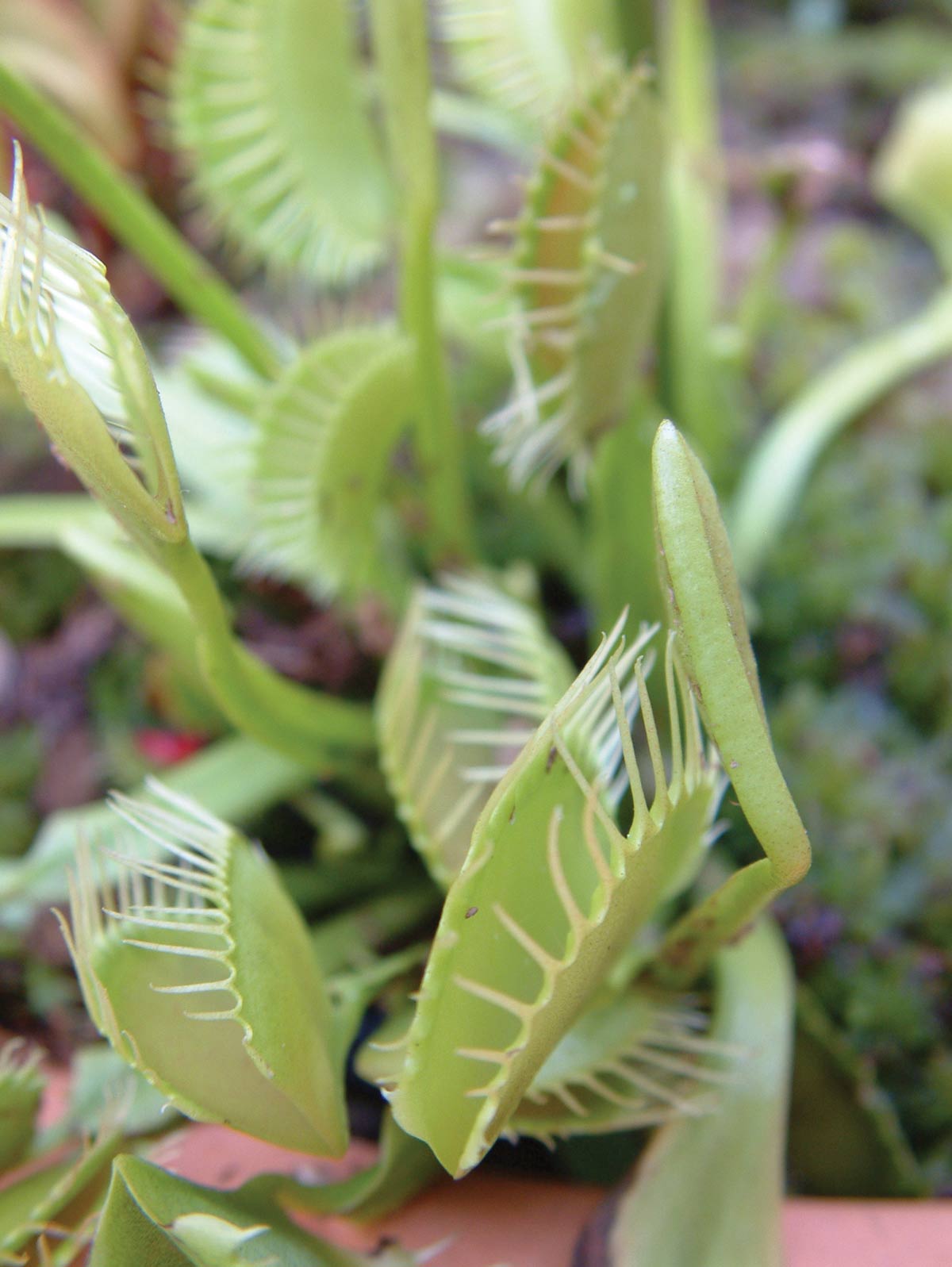
Venus flytraps have long fascinated people all around the world. But it might surprise many that they grow naturally only in a tiny part of the world, in a 1100-km (700-mile) region along the coast of North and South Carolina. They live only in humid, wet and sunny bogs, so they can’t get many nutrients from the soil. That is why they must obtain nutrition from insects. The plant is named after the pagan Roman goddess of love, and apparently by implication, seduction.
The plant grows to 20–30 cm (8–12 in) tall, produces a round cluster of small white flowers, and leaves 8–15 cm long. The leaves include the traps which can quickly fold on their midline to snap shut on an unwary insect, when it brushes against one of the six trigger hairs. Then the trap snaps shut faster than we can blink, in about a tenth of a second.1 The leaf then secretes a red sap that digests the insect in about 10 days, and opens out again when finished. After eating three or four insects, the trap withers.
Until recently, scientists had not worked out how the trap works. But now, with a high-speed camera and clever mathematics, a team led by Dr Mahadevan of Harvard University has shown how.2 The leaf changes from convex (outward-curving) to concave (inward-curving) when the trap is sprung. These researchers showed that the trap works somewhat like the way that a tennis ball cut in half can quickly flip inside out when pushed beyond a certain energy barrier.1 This elegant geometrical model makes accurate predictions, and could be scaled up to non-muscular engines.
With the flytraps, the snapping depends entirely on finely tuned geometry. If a certain ratio is too small,3 the trap will close too smoothly and not snap; if too large, then the energy barrier is too high and the leaf will take too long to snap. The closure is started when the insect brushes the trigger hairs, forcing a tiny amount of water into the leaf, quickly taking it past the energy barrier. Also, the succulent leaf has lots of water between the cells, and this quickly damps vibrations.
Even Darwin wrote a book about plants that catch insects, and called the Venus flytrap ‘one of the most wonderful in the world.’4 The lead researcher said, ‘Our study still leaves us baffled about one question that motivated him—how did this mechanism evolve?’1 and called plants ‘nature’s ultimate hydraulic engineers.’2 Of course, there is no reason to believe they evolved at all!

So how does this fit with the biblical teaching that death is the result of the Fall of Adam (Genesis 3:19, Romans 8:20–22)?
First, while insects are ‘living’ in the sense of modern Western biology, the biblical authors never considered them so. The Bible uses a specific Hebrew phrase nephesh chayyāh (נֶפֶשׁ חַיָּה = living souls/creatures) for vertebrates, but never for insects (or plants).
Second, this amazing design could have a non-predation-related function of, for example, catching scattered seeds. Indeed, some spiders even today catch pollen in their webs for food. But they must now eat insects as well, possibly because the pollen now lacks an essential nutrient.5 Before the earth and its vegetation was cursed after the Fall (Genesis 3:17), spiders may have thrived on pollen caught in webs spun for that purpose.
Third, the fly-catching mechanism could have been a latent feature programmed into the genes by the Creator who foreknew the Fall. This affected the ‘whole creation’ (Romans 8:19–22).6,7
References
- How a Venus flytrap snaps up its victims, New Scientist 185(2484):17, 29 January 2005. Return to text.
- Forterre, Y., Skotheim, J.M., Dumais, J. and Mahadevan, L., How the Venus flytrap snaps, Nature 433(7024):421–425, 27 January 2005. Return to text.
- A dimensionless geometric parameter α = L4κ2/h2, where L is leaf size, κ is curvature and h is thickness. Below a critical value αc ~ 0.8, the leaf closes smoothly; above it, it snaps rapidly. Return to text.
- Darwin, C., Insectivorous Plants, Murray, London, 1875. Return to text.
- White, T., Pollen-eating spiders, Nature Australia 26(7):5, 1999–2000; Anon., Pollen-eating spiders, Creation 22(3):5, 2000. Return to text.
- See also Batten, D. (Ed.) et al., The Creation Answers Book, ch. 6, Creation Ministries International, Brisbane, Australia; Sarfati, J. Refuting Compromise, Master Books, Arkansas, USA, 2004; Death and suffering questions and answers,
; Smith, H., Cosmic and universal death from Adam’s fall: an exegesis of Romans 8:19–23a, Journal of Creation 21(1):75–85, 2007. Return to text. - Update: see further research, Narayan, A.L., Venus flytrap inspires adaptive optics, Physicsworld.com, 4 December 2007. Return to text.

Readers’ comments
Comments are automatically closed 14 days after publication.