
Science and originsReligion and origins |
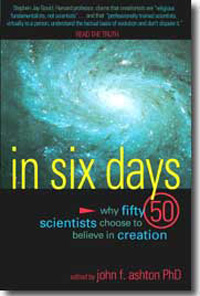
In Six Days
Why 50 Scientists Choose
to Believe in Creation
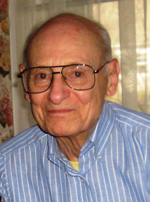
Wayne Frair, biology
Professor Frair is professor emeritus of biology at The King’s College, Tuxedo, New York. He holds a B.A. in zoology from Houghton College, New York, a B.S. in zoology from Wheaton College, Illinois, an M.A. in embryology from the University of Massachusetts, and a Ph.D. in biochemical taxonomy from Rutgers, The State University, New Jersey. He is the author of a number of research papers on turtles and also on creation-evolution topics, including the book A Case for Creation.1 He was a witness for the defense at the famous 1981 creation versus evolution trial in Little Rock, Arkansas. Professor Frair is a fellow of the American Association for the Advancement of Science and, for the years 1986 to 1993, served as president of the Creation Research Society.
My interest in Bible-science issues was amplified after I became a Christian in January 1945, while I was in the U.S. Navy during the Second World War. My personal journey into the mysteries of the origin of life began in 1946 when I was out of the navy and taking classes at the University of Massachusetts in Amherst. We were fed a diet of evolution, but I wondered if there were not other defendable positions.
In my junior year I transferred to a Christian institution (Houghton College) where I continued with a major in zoology and minors in chemistry and Bible. Here, my major professor, Dr. George Moreland, was a Bible-believing creationist, and I grew in knowledge under his tutelage. After completing a B.A. degree, I entered Wheaton College in Illinois, where I completed a B.S. degree with honors in zoology. Here I probed more into the Bible, theology, and several fields of science while working with professors who were creationists.
For one year I taught science at Ben Lippen, a Christian middle and high school. Then I returned to the University of Massachusetts and completed an M.A. degree in embryology, writing a research thesis on the effects of 8-azaguanine (the first anti-cancer drug) during a chick’s embryology.2 My advisor, Dr. Gilbert Woodside, was chairman of the Department of Zoology at the University of Massachusetts and was an evolutionist with an international reputation in embryology. He apparently did not appreciate a scientific alternative to evolution, but he declared to me very clearly that evolution was not applicable in the field of embryology. It was obvious to him that evolution actually had hurt embryological disciplines, because many fine scientists had wasted their time trying to fit data from their studies into some illusionary evolutionary scheme.
After graduation, I accepted a position as instructor in biology at The King’s College in New York, and four years later took a leave of absence to complete a doctorate at Rutgers University. My advisor there was Dr. Alan Boyden, department chair of zoology, and the world’s leader in serology. Using blood serum proteins, the professors and students in that department at Rutgers were classifying plants and animals. Another name for this field of research is biochemical taxonomy. In the implementation of a chemical approach to taxonomy (classification and naming) the Rutgers group were the pioneers.
Professor Boyden inclined to accept evolution, but actually he was very disillusioned about the value of evolution in his own field of research. He would call evolutionists “ancestor worshippers and people with a backward look.” He showed considerable concern in teaching his students not to think macroevolution in their studies involving systematics (system used for taxonomy) of plants and animals, and he even published a book against popular evolution positions.3 I did research and wrote a dissertation on the biochemical taxonomy of turtles, completing the doctorate in 1962. Then I returned to The King’s College, where I was chairman of the Department of Biology most of the time until my retirement in 1994.
My research, especially on turtles over nearly 40 years, has increased my admiration of God as Creator. Along with thousands of other scientists, I do not believe that evolution was the method that God used in creating various types of life.4 For example, there is no clear evidence that turtles ever evolved from anything else. However, there have been changes among the turtles. Actually, a purpose of my own research has been to understand better how turtles have diversified.5
The doctrine of evolution is popular, but I estimate that in the United States there are probably more than 25,000 scientists who reject the evolutionary doctrine that all living organisms are related. There are other thousands around the world who share similar feelings. Many who do not support evolution but rather prefer a creation position are Christians, but there also are Jews, Muslims, and those of other faiths (including atheism) who are anti-evolutionists and who have a variety of views regarding how living things appeared on the earth and developed their present features on this planet.
Also, as a Christian, I accept the historicity of the Bible, this being supported by much external empirical evidence, and I have found no reasons from science to reject the Bible. Of course, there are some figures of speech, such as “the rivers clap their hands” (Ps. 98:8), or when Christ called Herod “a fox” (Luke 13:32). But it has been my custom for more than 40 years, a custom which is consistent with that of conservative Christian biblical scholars, to take an inductive-historical approach to the Bible. This means that to construct our theology we start with accepting the Bible as literally and historically true, and we compare one passage with others to obtain a consensus on their meanings.
The Bible clearly does not answer every question we can concoct, but it is certainly clear on the fundamentals as found in the Apostles’ and other basic creeds. For instance, it does not clearly explain whether there is physical life outside the earth. The Bible in 1 Corinthians 13:12 tells us that we know only in part while we are in this life; so it is possible to live with some questions here on this earth, but someday in heaven we will know. In order to grow in better understanding our God’s revelation in the Bible, I have been reading completely through both the Old and New Testaments at least once a year for about 40 years.
There is much objective factual evidence (for example, from archaeology) for accepting the Bible as God’s revealed truth. But also it is very important to realize that the Scriptures deal realistically with the nature of humans. The Bible says that we all have sinned (Rom. 3:23) and need to experience the salvation made possible when Christ died for us (Rom. 5:8). We can experience biblical truths for ourselves, for example, when we realize that our attitudes to issues in life have noticeably changed following our acceptance of Christ as Savior (2 Cor. 5:17). I recall some time after my salvation experience reading the verse in Romans 8:16 that God’s spirit testifies with our spirit that we are God’s children; and it was exhilarating for me to realize that I had already experienced this glorious truth.
In our scientific studies we learn a lot about nature, which is God’s creation. Also, God reveals himself in history and our consciences, but most importantly in His inspired Word, the Bible. For a full and fruitful life, no matter what our occupation is, I believe we must live in accord with this book.
Articles
References and notes
- Wayne Frair and Percival Davis, A Case for Creation, School of Tomorrow, Lewisville, TX, 1983.
- W. Frair and G.L. Woodside, Effects of 8-azaguanine on Early Chick Embryos Grown in Vitro, Growth 20:9–18, 1956.
- Alan Boyden, Perspectives in Zoology, Pergamon Press, New York, 1973.
- Frair and Davis, A Case for Creation.
- W. Frair, Original Kinds and Turtle Phylogeny, Creation Research Society Quarterly 28(1):21–24, 1991. Also see K.P. Wise, Practical Baraminology, Journal of Creation 6(2):122–137, 1992 and D.A. Robinson, A Mitochondrial DNA Analysis of the Testudine Apobaramin, Creation Research Society Quarterly 33(4):262–272, 1997.
Readers’ comments
Comments are automatically closed 14 days after publication.