

Living fossils: a powerful argument for creation
Don Batten interviews Dr Carl Werner, author of Living Fossils (Evolution: the Grand Experiment vol. 2)

Dr Werner graduated from the University of Missouri with distinction in biology (summa cum laude). He received his doctoral degree in medicine at the age of 23 and practices emergency medicine in St Louis.
Dr Werner explained what living fossils are and why he became so interested in them, collecting photographs of these fossils over the last 14 years: “Living fossils are fossilized animals and plants that look similar to modern organisms. I became interested in living fossils as a tool to test evolution.”
“There are basically two models of how life came about: The evolution model suggests that chemicals coalesced and formed a living single-cell almost four billion years ago and then this changed over long periods of time into all other living things. Examples of evolutionary changes include a dinosaur into a bird, or a four-legged land mammal into a whale. The other model, creation, suggests that an external supernatural being (God) created all of the various types of animals and plants at once, and these organisms have changed little over time, other than variations within a basic type.”
Dr Werner’s use of ‘type’ is similar to the biblical use of the word ‘kind’ in Genesis. For example, an animal can change, but only within its kind, such as a wolf into a dog—not radical change such as a four-legged mammal into a whale.1
Dr Werner continued, “Living fossils provided me a simple way to test evolution. If evolution did not occur (animals did not change significantly over time) and if all of the animals and plants were created at one time and lived together (humans, dinosaurs, oak trees, roses, cats, wolves, etc), then one should be able to find fossils of at least some modern animals and modern plants alongside dinosaurs in the rock layers. I set out to test this idea without any foreknowledge of any modern organisms in the rock layers. My results (as laid out in the book & video Living Fossils) showed that many modern animals and plants are found with dinosaurs—far more than I ever expected to find.”
Dr Werner and his wife Debbie travelled over 100,000 miles (160,000 km) and took 60,000 photographs as they filmed the television series Evolution: The Grand Experiment. (Episode 2 of this series, Living Fossils, reveals exactly what they found.) They focused on fossils found in dinosaur rock layers, and compared these fossils to modern animals and plants.
“We looked only at fossils found in the dinosaur dig sites so that scientists who support evolution could not suggest that the fossils we looked at were not ‘old’. All of the fossils we used for comparisons were found in dinosaur rock layers (Triassic, Jurassic and Cretaceous).”
Many modern animals in dinosaur rock!
I asked Carl just how many modern types of animals he had found in the dinosaur rock layers.
“We found fossilized examples from every major invertebrate animal phylum living today including: arthropods (insects, crustaceans etc.), shellfish, echinoderms (starfish, crinoids, brittle stars, etc.), corals, sponges, and segmented worms (earthworms, marine worms).
“The vertebrates—animals with backbones such as fish, amphibians, reptiles, birds and mammals—show this same pattern.”
Modern fish, amphibians and reptiles
“Cartilaginous fish (sharks and rays), boney fish (such as sturgeon, paddlefish, salmon, herring, flounder and bowfin) and jawless fish (hagfish and lamprey) have been found in the dinosaur layers and they look the same as modern forms.
“Modern-looking frogs and salamanders have been found in dinosaur dig sites.
“All of today’s reptile groups have been found in the dinosaur layers and they look the same or similar to modern forms: Snakes (boa constrictor), lizards (ground lizards and gliding lizards), turtles (box turtles, soft-shelled turtles), and crocodilians (alligators, crocodiles and gavials).”
Modern birds
“Contrary to popular belief, modern types of birds have been found, including: parrots, owls, penguins, ducks, loons, albatross, cormorants, sandpipers, avocets, etc. When scientists who support evolution disclosed this information during our TV interviews it appears that they could hardly believe what they were saying on camera.”
Dr William Clemens, UC Berkeley, on modern birds being found in Cretaceous rock. (Clip from Living Fossils DVD)
Mammals
“At the dinosaur dig sites, scientists have found many unusual extinct mammal forms such as the multituberculates2 but they have also found fossilized mammals that look like squirrels, possums, Tasmanian devils, hedgehogs, shrews, beavers, primates, and duck-billed platypus. I don’t know how close these mammals are to the modern forms because I was not able to see most of these, even after going to so many museums.”
“Few are aware of the great number of mammal species found with dinosaurs. Paleontologists have found 432 mammal species in the dinosaur layers;3 almost as many as the number of dinosaur species. These include nearly 100 complete mammal skeletons. But where are these fossils? We visited 60 museums but did not see a single complete mammal skeleton from the dinosaur layers displayed at any of these museums. This is amazing. Also, we saw only a few dozen incomplete skeletons/single bones of the 432 mammal species found so far. Why don’t the museums display these mammal fossils and also the bird fossils?”
Many modern plants in dinosaur rock!
“In the dinosaur rock layers, we found fossils from every major plant division living today including: flowering plants, ginkgos, cone trees, moss, vascular mosses, cycads, and ferns. Again, if you look at these fossils and compare them to modern forms, you will quickly conclude that the plants have not changed. Fossil sequoias, magnolias, dogwoods, poplars and redwoods, lily pads, cycads, ferns, horsetails etc. have been found at the dinosaur digs.”

Were any modern organisms not found?
“I did not find fossils of every organism living today in the dinosaur layers, rather I found representative examples from all of the major animal phyla living today and all of the major plant divisions living today. Taking it one step further, within these bigger groups, I frequently found representatives of all of the major groups or classes within a phylum. For example, for echinoderms (starfish, sea urchins, etc.) I found fossils of all of the major types living today. Same with the insects and the crocodilians, etc. I did not find any large mammals. The largest mammal discovered in a dinosaur layer so far (live size) is 30 pounds (13 kg). Nevertheless, with so many living fossils, both plants and animals, from all of the major phyla and all of the major plant divisions, it points to stasis (lack of change), not evolution. I should also note that if you look at the serious problems with the fossil layer system (the geological column as presented by geologists today), the absence of the bigger mammals can easily be accounted for, but I will save this for a later day.”
Evolutionary story telling ‘unsinkable’?
I asked Dr Werner how evolutionary scientists deal with this evidence, given these remarkable findings. Dr Werner remarked, “If you whole-heartedly believe in a theory, you will always be able to sustain that belief—even in the face of contradictory evidence—by adding a rescue hypothesis to that theory. For example, if a scientist believes in evolution and sees fossils that look like modern organisms at the dinosaur digs, he/she might invent an hypothesis to ‘explain’ living fossils this way: ‘Yes I believe that animals have changed greatly over time (evolution), but some animals and plants were so well adapted to the environment that they did not need to change. So I am not bothered at all by living fossils.’ This added hypothesis says that some animals did not evolve. But if a theory can be so flexible, adding hypotheses that predict the opposite of your main theory, one could never disprove the theory. The theory then becomes unsinkable, and an unsinkable theory is not science.”
Different names for the same animal?
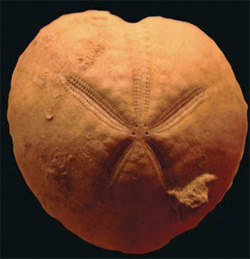
Carl related how evolutionary scientists give fossils different genus and species names from the living forms, creating the illusion of evolution: “Let me give you an example. A scientist found a fossil sea urchin in Cretaceous rock that looks nearly identical to a modern Purple Heart sea urchin, but assigned it to a completely new genus (Holaster). If you saw that creature alive in the ocean you would recognize it as a Purple Heart sea urchin (genus Spatangus). The different name suggests that sea urchins have changed over time, but this is contrived ‘evidence’ for evolution. The fossil looks the same as the living one.” (See photos right).
Evolution disproved?
I asked Dr Werner if his study disproved evolution.
“It is becoming more and more difficult for the evolutionary model to stand in the face of this great number of living fossils. Adding the many other problems with evolution (fossil record, origin of first life, geological layering problems, similarities of non-related animals, etc.), you can declare with confidence that yes, the theory is finished. If a few larger mammals were found in the dinosaur layers, it should be over even for the die-hard believers of evolution, but people tend to go to their grave with the theories they learned in college. A new generation might well look at all of this and ask, ‘What were they thinking?’ ”
References
- Sarfati, J., Variation and natural selection versus evolution, Refuting Evolution chapter 2; creation.com/rech2 Return to text.
- They were a rodent-like order of mammals, named after their teeth (multiple rows of bumps, or tubercles, on their molars). Return to text.
- See Kielan-Jaworowska, Z., Cifelli, R.L. and Luo, Z.X., Mammals from the Age of Dinosaurs: Origins, Evolution, and Structure, Columbia University Press, NY, 2004. Return to text.


Readers’ comments
Comments are automatically closed 14 days after publication.