
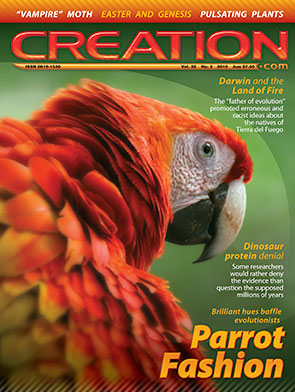
What makes us human?
Editorial
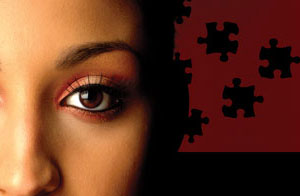
Evolutionists say that man is a “part of nature” and “has emerged as a result of a continuous process.”1 So, where do they draw the line between humans and animals?
The Bible says that man is distinct from the animals, created supernaturally by God: “And the Lord God formed man of the dust of the ground, and breathed into his nostrils the breath of life; and man became a living being.” (Genesis 2:7)
What makes us human? How we answer affects us profoundly: the way we view ourselves, how we treat others, and the laws of our land.
If we emerged through a continuous process then what qualifies to be human? The Spanish Parliament wrestled with this in June 2008 when their environmental committee approved rights to life and freedom … for great apes—rights previously restricted to people.2
In April 2008 a conference of scientists, philosophers and academics discussed this question for two days in Los Angeles.3 Does our humanness come from our capacity to communicate, our artistic skills, our poetry or our tool making? Is it in our ability to laugh and cry?
These evolutionary ideas about superior skills, superior abilities and the struggle to survive have led the world into global conflict (p. 15). And when Charles Darwin observed the limited abilities of the indigenous people of South America, he found it hard to believe they were fellow humans (p. 42).
A humanity decided on ability is a shaky foundation indeed. When do babies, who cannot speak or fend for themselves, qualify? What about those who are handicapped, by an accident, say, or with Down’s syndrome? Do they miss out?
With the rise of evolutionary philosophy in the West, the sanctity of human life has been unravelling. In 2001, the Netherlands was the first country to legalize “euthanasia”—the medical killing of the terminally ill. In 2008, Dutch doctors presided over more than 3,200 deaths including 550 deaths “without request”.4 Now, there are calls to allow physicians to euthanize “defective” or “unwanted” newborns.5
Creation affirms we are human because we are descended from Adam and Eve, whom God made in His own image. Our humanity does not depend on our abilities but on our heritage. We are human from the moment we are conceived. So human life must be cherished, and children raised to know the Creator (p. 52).
Some dismiss the story of Adam and Eve as myth. But the scientific evidence supports the biblical account, not the idea that we are related to apes (p. 46).

Creation magazine
Keep your family informed on the latest easy-to-understand evidences for creation and against evolution! This unique full-color family magazine gives God the glory, refutes evolution, and gives you the answers to defend your faith. Exciting articles and great witnessing material you won’t find anywhere else! Includes a beautifully illustrated full-color children’s section in every issue. Delivered to your home every three months! Subscribe now!
Respect for human life comes from the Christian view of man’s origin. People are valuable because we bear God’s image, as God stressed to Noah after the Flood: “Surely for your lifeblood I will demand a reckoning; … For in the image of God He made man.” (Genesis 9:5–6).
Noah’s Flood is not a myth, either. Geologist Dr Steve Austin has uncovered massive physical evidence revealing the magnitude of that cataclysm (p. 28). Even dinosaur fossils contain evidence that the global Flood was recent (p. 18).
So, enjoy this issue of Creation magazine. Marvel at the stunning evidence for creation, including the pulsating design of plants (p. 36), the aeronautical ability of dragonflies (p. 51) and the picturesque plumage of parrots (p. 12). May it strengthen your trust in the Bible. And may your confidence grow in what it means for you to bear God’s image.
References and notes
- Humanist Manifesto I, 1933. Return to text.
- Roberts, M., Spanish parliament to extend rights to apes, Reuters, 25 June 2008; <reuters.com/article/idUSL256586320080625>, 11 December 2009; see also Going ape about human rights. Return to text.
- What makes us human conference, <whatmakesushuman.info/program.html (11 December 2009). Return to text.
- Craine, P., Former Dutch health minister admits error of legalizing euthanasia, Life Site News, 2 December 2009; <lifesitenews.com/ldn/2009/dec/09120207.html>. Return to text.
- Ideas promoted by evolutionary “ethicist” Peter Singer. See Blurring the line between abortion and infanticide?. Return to text.
Readers’ comments
Comments are automatically closed 14 days after publication.