

Culture clash

When the first European explorers set foot in Tasmania, the large island-State off the south-east coast of mainland Australia, the local Tasmanian Aboriginal people seemed to have only a few ultra-basic ‘Stone Age’ type implements.
The way anthropologists commonly tell the story (as reflected in a major Discover magazine article1) they appeared to know nothing about simple devices which just about all other tribes had—such as friction tools to light fires, bone needles to sew clothes, and the like.
Despite the cold climate of this massive island, they would go around naked apart from being smeared with animal fat.
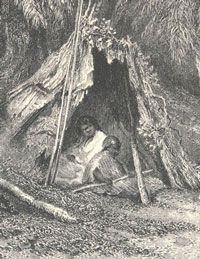
Having no way of starting a fire, they had to carry burning firebrands with them (from previous campfires or lightning strikes). Their shelters were mostly crude windbreaks of bark and branches, and their stone axes (unlike those of mainland Aborigines) had no handles.
Nor did they seem to have any of the spear-throwers, boomerangs, or fish-catching technology common on the mainland. Even though many lived on the coast, the idea of eating fish seems to have been regarded by them as odd.
Two views
Assuming for the moment that this widely held picture is accurate, how did this situation arise?
There are two basic responses. One is to look to revelation. The Bible teaches that all the peoples living on earth today have descended from Adam through Noah’s family. Their ancestors, having been dispersed from Babel, lived in a city-building culture, obviously more sophisticated than the simple ‘Stone Age’ technology of many later peoples, not just the Tasmanians. So on biblical authority, all such people must have lost or abandoned some of their ancestors’ technology.
Suddenly losing the ability to communicate with most other groups of people, even to read one’s own writing, would have plunged most people into an ‘instant Stone Age’ at Babel.2 The resultant fear, confusion, suspicion and subsequent hostility would have caused many family/language groups to quickly move away from the turmoil. Creationists have long pointed out that of all the small groups under such migration pressure, only some would take all the ‘know-how’ of their previous society with them.3
For those thus stripped of much of their old society’s technology, a cave is a logical place to seek shelter, and a stone-based technology still serves some societies well today. There might have been little need to rediscover ore bodies or reinvent lost smelting and forging techniques, for example (Genesis 4:22). In time, some would invent new implements and strategies, perhaps more suited to the needs of their new environment. The Tasmanian culture, for example, was actually highly adaptive for that locality, as we shall see.
The other idea
Unfortunately, most of the early European settlers in Tasmania did not allow their reason to be guided by revelation. Since in their (and our) experience, cultures keep on adding technology, it was ‘obvious’ to the settlers that whatever ancestors the Tasmanians had did not possess the intelligence to invent anything more than the crude implements they now had—therefore the Tasmanian Aborigines were regarded as subhuman.
Although this was before Darwin, evolutionary ideas were not uncommon. Darwin’s grandfather had his own theory of evolution. Many assumed that the reason Tasmanian society was low-tech was because they were not far removed from animal ancestors.
For example, Travers writes that the early settlers would scarcely allow the Tasmanians to hinder their expansion since they would have heartily agreed with a Captain Betts that they ‘may almost be said to form the connecting link between man and the monkey tribes’.4
Technological loss
Evolutionists believe that the Tasmanians migrated from mainland Australia on foot5 when sea levels were lower during the Pleistocene Ice Age, at a time when mainland Aborigines had many things which the Tasmanians were not seen to have when Europeans arrived.
Of interest for the creationist model is the evolutionist conclusion that small migrating groups can easily leave some aspects of their technology behind. Furthermore, it appears that even after their arrival, the Tasmanians actually lost some very significant aspects of technology.
They may possibly not have used bone tools to make clothes or go fishing when Europeans came, but generations earlier they did. Such implements have been found in Tasmania, making this claim ‘indisputable’, according to the author of the Discover magazine article.1
All this fits very comfortably with the biblical view of history. There is a general trend that societies at the outer limits of the post-Babel radiation from the Middle East are more ‘low-tech’.
Another factor
The alleged technological ‘primitivity’ of the Tasmanians has been greatly exaggerated in the mainstream view. Lingering evolutionist bias undoubtedly plays a role, as well as the fact that their culture was largely destroyed before it was well recorded.
In a rare 1837 book by Jorgen Jorgenson, who lived with the Tasmanians, he records that they certainly did know how to make fire.6 However, the general dampness of wood in Tasmania’s harsh, rainy climate made it more practical to carry embers from one camp-site to the next. The ‘burning brand’ carried was actually an efficient tool used to systematically burn off the forest floor, to promote new undergrowth and assist with hunting.
Tasmanian culture was actually extremely adaptive. In an island with almost a complete absence of indigenous grains, nuts and fruits, and notorious for sudden, freezing local squalls, high mobility was crucial. It made sense to carry little and not to invest much cultural energy in shelters. However, in certain parts of the State, they did construct substantial and cleverly designed huts, even with steamed and bent supports.
The squally weather meant clothing could be a disadvantage. Many Tasmanians died of pneumonia after clothing pressed upon them by well-meaning Europeans became rain-soaked.
A contemporary observer reported that the Tasmanian Aborigines did know how to make clothes, but only used them at times of sickness. “Their dress, in case of illness, was a kangaroo or an opossum skin with the woolly side in, laced together by sinews drawn from the kangaroo’s tail. In health and in fine weather they wore nothing.”7 It is not known whether the skin was sewn with wooden implements or small slits made with a stone knife and then the sinews threaded.
What about the lack of boomerangs? These were actually not much use in Tasmania’s dense forest. However, their skill with a throwing club was recognized. “They could kill animals with dexterity by throwing either spear or waddie.”8 Also, with an abundance of ‘tidal protein’ in the form of large oysters, mussels, abalone and crayfish, why continue to divert cultural resources into chasing after finned fish?
[The Discover magazine description of primitive unseaworthy watercraft appears to reflect early biased reports. Others have reported their watercraft being seaworthy in big storms many miles out to sea. It appears that the effort and care put into building the watercraft depended on its purpose. Ability to build these craft may also have varied between individuals.9]
One could go further, but the point should be clear. These were not half-evolved primitives, but fully human descendants of Noah. Forced to cope with an unusually harsh environment, they developed a highly specialized society, abandoning non-adaptive aspects of their technology in the process.
Before and after Darwin, this false evolutionary equation, that low-tech means ‘sub-human’, was an easy justification for the sinful, racist and incredibly brutal treatment (including rape, torture and slaughter) of these people. The Tasmanians were regarded as ‘wild beasts whom it is lawful to extirpate’.10
Then, as now, such ‘scientific’ views contaminated large segments of the Church, with the result that “clergymen in the early days of the colony ignored the aborigines, believing them to be so far beneath the level of humanity as to be not worth teaching”.4
Ideas have consequences
After Darwinism’s rapid triumph, Aborigines’ body parts were, because of their seemingly simple culture, perversely regarded as highly prized specimens of ‘missing links’ and eagerly sought by evolutionary scientists. It has been well documented that deliberate slaughter for ‘science’ was encouraged.11 The Tasmanians, having even fewer ‘tools’, and thus supposedly ‘closer to the animal’, were the most prized specimens. By the late 1870s, with the death of the last full-blood Tasmanian, their genocide was complete.
Then, as now, the Christian Church should have made a bold stand against all ideas which reject the real history of the world given in Genesis. What a difference it can make!
Acknowledgement
The research and insights of environmental scientist David Langlois of Hobart, Tasmania, were invaluable in the preparation of this article.
References and notes
- Diamond, J., Ten Thousand Years of Solitude, Discover, pp. 4, 49–57, March 1993. Return to text
- I owe this turn of phrase to physicist Dr Russell Humphreys. Return to text
- Imagine breaking our present-day society into small, family-based segments. Many such groups would not include anyone with the know-how to build a computer, a space-rocket, or even to get metal from ores, even though their society before break-up featured all that technology. Return to text
- Travers, R., The Tasmanians—The Story of a Doomed Race, Casella Australia, Melbourne, 1967. Return to text
- This may be open to question, with some suggesting that they were a different group of people altogether who arrived by sea. Future DNA studies may help resolve this. Return to text
- Jorgen Jorgenson and the Aborigines of Van Dieman’s Land, edited by N.J.B. Plomley, Blubber Head Press, Sandy Bay (Tasmania), reprinted in 1991, after being lost for years. Return to text
- Hull, H.M., Lecture on the Aborigines of Tasmania, Mercury Steam Press Office, Hobart (Tasmania), p. 13, 1870. (This lecture was presented by the Clerk of the House of Assembly, Hugh M. Hull, at the Mechanics’ Institute, Hobart, on October 28, 1869.) Return to text
- Hull, Ref. 7, p.15. Return to text
- Meston, A.L., The Tasmanian—A Summary, Rec. Queen Vic. Mus. II.3., August 15, p. 150, 1949. Return to text
- Turnbull, C., Black War: The Extermination of the Tasmanian Aborigines, F.W. Cheshire, Melbourne, 1948. Return to text
- Darwin’s bodysnatchers, Creation 12(3):21, June 1990; Wieland, C., Darwin’s bodysnatchers: new horrors, Creation 14(2):16–18, March 1992; Monaghan, D., The body-snatchers, The Bulletin, November 12, 1991, pp. 30–38. Return to text


Readers’ comments
Comments are automatically closed 14 days after publication.