

Forests that grew on water
Startling hard facts from coal uproot the ‘millions of years’ idea
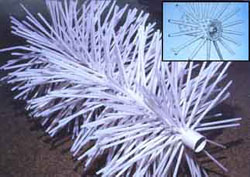
Fig. 1. Model and diagram (inset) of the central stigmarian root with radial appendices. Such a pattern is found in floating, not land, plants.

Fig. 2. Cross-section of stigmaria in shale showing spreading apendices.

Fig. 3. Reconstruction of Lycopod stembase.

Fig. 4. Erect cast of hollow Lycopod tree, Joggins, Nova Scotia, 1981.

Fig. 5. Fossil grove, Glasgow. The outer rind has gone, leaving a cast of the hollow interior (stem and roots).

Fig. 7. Sand-filled appendix (scale in millimeters, dark line retouched). Inset: Groove in fossil stigmaria from collapsed central cylinder.

Fig. 8. Fossil stigmarian root—the scars are where appendices were shed.

Fig. 9. Close-up from coal ball section—arrow shows where appendix is about to be shed (thin whitish layer).

Fig. 10. Rock with appendices (top arrow) and well-preserved fern fronds (bottow arrow).

Fig. 11. Appendices in limestone (a drop of HCL is reacting vigorously with it).

Fig. 12. Drawings from real trunks in various European museums.
In some parts of the world, we find many seams of coal separated by other rock layers, in repeated sequences on top of each other. In one part of Germany’s Ruhr district, for example, one can count up to 230 such separate coal seams from bottom to top. If, as is claimed, the coal in each seam formed from plants which grew in the same place as where the coal is now found, then obviously the whole thickness must have taken a very, very long time to form.
In the so-called ‘Carboniferous’ Euro-American coals of the Northern Hemisphere,1 people such as the lawyer-geologist Charles Lyell (whose book had a tremendous influence on the young Darwin) were able to point to what seemed like solid proof that the vegetation had indeed grown right in that spot. Under each of these coal-seams, there is a layer of rock, interpreted as a ‘root-bed’, or fossil ‘soil’.2 This contains many fossilized roots of trees commonly found as fossils in and above the coal. It seemed logical to suppose that this rock was once the soil in which these roots were growing while the coal-swamp was forming. If so, then this coal could not have formed as would be inferred from the biblical record of history, from plants washed in from elsewhere and buried.
Rejecting the Bible
This claimed evidence of a great age for coal was one of the factors which caused many people, including Darwin, to reject the Bible’s account of recent creation and a great Flood. Belief in a long age for the earth became firmly entrenched, even among many godly Church people. This gave rise to strained and unnatural new ways of ‘reinterpreting’ Genesis, such as the ‘gap’ theory, ‘day-age’ theories, and so on. It also laid the groundwork for the later widespread acceptance of the idea of evolution.
The staggering fact, however, is that a close look at these ‘root-soils’ shows the very opposite: the vegetation which formed the Euro-American coals did not, and could not, have grown in place. In fact, the roots of these now-extinct trees3,4 were not growing in soil at all, but floating in water!
The name given to the fossil roots found in these layers is stigmaria. Attached to these, we often still find the secondary roots, or appendices. These were arranged in life as shown in Fig.1, coming out like spokes from a central hub.
The evidence that these coal forests grew on water
1. Such a ‘radial’ root pattern is only found in water plants.
Water in soil moves downwards under the influence of gravity, so roots growing in soil are designed to send their secondary rootlets in that direction, away from the soil surface. By contrast, the rootlets of plants floating in water today (equally likely to get a ‘drink’ whichever way they head) grow straight out from the main root in all directions, just like the stigmarian appendices. Fig. 2 shows this pattern in fossil specimens.
2. The trees were almost entirely hollow inside.
Fig. 3 is a diagram of the trunk construction of one of these trees. With mostly air between the central cylinder and the outer rind, they would have been extremely lightweight. In Fig. 4, the hollow interior of the tree has been filled in with sediment, leaving a ‘cast’ of the inside of the tree after the rind has rotted away. Fig. 5 is the famous ‘fossil grove’ in Glasgow. These stumps are actually not petrified wood, but are the result of sediment filling the hollow interiors of these lycophyte trees. Note how the cavity of the main stem is continuous with the interior of the large stigmarian ‘roots’.
3. The roots and the rootlets were also hollow.
Not only were the stigmaria themselves hollow, but even the secondary rootlets (appendices) were hollow (see Fig. 1). Air-filled roots in floating plants make sense, but not in soil.
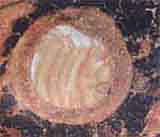
Fig. 6a. Close-up of cross-section of an appendix (from Fig. 6b); agate-like bands of calcite fill its hollow interior

Fig. 6b. Partly sectioned coal ball
‘Coal balls’, found in and around coal seams, are pockets of the original coal-forming vegetation (or peat) and water, which were then infiltrated by minerals (carbonates or iron oxides). This prevented compression and coalification, petrifying and preserving the peat tissues, enabling better study of them. Fig. 6a shows calcite filling the hollow interior of an appendix in such a coal ball (Fig. 6b).
In Fig. 7, the hollow interior of an appendix has been filled with a cast of sediment. The inset shows how compression of the tissue of the thin central stigmarian cylinder (while the sediment was still somewhat soft) by the overburden has caused a groove to form at the upper surface.
4. The appendices were designed to be cast off.
The very word stigmaria comes from the characteristic stigmata, or scars, apparent on the outside of these root structures. After an appendix has been shed, like a tree drops its leaves in autumn, one of these pockmarks is left on the surface. No land plant is known to us which sheds secondary roots of anywhere near such thickness (Fig. 7) into soil. Fig. 8 shows a fossil stigmarian root with its characteristic scarred exterior. Fig. 9 shows a remarkable close-up section, from a coal ball, of an appendix on the verge of being shed, showing the ‘abscission layer’ where the separation was about to take place.
Further evidence against the ‘slowly growing swamp with root-soil’ idea
1. No rot in accompanying fossils.
Fig. 10 shows, in the same specimen of this alleged ‘root-soil’, fossil appendices and a fossil fern frond showing no sign of decay. If the roots are interpreted to mean that this rock was originally the soil for a forest growing on it, the fern would have been quickly converted to compost. The well-preserved fossil fern in the same rock thus indicates that both fern and roots were rapidly covered by sediment.
2. Many evidences of high-energy sedimentation in these layers.
This allegedly petrified ‘soil’ often shows such things as cross-bedding, underwater ‘duning’, and even ‘slump’ marks showing that one layer of sediment was deposited while the one beneath was still soft. Undisturbed layering around the stigmarian roots is consistent with their sedimentary burial, not with the intrusion of roots into an already layered soil.5
3. Fossilized stigmaria are found in too wide a range of rock types.
Stigmaria/appendices, while often found in sandstone, can also be found in limestone (Fig. 11). If these rock types were originally, before hardening, the ‘soils’ in which the roots grew, it would mean that this one group of extinct plants, then covering huge areas of the earth’s surface, was tolerant of a range of soil types vastly greater than knowledge of living plants today would indicate.
Reconstruction of the floating forest
Fig. 12 is a drawing, based on fossil evidence, of how such lycophyte trees would have had their roots intertwined, supporting each other while floating. Fallen leaves and debris would have been caught in this mat, providing a nutrient substrate for the ferns and other species now also found fossilized with these coals. Such a mat (later upon burial to become the coal seam) of living roots, fallen debris and living small plants, would have had substantial structural integrity, its flexibility resisting easy rupture. It would have been buoyant enough to support these ultralight hollow ‘tree’ trunks, aided by the many air-filled appendices twining through it (as shown by coal ball sections).6,7
Burial of floating forests
The Flood of Noah would have involved great turbulence, erosion, sedimentation and subsidence in association with the ‘fountains of the great deep’, the rising waters, volcanic activity and earth movements. One can envisage (in addition to the sinking of waterlogged mat debris) portions of relatively intact mats being successively broken off and beached, only to be covered by sediment. Since these forest mats would usually be entombed ‘right side up’, it explains why the stigmaria are generally underneath the coal, but not so the roots of the other plants; they were not dangling in water (as were the roots of the hollow lycophytes), but growing in the higher-level ‘nutrient mat’ (which then became the coal layer).

The usual slow-and-gradual philosophy of earth history actually has difficulty explaining why we have such large ‘stacks’ of layers (called cyclothems) in which the coal and the other rock types are repeated in essentially the same or similar sequence over and over.8 However, cyclic waves of sedimentary activity during the Flood like that described below (see Fig. 13), provide a viable explanatory framework.
Conclusion
The evidence that the vegetation which formed the ‘Carboniferous’ Euro-American coals was not ‘grown in place’, but consisted of huge mats of floating forest washed into place as part of a sedimentary sequence, is not just suggestive, it is overwhelming. The fact that such obvious evidence continues to be overlooked or ignored speaks volumes. The idea of ‘root-soils under coal’ greatly helped to undermine the acceptance of God’s Word by establishing the concept of long ages (which are also a necessary underpinning for evolutionary belief). It has been shown that this idea is without foundation, and that the facts are much more in accordance with the record of earth history given in the Bible.
Acknowledgment
This article was based on original research, insights and photos of German creationist Dr Joachim Scheven. Many more details and photographic illustrations are featured on Dr Scheven’s video Coal, Catastrophe and Floating Forests.
References and notes
- As opposed to the (so-called Permian) ‘Gondwana’ coals of S. Africa, Australia, India, Antarctica, etc. Return to text.
- Also known as an underclay or seat-earth. Return to text.
- Mostly the extinct club mosses and their allies (all Lycophytes) such as the genus Lepidodendron, also Sigillaria and Lycopodites. Some of these trees reached sizes of up to 30 metres (almost 100 feet) high, with trunks one metre (three feet) in diameter, and leaves one metre long. Return to text.
- Gondwana coals (e.g. the Sydney-Bowen Basin ‘Permian’ coals) have a different type of fossilized vegetation. ‘Root-soil’ claims are made in association with some of these coals because of the existence of occasional apparent ‘root’ structures called vertebraria. However, these have not been found attached to any tree, while other evidence is contrary to the ‘root-soil’ hypothesis. The (unrelated) massive ‘Tertiary’ brown coal beds of Yallourn and Morwell, Australia, being underlain by clay derived from volcanic ash rather than any ‘root-soil’, cause even more difficulty for long-age explanations. Return to text.
- On-site evidence is shown in the video by Dr Scheven, Coal, Catastrophe and Floating Forests. Return to text.
- In fact, such large forest mats, covering a huge area of the pre-Flood seas, would have been able to host an entire (possibly unique) ecosystem, including vertebrates. This adds new possibilities to ecological explanations of fossil zoning in Flood geology models. See the forthcoming paper on this by Dr Kurt Wise in the Journal of Creation. Return to text.
- After Dr Scheven had come to the floating forest conclusion based on his own research, it was interesting to discover that evolutionist botanist, Otto Kunze, had concluded this in his 1884 book, Die vorweltliche Entwicklung der Erdkruste und der Pflanzen. Phytogeogenesis. He was ignored; perhaps it would have been too damaging to the ‘millions of years’ idea. Return to text.
- The main problem they have is explaining the cyclic repetition of the same or similar sequence of conditions (sediment type A is laid down (becomes ‘root-soil’ A), then a swamp-forest B grows on it forming peat that later becomes coal layer B, later covered by sediment of type C followed by type D, E, etc., sometimes up to I). Various combinations (but always beginning with AB, and generally in the same order, though some might be omitted) are repeated up to hundreds of times, over and over in the same place, even the same vegetation type, throughout vast ages. Long-agers have attempted to apply the analogy of repeated marine incursions over some present-day river deltas or coastal swamps. However, the analogy breaks down because inexplicable repetitive changes in land and sea levels are required, and because the lateral continuities of sediment and vegetation types commonly seen in coalfields over large distances are not found in such deltas or swamps. Return to text.


Readers’ comments
Comments are automatically closed 14 days after publication.