
Genesis: The Missing Piece of the Puzzle

Most church leaders would agree that the western world is becoming ‘less Christian’ every year.
Worldviews
Nations once built upon biblical foundations are watching the collapse of godly values in our culture and Christians seem powerless to stop it. Competing worldviews like atheism, humanism, communism, new age, and the occult are being vigorously promoted in education, the media and one-on-one to children and adults alike.
With so many areas for the church to deal with we need to ask ourselves, how do we make a difference? Where do we focus our efforts? Did this happen by chance, or is there a deeper issue? Church leaders are busy with programs, counselling and such but it seems as though something’s been lost. It’s like a giant puzzle, and the church can’t seem to find the ‘missing piece’.
When things are crumbling around us we need to go back to basics. Without a strong foundation, a structure will eventually erode and collapse. Psalm 11:3 says, ‘If the foundations be destroyed, what can the righteous do?’ This verse should cause us to examine our foundations, which may lead us to a better realization of why we face the issues we do.
Atheistic worldview
But before we look at our own foundations, let’s look at those of the polar opposite of the Christian worldview—atheism. A-theism, by definition, states foundationally that there is ‘no God’. All worldviews provide answers to the big questions in life like ‘Where do we come from?’ How do atheists explain our origins without God? Their answer is evolution. This gives them an explanation for our existence without God—naturalistically. Briefly stated the grand theory of evolution embraces the following.
Cosmic evolution

Billions of years ago time, matter and energy came into existence as the result of the ‘big bang’. Over billions of years the galaxies, stars and planets formed—all by themselves.
Geological evolution
The earth started as a hot molten orb, eventually cooling down enough for water to condense and fill the oceans.
Chemical evolution
After some time the first self-replicating life form spontaneously generated from non-living chemicals.
Biological evolution
This simple organism became more complex over millions of years via genetic mutation and natural selection, ultimately producing all of the life forms that have ever existed on our planet.
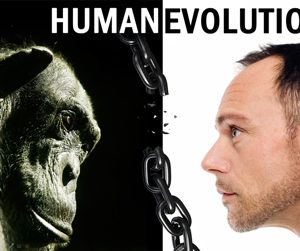
Human evolution
Eventually ape-like creatures developed higher brain functions and humans evolved, forming societies and cultures that developed laws, religions and institutions like marriage. Evolutionists point to the geologic column and the fossils it contains as ‘scientific proof’ of these processes.
Heat death
Because the entire universe is subject to the laws of entropy, the future ultimately is ‘heat death’, where there will be no more available energy. No life will exist, and perhaps everything will collapse and begin all over again.
No ultimate hope
The atheistic worldview, based on this supposed history, says that we had an accidental beginning; we developed through random processes and that there is no ultimate hope for the future. It says that there are no absolutes, no basis for morality or ethics outside of what each person decides is right for themselves.

Atheism vs. theism is sometimes misrepresented as ‘science’ vs. ‘faith’. This is untrue because evolution is a worldview that is also based on faith. In fact, evolutionists and creationists have the exact same scientific facts to examine. There isn’t a scientific observation that a creationist would disagree with an evolutionist about. Creationists disagree with evolutionists conclusions because we do not agree with their starting presuppositions.
The real difference is that of the world history that each group believes in, by faith. Why by faith? Because we cannot travel back in time to see the first life form evolve or observe God create the universe. So our understanding of what happened in the past is ultimately accepted by faith. We can use scientific methods to observe evidence in the present, and then make an assessment of which history is best supported by that evidence.
The key piece of the puzzle; Christ died for our sins
Many Christians believe the creation/evolution issue to be a side issue, an unprofitable area on which to focus. To many it seems divisive, and has little relation to proclaiming the Gospel.
To find out if this is a side issue or not, let’s move to the core teaching of virtually all evangelical churches. Almost every Christian would agree that the key piece of the Christian worldview is our Saviour, Jesus Christ. The Bible says that Jesus became the ‘last Adam’, died on a cross for the sins of the world and paid the penalty that we deserve, so that on judgement day we won’t suffer eternal separation from God in hell.

Virgin birth
Traditions like Christmas arose from the event of Jesus’ birth, foretold in the Old Testament. Christ was ‘born of a virgin’, the sinless Son of God, perfect in every way so that he was able to take on the sins of the world as the only suitable sacrifice.
Resurrection
Easter Sunday is the Celebration of Jesus’ resurrection, the demonstration of his victory over sin and death. Jesus acknowledged the link between these ‘earthly’, real time/space events relating to spiritual truths when he spoke to Nicodemus about being born again.
Jesus says; ‘I have spoken to you of earthly things and you do not believe; how then will you believe if I speak of heavenly things?’ (John 3:12) The Bible makes it clear that if these events didn’t actually occur we are still lost in our sins, our faith is in vain, and we are to be pitied above everyone.
But why was the crucifixion necessary? Why did Jesus have to suffer such a horrible death? To understand this we must return to the foundations of our faith, rooted in the Old Testament. Jesus acknowledged the authority of the O.T. each time he said ‘It is written … ’ or ‘Have you not read … ’
The book of Genesis gives us a clear understanding for the reason Jesus came. It was to fix the problem caused by the head of the human race, the first Adam.
Creation
The Bible describes God’s creation of a perfect world, a paradise where everything was ‘very good’. Genesis 1:29 says that man and animals ate plants (there were no carnivores) and therefore no bloodshed. There was no sin, corruption or death.
The Fall

God gave Adam a command that he should not eat from the fruit of the tree of knowledge of good and evil, and told him that death would be the consequence should he do so. Unfortunately, Adam chose to exercise his free will in clear rebellion against God.
As a result, God cursed the earth, and suffering and death entered the world. Because Adam was the head of the human race his sin nature was passed on to all his descendants. Romans 5:12 says, ‘Therefore, just as through one man sin entered into the world, and death through sin, and so death spread to all men, because all sinned … ’
Mankind is now separated from God, not just able to die physically, but spiritually dead as well.
Judgment
In Genesis 6 we read how God judged the wicked in a global flood where ‘ … all the high mountains under the entire heavens were covered.’ (Genesis 7:19) This judgment was sent specifically to destroy everything living on land, except for righteous Noah, his family, and representative kinds of land animals on board the great Ark. This is a perfect cause-and-effect explanation of the fossil record, the billions of dead things buried in sedimentary rock all over the earth.
This parallel to the coming judgement is spoken of in 2 Peter 3:6 and 7: ‘By these waters also the world of that time was deluged and destroyed. By the same word the present heavens and earth are reserved for fire, being kept for the Day of Judgment and destruction of ungodly men.’
The Law
After this God established the Law through Moses, which taught right from wrong and social doctrines. Most importantly it showed that mankind could never reach God’s standard, that ‘all have sinned, and come short of the glory of God.’ (Romans 3:23) Paul says ‘ … I would not have known what sin was except through the law.’ (Romans 7:7) The knowledge of sin and judgment leads people to seek mercy at the cross of Christ.
Restoration
The blessed hope of the Bible is the time after God’s coming judgment when He will restore the earth to the way it was in the beginning as far as sin and death is concerned. There will be ‘ … no more death or mourning or crying or pain … ’ (Revelation 21:4) We will get new, incorruptible bodies. The last enemy, death, will be destroyed …
Foundational knowledge—transforming power—blessed hope
Perfection, corruption, judgement, salvation and restoration. This is the ‘big picture’ of the history of the world and humanity as it has been taught and accepted by the Christian church for some eighteen hundred years now. Up until about 200 years ago in the western world, even most non-Christians accepted this history. So what changed? Does this have any bearing on the struggles the church is facing?
Around 200 years ago the concept of ‘millions of years’ started to gain popularity when certain people reinterpreted the rocks and fossils, not as a result of Noah’s Flood, but as a record of millions of years of history. The idea of a long-pre-history ‘recorded’ in the rocks paved the way for Darwin’s theory of evolution—its mooted slow step-by-step processes needing eons of time, which ‘long-age’ geology provided.
Today this long-age history of the world is promoted by virtually all public educational centres. Many Christians have adopted portions of this ‘history’ and attempted to reconcile it with the Bible. Many wonder if God may have used evolution, or if millions of years of evolutionary processes are compatible with the teaching of Scripture. Some people feel that science and religion are two separate areas of thought and that the Bible has no bearing on the real world. Many simply believe it’s a side issue.
Contrasting worldviews

Let’s look at just one aspect of the evolutionary story and see how it impacts Christian theology. Many Christians that may not believe in evolution of animals and man per se still believe in millions of years of earth history. But the idea of millions of years comes from an interpretation of the sedimentary rock layers all over the world, which are assumed to have been deposited slowly, and which contain fossils.
Where do you fit the ‘Millions of Years’?
Virtually no one would attempt to fit these millions of years of history after the account of Adam and Eve. They try to fit it into the Bible before Adam and Eve appear on the scene. But if that’s true then we must reconcile the fossil record, which is a record of death! Palaeontologists have even discovered carnivorous activity, cancerous tumours and thorns in the fossil record.
Death before sin
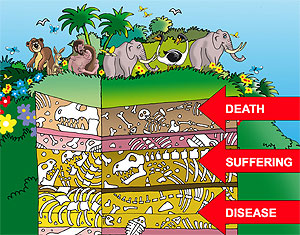
This has massive theological implications. When we accept the idea of millions of years we are saying that there were millions of years of death, disease and bloodshed before Adam sinned. But this contradicts the clear teaching of the Bible where God pronounced His completed creation ‘very good’ and where death occurred because of the event of Adam sinning.
When we put millions of years of time into the Bible like this, suddenly portions of Scripture make no sense; Romans 6:23 ‘ … For the wages of sin is death … ’ If death occurred before Adam sinned, what are the wages of sin? Romans 5:12 ‘ … by one man sin entered into the world, and death by sin … ’ Death could not have entered because of Adams sin if it was there already. Hebrews 9:22 ‘ … without the shedding of blood there is no forgiveness … ’ What would the shedding of blood have to do with forgiveness of sin if bloodshed had been occurring for millions of years?
This affects the Gospel

This directly affects the Gospel message because Jesus was sent to repay the debt that Adam’s sin brought. Jesus died a physical death, shed His blood, conquered sin and death and promised to return again and restore the world to the way it was ‘in the beginning’. If millions of years of bloodshed occurred prior to man’s sin, what will God restore the world to in the future?
If the world really is millions of years old then the creation account seems more like mythology than history, but this is inconsistent with Jesus’ teaching. He gave a direct endorsement to, and a warning against disbelieving, the writings of Moses in John 5:46–47 when He said ‘If you believed Moses, you would believe me, for he wrote about me. But since you do not believe what he wrote, how are you going to believe what I say?’
Most non-believers today deny the writings of Moses, and so reject the teaching of Christ. Creation is thought of in evolutionary terms; sin is ‘something fun’, the law is no longer ‘right from wrong’ but whatever you decide. And the belief in a global Flood is almost universally rejected.
For Christians, denying the writings of Moses but clinging to the teachings of Jesus is inconsistent thinking. Unfortunately, atheists seem to understand these inconsistencies more than most Christians, and capitalise on them when trying to undermine the Christian worldview and promote their own. Look at the following quote from atheist Richard Bozarth from the February 1978 issue of American Atheist:
‘It becomes clear now that the whole justification of Jesus’ life and death is predicated on the existence of Adam and the forbidden fruit he and Eve ate. Without the original sin, who needs to be redeemed? Without Adam’s fall into a life of constant sin terminated by death, what purpose is there to Christianity? None. What all this means is that Christianity cannot lose the Genesis account of creation … Christianity is fighting for it’s very life.’
Not a side issue
Far from being a side issue, the creation/evolution debate is at the forefront of the assault on the Christian worldview. Creation Ministries International exists to help pastors and church leaders equip their congregations in this vital area of origins from a God honouring, ‘Bible first’ perspective.
Most Christians have questions about science and the Bible, and many struggle with their faith because of them. Witnessing can be difficult because the world asks tough questions in these areas and many Christians feel ill equipped to answer. Many times it is hard to share the Gospel of Jesus because of questions that arise from the books of Moses.
What about dinosaurs? Where did Cain get his wife? How do you know there’s a God? What about evolution? Could Noah get all the animals on the Ark? Was the flood global? What about dating methods?
Equipping the church
CMI’s expert speakers, many of whom are PhD scientists, accept invitations from churches to present answers to these and many other questions in a professional, non confrontational manner, while never straying from the authority of Scripture.
They can show your congregation many examples of how science supports what the Bible says in Genesis. The presentations are fast-paced with PowerPoint graphics that hold the attention of everyone from Jr. High and up.
From testimonies that we have received over 30 years of ministry a pattern has developed. After meetings people become excited about the word of God, see that it can be defended logically, and begin witnessing with more boldness.
If you’re interested in booking one of our speakers1 or would like more information you can contact/email us
References
- CMI speaker presentations demonstrate that there are straightforward answers to the common objections and queries people have relating to the creation/evolution issue, which are some of the most frequent objections to faith in Christ. For further info, see under ‘Speaking and direct ministry’ on the What we do page. Return to text.

Readers’ comments
Comments are automatically closed 14 days after publication.