
Feedback archive → Feedback 2009
Gospel Dates and Reliability

MH from Taiwan writes about Lita Sanders’s article over this year’s Resurrection Weekend, The Resurrection and Genesis, asking about how we know the dates of the New Testament books. The author explains.
I want to start by saying I agree with most of what has been said in this article, (that’s not important overall, as whether I agree or not is not that relevant to scripture’s truth), though I would like to know how one could say, with absolute certainty (read, “Were you there?”), that the gospels were written decades after the resurrection? That has been a sticking point for me for years.
Bible scholars can say little with absolute certainty when trying to reconstruct the timeline of authorship for the documents which make up our New Testament.1 There are debates as to when the Gospels were written; some would like to date them earlier, and some a bit (or much!) later. The dates I cited in my article are somewhat mainstream / conservative estimates for the authorship of the Gospels (and from major in-depth commentaries), but one can find people who date Mark in the late 50’s AD and John in the early second century who are not outside mainstream scholarship.
None of the Gospels come with dates attached to them; we get some information from the testimony of the Church Fathers. Some were there—even knowing the Apostles themselves, and passing on a lot of reliable accounts for early Church history. Their testimony is not infallible (especially when, as in the case of the tradition about Mark, the tradition is recorded over a century after the Gospel was written2,3), but it serves as a valuable starting point when we are looking for information about the Gospels’ authors and dates, and shouldn’t be dismissed lightly.
There are also clues hidden in the text itself that can be used to date it. For instance, when we see a prediction in Matthew that the Temple will be destroyed (Matthew 24:1– 2), with no mention of that prophecy’s fulfilment, this can be taken as evidence that the document was written before the Temple was destroyed.
Note that this is not an argument from silence, but one of conspicuous absence. Matthew so often cited a fulfilled prophecy that it would be an uncharacteristic omission. If Jerusalem had fallen when Matthew wrote, there would surely have been something like “and it came to pass as Jesus foretold”. In formal logical terms, this is a valid argument called denying the consequent, while an argument from silence is an invalid argument called denying the antecedent (see the explanation in Conditional Statements and Implications, from Logic and Creation).
Or when we see Acts end with the imprisonment of Paul in Rome with no comment about the outcome of the imprisonment, we can assume that Acts was completed after Paul was arrested but before he was martyred ( AD 64), and extrapolate back to an even earlier date for the Gospel of Luke (who wrote Acts as a sequel). To strengthen this point, Acts also mentions neither the fall of Jerusalem, the horrific Neronian persecutions (mid 60s) although other persecutions are mentioned, nor the martyrdoms of James (61) and Peter (65), so was probably written before those events. If I were to cite every instance of information that helps us to date the Gospels, it would require a lot more space than I have here!4
All this evidence puts an upper limit on the date (terminus ad quem). The principle is straightforward though—if we saw the text of a novel set in New York, and it straightforwardly mentioned the Twin Towers dominating the skyline, with no hint of their destruction by terrorists, it would be good evidence that it was written before 11 September 2001.
Another conspicuous absence is the less frequent “theologizing” that we see in even Paul’s earliest epistles which probably predate all the Gospel accounts. For example, if they had been written by later church committees (as many liberal churchians claim), then it would have been very easy to solve controversies like circumcision or gentile church membership by putting words in Jesus’s mouth. Thus the internal evidence points to the Gospels’ being written before many of the Church’s problems arose.
Conversely, there is much about parochial Judaean Jewish issues that would have been of little interest to much later churches, such as Christ’s being sent to the lost sheep of the house of Israel (Matthew 10:5–6), and the Temple tax with the special story of the fish and the coin (Matthew 17:24–27).Dating John is a bit trickier because it doesn’t have as much of a link to the other Gospels (the Synoptics). Introduction to the New Testament, by New Testament scholars Don Carson and Douglas Moo, says:
“During the past 150 years, suggestions as to the date of the fourth Gospel have varied from before AD 70 to the final quarter of the second century. Dates in the second century are pretty well ruled out by manuscript discoveries. But apart from this limitation, none of the arguments is entirely convincing, and almost any date between 55 and 95 is possible. John 21:23 suggests it was probably nearer to the end of that period than the beginning.
“Some dates seems implausibly early. Probably the inference to be drawn from 21:19 is that Peter had by his death glorified God when chapter 21 was composed. Peter died in AD 64 or 65; dates earlier than that for the composition of the fourth Gospel seem unlikely. Those who hold to a date before 70 point to details of Palestine presented as if Jerusalem and its temple complex were still standing; for example, the evangelist writes: ‘Now there is in Jerusalem near the Sheep Gate a pool’ (John 5:2). The argument would be conclusive except that John frequently uses the Greek present tense to refer to something in the past. The silence of the fourth Gospel on the destruction of the temple is considered powerful evidence for a pre-70 date by some authors. Arguments from silence, however, are tricky things. … If he wrote in, say, 80, he may have taken the destruction of the temple as a given and let this fact make its own contribution to his theological argument.”
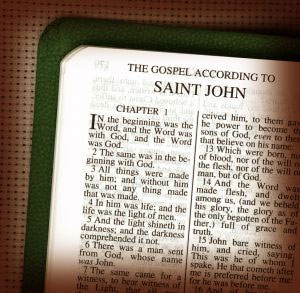
The Gospels are usually dated to several decades after the Ascension of Christ, and some will use this as a way to attack the accounts. But four different written accounts of a fairly obscure individual (by the standards of that day) within several decades of His life that agree in the major details (and allegedly conflicting accounts are never mutually exclusive) regarding His life and teachings is astounding evidence that lends credibility to what they wrote.
We can trust the Gospels, even knowing that they were produced decades after the events they record, because they were written by eyewitnesses in the case of Matthew’s and John’s Gospels, or by people who were writing the testimony of eyewitnesses in the case of Mark (who was writing Peter’s testimony) and Luke (who used both interviews of eyewitnesses and existing written documents). Other witnesses to these events would still be alive; it was simply too early for the Gospel writers to fabricate things. Also, they include some pretty unflattering statements about the apostles, who go on to become major heroes in Church History. One would expect that the first thing to be edited out of an account would be the incredibly unintelligent remarks of the major protagonists, but we see that Peter makes one boneheaded remark after another, Jesus nicknames James and John the “Sons of Thunder” because of their hot tempers (Mark 3:17), and the disciples in general tend to miss the point at every possible turn, causing Jesus to show exasperation and frustration with them. These are clearly not accounts which were edited to make the leaders of the early church look good, and this adds to the evidence that the accounts are accurate overall.
That the Gospels were written decades later than the events does not devalue them as historical accounts; indeed, for ancient history, the Gospels were written surprisingly quickly. The only accounts we have of some events in Jewish history are in Josephus, written far longer after they occurred. Oral tradition was much more reliable than it is today; literacy was rare so people were much better at memorizing things.5 Furthermore, Jesus’ teaching was repeated and designed for easy memorization (that’s why His sayings are so memorable even today). The Scandinavian scholar Birger Gerhardsson showed that the canonical Gospels drew on a collective communal memory made strong by the oral teaching methods of the time. These techniques would have enabled “very accurate communication between Jesus and his followers” and would have ensured “excellent semantic recall”.6 The desire to date the Gospels early often springs from a genuine desire to protect the accuracy of Scripture, but there is no evidence and no reason to date them earlier than the dates listed in the article, and this should not pose a problem to the Christian.
As CMI has pointed out before (The Nativity: Fact or Fiction?), the Gospel reports compare extremely favorably with other famous historical events that historians have no trouble accepting :There are two generally reliable accounts of Hannibal (247–183 BC) crossing the Alps in 218 BC to attack Rome. Polybius (c. 200 – c. 118 BC), a Greek historian, chronicled Hannibal’s invasion at least 50 years after the actual event.7 Livy (c. 59 BC – AD 17), a Roman historian, wrote of Hannibal’s invasion about 190 years after the actual event.8
Another famous event in history was Julius Caesar (100–44 BC) crossing the Rubicon in 49 BC without disbanding his army.9 Suetonius (c. 69/75 – after 130), a Roman historian, wrote his historical account of Caesar crossing the Rubicon at least 110 years after the event,10 and it is considered to be generally reliable. In addition, the two earliest biographies of Alexander the Great, written by Arrian and Plutarch, were written over 400 years after his death.11 And these biographies are considered to be generally trustworthy.
I know it is not that relevant to the overall testimony of scripture, but adding thoughts to scripture that scripture does not support cannot help to maintain the accuracy or credibility of scripture when it is discussed.
I absolutely agree that we should not add thoughts to Scripture that it does not support. However, as explained above, the dates given to the documents are generally supported by evidence within the documents themselves. And an accurate dating of Scripture helps us to understand the occasions which might have prompted its authorship, which leads to a better understanding of the book and its proper application.
An argument that “the best minds” on the subject agree doesn’t mean much to me (I do accept authority arguments for a lot of things).
And it shouldn’t, because very often “the best minds” on the subject (even those who agree ideologically) can have substantial disagreements, much like you would find in any scholarly field!
Is there anything in the scriptures that would lead one to undoubtedly know that the dates assigned are correct?
“Undoubtedly know” is sometimes an unrealistic bar to set when we do not have a document saying, “Luke wrote his Gospel in (year) AD and here is a list of every source he used and every person he interviewed.” Hence the need to give a range of dates in which the Gospels were probably written. But the range can be considerably narrowed based on the clues we receive from the documents and the inter-relatedness of some of the New Testament documents. The impossibility of setting dates with absolute certainty and the disagreement by biblical scholars about precisely when a certain document should be dated should of course not cause the Christian to doubt their accuracy.
I have been born-again for 29 years, so I have some understanding of Scripture. I am an enthusiastic supporter, though not always financially unfortunately, of this and other “bona-fide” ministries, so my question is one mainly of Berean curiosity—I don’t want to get it wrong. Stay in the race and keep up the good work.
It is always a pleasure to receive a question motivated by a sincere desire for the truth; I hope this reply has answered your concerns.
God bless,
Feedback on this article
CMI–Au board member and bible college lecturer Rev. Dr Don Hardgrave writes:
Lita’s article is one of the best I've seen on the topic. Would you kindly pass on my heartiest congrats.
References
- See also: J.P Holding, “Gospel Dates, Gospel Authors, Gospel Freedoms”, Tekton Apologetics Ministries. Return to text.
- D.A. Carson and Douglas Moo, An Introduction to the New Testament (Grand Rapids: Zondervan, 2005), p. 181. Return to text.
- Namely, the anti-Marcionite prologue to Mark and Irenaeus (Against Heresies 3.1.2, AD 185) Return to text.
- See J.P Holding’s discussions of the dating of Matthew, Mark, Luke, and John on Tekton Ministries for a discussion of the issues related to the dating of each Gospel. Return to text.
- J.P Holding, On the Reliability of Oral Tradition, Tekton Ministries. Return to text.
- B. Gerhardsson, Memory and Manuscript, Trans. Eric Sharp (Copenhagen: Villadsen og Christensen, 1964. Return to text.
- Polybius, The Histories or The Rise of the Roman Empire 3(50ff.), c. 140 BC. Return to text.
- Titus Livius, Ab Urbe condita (History of Rome, lit. ‘From the founding of the city’) 21(32):6–37(6), 19 BC. Return to text.
- The Rubicon is a river in modern-day northern Italy marking the border between the ancient provinces of Cisalpine Gaul and Italy. Roman generals were supposed to disband their armies before crossing it on their return to Rome. By refusing to do so, Caesar was declaring war. Return to text.
- Gaius Suetonius Tranquillus, The Lives of the Twelve Caesars 1:31–33, AD 121. Return to text.
- Craig, William Lane, The Evidence for Jesus, 2005. Return to text.
Readers’ comments
Comments are automatically closed 14 days after publication.