

Journal of Creation 23(2):17–24, August 2009
Browse our latest digital issue Subscribe
How old is Grand Canyon?
The origin of Grand Canyon is a mystery unexplained by uniformitarian geology. In order to solve that mystery, uniformitarian scientists would like to know the date of its origin. The date for Grand Canyon started off older than 70 Ma. Then the western and central portions of the Canyon were dated as 5 to 6 Ma old—a date always uncomfortable with uniformitarian scientists since it implied rapid erosion within their paradigm. Recently, the Canyon has been redated, twice. One dating technique discovered that the western Canyon was about 17 Ma old. Another found that the western and central portions are 55 to 65 Ma old. Those who believe that the canyon is only 5 to 6 Ma claim these new dating methods are flawed, while the advocates of the new dating techniques claim the opposite. Regardless, none of these dates help resolve the origin of Grand Canyon from a uniformitarian point of view—all hypotheses have serious problems. Vertical cliffs and lack of talus indicate the Canyon is young, suggesting a catastrophic origin. The dam-breach hypothesis is currently the most popular creationist hypothesis, but it has numerous problems, two in particular that seem fatal. A second creationist hypothesis originates the Grand Canyon during late Flood channelized runoff.

Grand Canyon is one of the most awesome, readily seen deep canyons in the world. But yet its origin is cloaked in mystery. Grand Canyon also lies at the forefront of competing paradigms for its origin, namely the uniformitarian and catastrophic paradigms:
“The famous landscape of the Grand Canyon lies along the front lines of competing scientific and non-scientific views of Earth’s antiquity and evolution.”1
So, the paradigm that provides a reasonable explanation for the origin of Grand Canyon would mostly likely be correct.
Despite abundant data collected since John Wesley Powell’s first courageous trip down Grand Canyon in 1869,2 a uniformitarian theory for the origin of the Canyon is still unknown:
“Regional geological knowledge of the Grand Canyon is especially rich and detailed, but it is frustratingly difficult to synthesize and communicate to the public.”1
In a popular book on the geology of Grand Canyon, Greer Price admitted:
“But while the principles of erosion, like so much of geology, are simple, the detailed history of the Colorado River and its canyons remains elusive and difficult to grasp.”3
In another recent book, Wayne Ranney repeatedly notes how little is actually known about the origin of Grand Canyon:
“The canyon’s birth is shrouded in hazy mystery, cloaked in intrigue, and filled with enigmatic puzzles. And although the Grand Canyon is one of the world’s most recognizable landscapes, it is remarkable how little is known about the details of its origin.”4
An earlier revolution in dating the Canyon
For a long time Grand Canyon was considered old. Such an old age started after John Wesley Powell floated the river in 1869 and assumed the origin of Grand Canyon was by antecedence. An antecedent stream is defined as “A stream that was established before local uplift began and incised its channel at the same rate the land was rising; a stream that existed prior to the present topography.”5
In other words, there was a river flowing before uplift on a landscape of low relief. Then a barrier, such as a mountain range or plateau, uplifted in the path of the stream, but the uplift was “so slow” that the stream or river was able to maintain its course by eroding down into the rising landscape. Powell was convinced this river was able to maintain its present course for tens of millions years while the mountains and plateaus slowly uplifted across its path. Figure 1 shows the antecedent stream hypothesis for the origin of the Yakima River water gaps. Powell and other early advocates of this hypothesis were dogmatic in their insistence (like current evolutionary dogmatism), despite the absence of evidence.6 Their belief was simply that; an arbitrary deduction based on their uniformitarian faith. So, the Colorado River and Grand Canyon were assumed to be older than 70 Ma, the assumed uplift time of the Kaibab Plateau during the “Laramide orogeny”. This belief lasted about 60 years and was assumed to be a fact.7

However, it was later realized that the Colorado River did not flow west of Grand Canyon through the Muddy Creek Formation and the overlying Hualapai Limestone.8 Since the Muddy Creek Formation is dated as late Miocene or Pliocene, this means that Grand Canyon is younger than late Miocene. More recent dates on basalt or ash from west of Grand Canyon in the Muddy Creek Formation, the Hualapai Limestone, and Bouse Formation gave an age for the Colorado River of about 5.5 Ma.9 Such a young date within the uniformitarian dating system, 7% of the previously assumed date, spawned all kinds of speculation on the origin of Grand Canyon and the whereabouts of the “ancestral” Colorado River during the past 70 Ma. Grand Canyon had to cut down more than 1.5 km in less than 6 Ma!
Then it was discovered that K-Ar dates of lava flows in western Grand Canyon ranged from 3 million to 1,000 years.10 Multiple lava flows, mostly from the northwest rim had flowed down into Grand Canyon (Figure 2), blocking the Colorado River and causing many lakes to back up in Grand Canyon. Two lakes supposedly extended into Utah.10 Lake deposits were discovered upstream in Grand Canyon and were cited as evidence of occasional large lava-dammed lakes. Even shorelines have been observed.11 Thus, such dates of basalt near the bottom of Grand Canyon showed that the Canyon was near its current depth several million years ago. Hence the Canyon must have been carved in even a shorter time of only a few million years within the uniformitarian paradigm! However, the uniformitarians could not quite come up with such rapid incision rates over 6 Ma.12,13
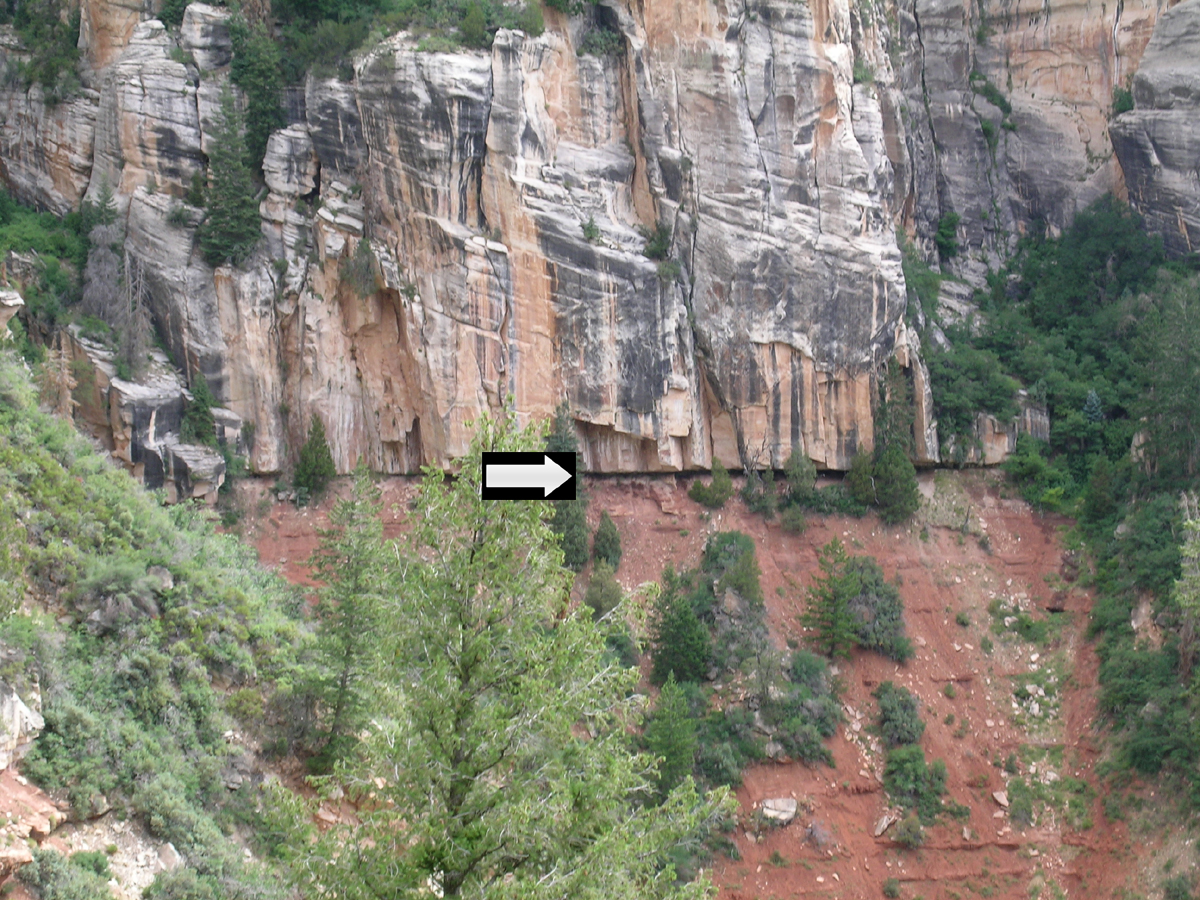
These were radical changes and made many geologists unconformable. Such quick development of a deep canyon within the uniformitarian paradigm contrasts sharply with the almost complete lack of erosional features within the walls of Grand Canyon. The horizontal strata represent almost 300 Ma of deposition, and yet extremely little erosion is found within and between layers in all that time. Especially revealing is the gap of 140 to 160 Ma between the flat contacts of the Muav and Redwall Limestones (figure 3). The knife sharp contact between the supposedly wind blown Coconino Sandstone and the subjacent Hermit Shale (figure 4) over more than 300 km represents 10 Ma missing with no erosion. Uniformitarians cannot appeal to some deep-sea environment protected from erosion for 300 Ma, since the claimed environments for the horizontal formations of Grand Canyon range from shallow marine to terrestrial. Such non-existent erosion for 300 Ma contrasts with the observation that at the current erosion rate, the continents can be worn down to sea level in only 10 Ma.14 This figure is a minimum. If other factors are included, the wearing of the continent down to sea level would probably be a maximum of around 50 Ma. Regardless, both times are short enough to expect abundant evidence for deep canyons and valleys in the walls of Grand Canyon. Because there is little or none, the walls of Grand Canyon support rapid deposition over large areas, consistent with the deposition during the Genesis Flood.

So, the 6 Ma age of Grand Canyon became established as the consensus view:
“In spite of over a century of work on the Grand Canyon, there are still fundamental questions about the age of the canyon and the processes that have formed it. There is consensus (e.g. Young and Spamer, 2001) that the present Colorado River system through Grand Canyon took its shape only in the last 6 Ma, ca. 65 Ma after Laramide uplift of the Colorado Plateau and 10–20 Ma after the Sevier/Laramide highlands collapses to form the Basin and Range province in the Miocene.”15
It also had been assumed that the southwest Colorado Plateau significantly uplifted in the past 6 Ma to cause downward incision.13
Not much changed for almost 50 years, except that some of the original K-Ar dates for the basalt flows within western Grand Canyon were found to be erroneous. The lavas were dated younger, which gave uniformitarian scientists about 5 Ma to erode Grand Canyon instead of a few million years:
“Earlier 40K/40Ar dates indicated that Grand Canyon had been carved to essentially its present depth before 1.2 Ma. But new 40Ar/39Ar data cut this time frame approximately in half … ”16
This does not inspire confidence in K-Ar dating. However, it was also discovered that the impounded lakes east of the lava dams in Grand Canyon were very short lived.17 What about all those lake features well upstream? “Shorelines” and other evidence of impounded lakes in Grand Canyon have been “reinterpreted” as formed by other processes.18 The basalt dams apparently formed only small lakes that soon failed catastrophically. There certainly is no contradiction with the existence of these basalt-dammed lakes and the short post-Flood time scale.
New “age” of Grand Canyon turns previous “age” on its head
Of course there have been previous consensuses on aspects of Grand Canyon history that have since come and gone. The established ages above, all worked out with meticulous radiometric dating techniques and detailed incision rates during the past 6 Ma, are now in the process of being tossed by a number of geologists.
Three scientists publishing in Science19,20 determined that western Grand Canyon was carved about 17 Ma ago and eroded headward to connect the central and eastern Grand Canyon. Such a change in dates for the origin of Grand Canyon were based on U-Pb dating of cave speleothems assumed to record ground water changes as Grand Canyon deepened. It is interesting that this older date is actually a relief to some geologists, who seemed to have been internally chafing over the 6 Ma date for the beginning of Grand Canyon:
“This [new] time scale is not surprising—many geologists have long suspected it—but the study uses an ingenious combination of methods to demonstrate it firmly for the first time (emphasis added).”21
Again, another supposedly firm date that cancels out previous “firm” dates.
But that is not all, another group of scientists have dated the canyon by what is called apatite thermochronometry and discovered that a “proto-Grand Canyon” of kilometer-scale depth had incised by 55 Ma ago.22 This means that “Grand Canyon” could have started eroding by 65 Ma ago and the last of the dinosaurs may have seen it, as a internet science news service states:
“How could everyone have gotten it so wrong? New research indicates that the Grand Canyon is perhaps 65 million years old, far older than previously thought—and old enough that the last surviving dinosaurs may have stomped along its rim.”23
Now that is really turning the previous Grand Canyon dates on their head! So, in this new scenario, the Colorado Plateau uplifted during the Laramide orogeny and the Grand Canyon is of similar age.24 Who knows whether the uniformitarian belief in the origin of Grand Canyon, in the future, will turn full circle and come back to Powell’s antecedence hypothesis. All they have to do is date Grand Canyon a little older than the Laramide uplift of the southwest Colorado Plateau.
The old guard fights back
The new dates, of course, leave a lot of unanswered questions, such as where was the Colorado River west of Grand Canyon before 6 Ma? Predictably, the old guard is not happy with the new dating results for Grand Canyon. Some researchers, who have spent years trying to solve the origin of Grand Canyon, claim in letters to the editor that the new results contradict several lines of “established” geological knowledge:
“This contradicts several lines of published geological knowledge in the region, hinges upon unjustified hydrogeological assumptions, and is based on two anomalous data points for which we offer alternative explanations.”1
Such claims had no impact on those geologists who generated the new results:
“Although it is true that this concept does contradict pre-early 1990s knowledge, it does not contradict more recent findings … ”25
But, a full assault on these new dates was published in the November 2008 Geology.26 Karl Karlstrom and colleagues dogmatically insist that Grand Canyon is less than 6 Ma old. They claim that they have falsified a key assumption used in the dating of the western Canyon at 17 Ma. This is the assumption that water table decline, which supposedly can be dated from speleothems in caves, is not equivalent to Grand Canyon incision rate. It is interesting that these researchers “discovered” just the right incision rates for the Canyon to be a little less than 6 Ma. They apparently believe the dates of 55 to 65 Ma ago for “proto Grand Canyon”, since they do not challenge these dates. Instead, they state that western Grand Canyon “reused” these preexisting Tertiary paleocanyons. It is hard to tell how this controversy will turn out.

Regardless, it is quite interesting (to creationists) that a previous uniformitarian history with “firm” dates, etc. could simply be brushed off by some researchers with “new” dates. And these new dates are also claimed to be flawed. It tells me that the uniformitarian dating methods and conclusions really are not that solid to begin with, and that they are mostly the results of “consensus”.
Uniformitarian origin hypotheses show little evidence
The dates still do not solve the main problem and that is the origin of Grand Canyon. Over the years uniformitarian scientists have used the assumed ages of events in the Grand Canyon area to postulate a number of hypotheses for the origin.

There have been generally three uniformitarian hypotheses for its origin: (1) the antecedent stream, (2) stream piracy, and (3) lake spillover.4,6,27,28,29,30,31,32 Superposition (figure 5), one of the ideas for the origin of water gaps, was considered by only a few early geologists, but was soon seen as impossible. A water gap is defined as: “A deep pass in a mountain ridge, through which a stream flows; esp. a narrow gorge or ravine cut through resistant rocks by an antecedent stream.”33
Although this definition was made for a mountain ridge, it applies to a perpendicular cut through any topographical barrier, including a plateau.34 Furthermore, antecedence is only one of about four hypotheses and should not be in the definition of a landform.
Superposition is the hypothesis where rivers maintain their course while eroding straight down through a layer of sedimentary rocks (figure 5). After the layer erodes the river ends up flowing through ridges and mountains.
As already mentioned, the antecedent stream hypothesis for Grand Canyon was rejected in the mid twentieth century. So, that leaves only stream piracy and lake spillover as currently believed hypotheses.

The stream piracy hypothesis is incredible
Stream piracy in relation to Grand Canyon has many problems.27,31 It asserts that a stream plunging from the uplifted or uplifting Colorado Plateau into the Lake Mead area eroded headward 160 to 320 km and captured the ancient Colorado River. This is an incredible claim with no evidence, which is one of several serious problems with the hypothesis.35
The lake spillover hypothesis does not hold water
In 1934, geologist Eliot Blackwelder36 proposed that Grand Canyon was eroded by the spillover of a lake ponded northeast of the Kaibab Plateau.37 His suggestion remained obscure but has recently been revived from the dustbin of rejected geological hypotheses.28,37,38,39,40 The hypothesis proposes that a lake developed in the region of the Little Colorado River area, called Lake Hopi or Lake Bidahochi, with another lake possibly existing northeast of the Kaibab Plateau. At some point the lake or lakes breached the Kaibab Plateau to form Grand Canyon. However, there are also many problems with this hypothesis.
First, there is no evidence for a lake northeast of the Kaibab Plateau.37 Second, only a minor proportion of the Bidahochi Formation, in the northern and eastern Little Colorado River Valley, is considered a lake deposit,41 and that interpretation rests only on the sediments being fine grained.42 Third, recent work has reinterpreted these lake sediments as shallow water sediments formed in an ephemeral desert lake.43,44 Given that situation, “Lake Hopi” would have been small and there would not have been enough water to erode the Canyon.
Fourth, the elevation of Grand Canyon through the Kaibab upwarp is significantly higher than the spillover points for these putative lakes. The lowest point of Grand Canyon through the Kaibab Plateau is 7,300 feet (2,225 m), while the lowest points through the Kaibab Plateau are around 6,000 feet (1,830 m) to the north and south of the highest point.
Fifth, if the lake did overtop the Kaibab Plateau, it would not follow the current path of Grand Canyon, because the slope of the topography is perpendicular to the current path of Grand Canyon.45 The water would have run off to the southwest, but instead the Canyon turns to the northwest after breaching the Kaibab Plateau. Some scientists have suggested the overspill followed a previous channel cut during the period of northeast water flow on the plateaus. This may help for part of the path, but not for western Grand Canyon.
The overspill hypothesis is admittedly speculative, even by geologists who believe in it.46 Another Powell recently summarized the evidence:
“Thus, lake overflow and integration appears to be another speculative idea—an educated geological guess—without direct evidence.”43
Table 1 summarizes five major problems with the spillover hypothesis.
| Table 1. Five major problems with the spillover hypothesis for the origin of Grand Canyon |
|---|
| 1. No evidence for a lake northeast of the Kaibab Plateau |
| 2. Only a minor portion of bidahochi Formation is claimed for “Lake Hopi” |
| 3. Supposed lake sediments in Bidahochi Formation now seen as formed in small lake |
| 4. Spillover point across Kaibab Plateau much lower then top of Grand Canyon |
| 5. If lake overspilled, it is unlikely to have followed current course of Grand Canyon |
How about a date of 4,500 years?
The myriad of dates proposed for the origin of the Canyon calls into question all the uniformitarian dating methods. Creationists have shown that uniformitarian dating methods are inaccurate.47 As far as the millions-of-year ages are concerned, such old ages are relished because it reinforces their uniformitarian and evolutionary beliefs. A period of accelerated radiometric decay in the past, as creationists have discovered,48,49 makes the age of Grand Canyon much younger.
Other features indicate that the Canyon is very young and rapidly formed, such as the lack of talus and the vertical walled cliffs. It is interesting that a catastrophic origin is usually the first thought that comes to peoples’ minds when they first see Grand Canyon,50,51 so we should look for a fairly recent catastrophe for the origin of Grand Canyon.
Two creationist hypotheses
There are two hypotheses for the origin of Grand Canyon that have been developed by creationists. One is the dam-breach hypothesis.27,52 After first believing in this hypothesis,53 and thinking about it for 20 years, I have come to realize that there is very little evidence for its support.54 Among the problems, there seems to be two fatal ones. These are the lack of evidence for lakes east and northeast of the Kaibab Plateau and the long tributary Kanab and Havasu Canyons. Both of these canyons start about 50 miles (80 km) north and south, respectively, of Grand Canyon and cut all the way down to the level of Grand Canyon. At the level of the Colorado River, Kanab and Havasu Canyons are a mile high and about one quarter mile wide (figures 6 and 7). For such long, deep tributaries to form, water must extend a hundred miles wide and channel into the main canyon of Grand Canyon. No dam-breach scenario that I am aware of suggests such a wide current. Besides, there is no evidence of such a wide current, which should be abundant using the Lake Missoula flood as an analog.55
The second hypothesis is the suggestion that late Flood channelized flow56 carved the Canyon.57,58 Grand Canyon is one of over a thousand water gaps across the earth, which could have easily been carved during late Flood channelized flow.59,60 The fleshing out of this hypothesis will be published elsewhere.61,62,63
References and notes
- Pederson, J., Young, R., Lucchitta, I., Beard, L.S. and Billingsley, G., Comment on “Age and evolution of the Grand Canyon revealed by U-Pb dating of water table-type speleothems”, Science 321(1):634b, 2008. Return to text.
- Powell, J.W., The Exploration of the Colorado River and Its Canyons, (Republished by Dover in 1961), Dover Publishing, New York, 1895. Return to text.
- Price, L.G., An Introduction to Grand Canyon Geology, Grand Canyon Association, Grand Canyon, AZ, p. 7, 1999. Return to text.
- Ranney, W., Carving Grand Canyon: Evidence, Theories, and Mystery, Grand Canyon Association, Grand Canyon, AZ, p. 11, 2005. Return to text.
- Bates, R.L. and Jackson, J.A., (Eds.), Dictionary of geological terms, 3rd ed., Anchor Press/Doubleday, Garden City, NY, p. 22, 1984. Return to text.
- Powell, J.L., Grand Canyon: Solving Earth’s Grandest Puzzle, PI Press, New York, 2005. Return to text.
- Lucchitta, I., History of the Grand Canyon and of the Colorado River in Arizona; In: Beus, S.S. and Morales, M. (Eds.), Grand Canyon Geology, Oxford University Press, New York, pp. 311–332, 1990. Return to text.
- Longwell, C.R., How old is the Colorado River? American Journal of Science 244(12):817–835, 1946. Return to text.
- Howard, K.A., Lundstrom, S.C., Malmon, D.V. and Hook, S.J., Age, distribution, and formation of late Cenozoic paleovalleys of the lower Colorado River and their relation to river aggradation and degradation; in: Reheis, Hershler, M.C., Miller, R. and D.M. (Eds.), Late Cenozoic Drainage History of the Southwestern Great Basin and Lower Colorado River Region: Geologic and Biotic Perspectives, GSA Special Paper 439, Geological Society of America, Boulder, CO, pp. 391–410, 2008. Return to text.
- Hamblin, W.K., Late Cenozoic Lava Dams in the Western Grand Canyon, GSA Memoir 183, Geological Society of America, Boulder, CO, 1994. Return to text.
- Dalrymple, G.B. and Hamblin, W.K., K-Ar ages of Pleistocene lava dams in the Grand Canyon in Arizona, Proceedings of the National Academy of Science 95(9):744–749, 1998. Return to text.
- Karlstrom, K.E., Crow, R.S., Peters, L., McIntosh, W., Raucci, J., Crossey, L.J., Umhoefer, P., Dunbar, N., 40Ar/39Ar and filed studies of Quaternary basalts in Grand Canyon and model for carving Grand Canyon: quantifying the interaction of river incision and normal faulting across the western edge of the Colorado Plateau, GSA Bulletin 119(1):283–312, 2007. Return to text.
- Pederson, J., Karlstrom, K., Sharp, W. and McIntosh, W., Differential incision of the Grand Canyon related to Quaternary faulting—constraints from U-series and Ar/Ar dating, Geology 30:739–742, 2002. Return to text.
- Roth, A.A., Origins—Linking Science and Scripture, Review and Herald Publishing, Hagerstown, MD, 1998. Return to text.
- Karlstrom et al. ref. 12, p. 1284. Return to text.
- Karlstrom et al. ref. 12, p. 1283. Return to text.
- Fenton, C.R., Webb, R.H. and Cerling, T.E., Peak discharge of a Pleistocene lava-dam outburst flood in Grand Canyon, Arizona, USA, Quaternary Research 65:324–335, 2006. Return to text.
- Kaufman, D.S., O’Brien, G., Mead, J.I. Bright, J. and Umhoefer, P., Late Quaternary spring-fed deposits of the Grand Canyon and their implication for deep lava-dammed lakes, Quaternary Research 58:329–340, 2002. Return to text.
- Polyak, V., Hill, C. and Asmerom, Y., Age and evolution of the Grand Canyon revealed by U-Pb dating of water table-type speleothems, Science 319(1):377–1, 380, 2008. Return to text.
- Perkins, S., Ancient chasm: part of Grand Canyon may be 17 million years old, Science News 173:147–148, 2008. Return to text.
- Atkinson, T., and Leeder, M., Canyon cutting on a grand time scale, Science 319(1):343, 2008. Return to text.
- Flowers, R.M., Wernicke, B.P. and Farley, K.A., Unroofing, incision, and uplift history of the southwestern Colorado Plateeua from apatite (U-Th)/He thermochronometry. GSA Bulletin 120:571–587, 2008. Return to text.
- Berardelli, P., Did dinosaurs gawk at the Grand Canyon?, sciencenow.sciencemag.org/, accessed April 2008. Return to text.
- Young, R.A., Pre-Colorado River drainage in western Grand Canyon: potential influence on Miocene stratigraphy in Grand Wash trough; in: In, Reheis, M.C., Hershler, R. and Miller, D.M. (Eds.), Late Cenozoic Drainage History of the Southwestern Great Basin and Lower Colorado River Region: Geologic and Biotic Perspectives, GSA Special Paper 439, Geological Society of America, Boulder, CO, pp. 319–333, 2008. Return to text.
- Polyak, V., Hill, C. and Asmerom, Y., Response to comments on the “Age and evolution of the Grand Canyon revealed by U-Pb dating of water table-type speleothems”, Science 321:1634d, 2008. Return to text.
- Karlstrom, K.E., Crow, R., Crossey, L.J., Coblentz, D. and Van Wijk, J.W., Model for tectonically driven incision of the younger than 6 Ma Grand Canyon, Geology 36(11):835–838, 2008. Return to text.
- Austin, S.A., How was Grand Canyon eroded? in: Austin, S.A. (Ed.), Grand Canyon–Monument to Catastrophism, Institute for Creation Research, Santee, CA, pp. 83–110, 1994. Return to text.
- Douglass, J., Late Cenozoic Landscape Evolution Study of the Eastern Grand Canyon Region, Master of Arts thesis, Northern Arizona University, Flagstaff, AZ, 1999. Return to text.
- Hunt, C.B., Grand Canyon and the Colorado River, their geologic history; in: Breed, W.J. and Roat, E. (Eds.), Geology of the Grand Canyon, Museum of Northern Arizona, Flagstaff, AZ, pp. 129–141, 1976. Return to text.
- Williams, E.L., Meyer, J.R. and Wolfrom, G.W. Erosion of Grand Canyon Part I—Review of antecedent river hypothesis and the postulation of large quantities of rapidly flowing water as the primary agent of erosion, CRSQ 28:92–98, 1991. Return to text.
- Williams, E.L., Meyer, J.R. and Wolfrom, G.W., Erosion of Grand Canyon Part II—Review of river capture, piping and ancestral river hypotheses and the possible formation of vast lakes, CRSQ 28:138–145, 1992. Return to text.
- Young, R.A. and Spamer E.E. (Eds.), Colorado River Origin and Evolution: Proceedings of a Symposium Held at Grand Canyon National Park in June, 2000, Grand Canyon Association, Grand Canyon, AZ, 2001. Return to text.
- Bates and Jackson, ref. 5., p. 559. Return to text.
- Douglass, J.C., Criterion Approach to Transverse Drainages, PhD thesis, Arizona State University, Tucson, AZ, 2005. Return to text.
- Oard, M.J., The origin of Grand Canyon Part I: uniformitarian failures. CRSQ (in press). Return to text.
- Blackwelder, E., Origin of the Colorado River, GSA Bulletin 45:551–566, 1934. Return to text.
- Meek, N. and Douglass, J., Lake overflow: An alternative hypothesis for Grand Canyon incision and development of the Colorado River; in: Young, R.A. and Spamer, E.E. (Eds.), Colorado River Origin and Evolution: Proceedings of a Symposium Held at Grand Canyon National Park in June, 2000, Grand Canyon Association, Grand Canyon, AZ, pp. 199–204, 2001. Return to text.
- Perkins, S., The making of a Grand Canyon: Carving this beloved hole in the ground may not have been such a long-term project, Science News 158:218–220, 2000. Return to text.
- Scarborough, R., Neogene development of Little Colorado River Valley and eastern Grand Canyon: Field evidence for an overtopping hypothesis; in: Young, R.A. and Spamer, E.E. (Eds.), Colorado River Origin and Evolution: Proceedings of a Symposium Held at Grand Canyon National Park in June, 2000, Grand Canyon Association, Grand Canyon, AZ, pp. 207–212, 2001. Return to text.
- Spencer, J.E. and Pearthree, P.A., Headward erosion versus closed-basin spillover as alternative causes of Neogene capture of the ancestral Colorado River by the Gulf of California; in: Young, R.A., and Spamer, E.E. (Eds.), Colorado River Origin and Evolution: Proceedings of a Symposium Held at Grand Canyon National Park in June, 2000, Grand Canyon Association, Grand Canyon, AZ, pp. 215–219, 2001. Return to text.
- Dallegge, T.A., Ort, M.H., McIntosh, W.C. and Perkins, M.E., Age and depositional basin morphology of the Bidahochi Formation and implications for the ancestral upper Colorado River: in: Young, R.A. and Spamer, E.E. (Eds.), Colorado River Origin and Evolution: Proceedings of a Symposium Held at Grand Canyon National Park in June, 2000, Grand Canyon Association, Grand Canyon, AZ, pp. 47–51, 2001. Return to text.
- Dallegge, T.A., Ort, M.H. and McIntosh, W.C., Mid-Pliocene chronostratigraphy, basin morphology and paleodrainage relations derived from the Bidahochi Formation, Hopi and Navajo Nations, Northeastern Arizona, The Mountain Geologist 40(3):55–82, 2003. Return to text.
- Powell, ref. 6, p. 228. Return to text.
- Ranney, ref. 4, pp. 104, 129. Return to text.
- Hunt, A.B. and Elders, W.A., Climate change and the evolution of Grand Canyon and the Colorado River delta; in: Young, R.A. and Spamer, E.E. (Eds.), Colorado River Origin and Evolution: Proceedings of a Symposium Held at Grand Canyon National Park in June, 2000, Grand Canyon Association, Grand Canyon, AZ, pp. 191–194, 2001. Return to text.
- Meek and Douglas, ref. 37, p. 201. Return to text.
- Woodmorappe, J., The Mythology of Modern Dating Methods, Institute for Creation Research, El Cajon, CA, 1999. Return to text.
- Vardiman, L., Snelling, A.A. and Chaffin E.F. (Eds.), Radioisotopes and the Age of the Earth: A Young-Earth Creationist Research Initiative, Institute for Creation Research and Creation Research Society, El Cajon, CA, and Chino Valley, AZ, 2000. Return to text.
- Vardiman, L., Snelling, A.A. and Chaffin, E.F. (Eds.), Radioisotopes and the Age of the Earth: Results of A Young-Earth Creationist Research Initiative, Institute for Creation Research and Creation Research Society, El Cajon, CA, and Chino Valley, AZ, 2005. Return to text.
- Powell, ref. 6, p. 6. Return to text.
- Ranney, ref. 4, p. 39. Return to text.
- Brown, W., In the Beginning: Compelling Evidence for Creation and the Flood, 7th ed., Center for Scientific Creation, Phoenix, AZ, 2001. Return to text.
- Oard, M.J., Comments on the breached dam theory for the formation of the Grand Canyon, CRSQ 30:39–46,1993. Return to text.
- Oard, M.J., The origin of Grand Canyon Part II: numerous problems with the dam-breach hypothesis. CRSQly (in press). Return to text.
- Oard, M.J., The Missoula Flood Controversy and the Genesis Flood, Creation Research Society Monograph No.13, Chino Valley, AZ, 2004. CRSQ
- Walker, T., A biblical geologic model; in: Walsh, R.E. (Ed.), Proceedings of the Third International Conference on Creationism, technical symposium sessions, Creation Science Fellowship, Pittsburgh, PA, pp. 581–592, 1994. Return to text.
- Gish, D.T., More creationist research (14 years)—Part II: biological research, CRSQ 26(1):5–12, 1989. Return to text.
- Whitcomb, Jr., J.C. and Morris, H.M., The Genesis Flood, Baker Book House, Grand Rapids, MI, 1961. Return to text.
- Oard, M.J., Flood by Design: Receding Water Shapes the Earth’s Surface, Master Books, Green Forest, AR, 2008. Return to text.
- Oard, M.J., Water gaps in the Alaska Range, CRSQ 44(3):180–192, 2008. Return to text.
- Oard, M.J., The origin of Grand Canyon Part III: a geomorphological problem, CRSQ (in press). Return to text.
- Oard, M.J., The origin of Grand Canyon Part IV: the Great Denudation, CRSQ (in press). Return to text.
- Oard, M.J., The origin of Grand Canyon Part V: carved by late Flood channelized ereosion, CRSQ (in press). Return to text.


Readers’ comments
Comments are automatically closed 14 days after publication.