
Hosing down the hype
New planet find has ET hopefuls in a frenzy
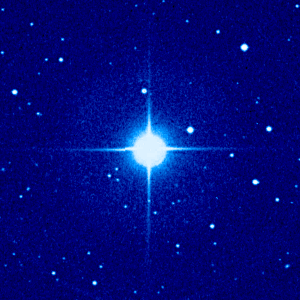
The latest discovery of a new extrasolar planet is being hailed as ‘ … the first truly Earth-like planet to have been found outside our Solar System.’ And ‘This remarkable discovery appears to confirm the suspicions of most astronomers that the universe is swarming with Earth-like worlds. We don’t yet know much about this planet, but scientists believe that it may be the best candidate so far for supporting extraterrestrial life.’
So what’s it all about?
For as long as mankind has been able to comprehend that there are other planets besides the earth in our own solar system, he has been obsessed with the ‘hope’ that there may be other life forms other than our own. This is the true driving force behind the massive efforts of many space agencies and astronomers in their search of the heavens. By finding life forms on other planets, astrobiologists hope that it will give them some insight into how life began (evolved) on the earth.
The first discovery of an alleged planet outside of the known bodies of our own solar system came in 1995 when Michael Mayor and Didier Queloz of Geneva announced that they had detected a rapidly orbiting mass close to star 51 Pegasi. However, calculations for the size of this mass ranged from half the mass of Jupiter to twice its mass. Given the understanding of the enormous gravity of Jupiter, and the fact that this new body was very close to its parent star, this meant any life forms would be frazzled from the heat and radiation, thus it made the chance of any life existing on it nigh impossible.
Size has been one of the major problems with most of the extrasolar planets (also known as exoplanets) discovered so far. The most common problems have been that:
- Many are too close to the nearest stars they orbit—meaning extreme surface temperatures.
- Some have huge elliptical shaped orbits around their stars causing enormous variations in conditions.
- Extreme gravitational forces, several times stronger than the earth’s, would exist on these massive planets.
- It is presumed that the composition of these massive planets would be mainly gaseous. In other words they might be gas giants (like our own Jupiter) or even small stars known as brown dwarfs.
For exoplanets ‘size does matter’
It should be remembered that these planets are not detected by direct observation. There are several indirect methods of detection used for extrasolar planets. One way is to measure the decrease in light given off by the star each time the neighbouring planet passes between our line of sight and its sun. This is known as the transit method. We can observe a similar effect when Mercury or Venus passes between our sun and the earth. But in most cases a planet does not pass in front of its star along our line of sight.
One of the most common methods of detection is by looking for a wobble in a star, and assuming it’s caused by the gravitational pull of a planet. The exoplanets’ size and distance from its star is determined by studying the wobble. For example, Jupiter causes our sun to wobble slightly, pulling it off centre.1 This is called the ‘radical velocity’ or simply the wobble technique. As the star wobbles from the gravitational pull of a planet, the frequency of the starlight we observe from it can shift up and down. This is known as the Doppler Effect. A similar thing happens with sound waves. You may have noticed how an approaching police siren suddenly seems to change pitch when it passes you and begins moving away.2
This is one is different
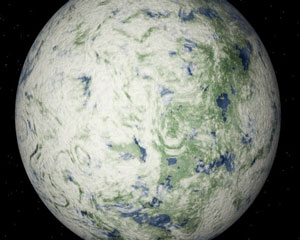
Of the 220 or so claimed extrasolar planets discovered to date this is the only one reported to be in the ‘Earth-size’ range that astronomers believe might be conducive to supporting life. Called Gliese 581c, after its parent star, it is presumed to be 20.5 light years3 from Earth and have a diameter about 1.5 times that of the earth. This means it would have 5 times our mass and have a surface gravity approximately twice the earth’s. Gliese 581c is only 11 million kilometres (7 million miles) from its sun. By comparison, the earth averages a distance of 150 million kilometres (92 million miles) from our sun. At such a close range to its sun, one might think any potential extraterrestrials would be fried on this new planet. However, its sun is presumed to be about 50 times cooler than ours. This puts planet Gliese 581c in the ‘Goldilocks zone’—a distance where temperatures are just right—not so hot as to vaporize any water on the surface or neither cold enough to freeze it. Earth ‘just happens’ to exist in such a perfect habitable zone.
Because water is an essential ingredient for life, astrobiologists are virtually salivating at what they regard is a huge potential for extraterrestrial life. However, these planet-hunters start from the mistaken premise that evolution has occurred on the earth, which leads them to believe that ET could have evolved on other earth-like planets. Indeed, this is really the agenda behind the search for exoplanets, as most Earthlings believe they are not alone in the universe. Accordingly, the discovery of Gliese 581c has made headlines all around the world, in which most proclaim a theme of ‘At last, an Earth-like planet found’. But in reading most of these articles you will note there is a great deal of wishful thinking involved. Expressions such as ‘it might be’, ‘potentially is’ and ‘astronomers believe’ are interspersed among the facts surrounding the discovery. Do you recall similar hyperbole when microbes were supposedly found on Mars? There is a very tangible reason for their hyping up of the evidence. It is because most researchers rely upon external funding to continue their work. In a field of endeavour where so little is ever actually delivered, one certainly has to make ‘much ado about nothing’ to help pay the bills.
Even the bookies are worried!
Beliefs in alien life are so rampant, that British bookmakers William Hill cut the odds on finding extraterrestrial life from 1,000–1 down to 100–1.4 Spokesman Graham Sharpe said, ‘We felt we had to react to the news that an Earth-like planet which could support intelligent life had been discovered—after all, we don’t know for sure that intelligent extra-terrestrial life has not already been discovered, but is being hushed up.’ These ‘cover up’ conspiracy theory-type notions are also driving an even more bizarre resolution that has been presented to the United Nations, asking it to declare a ‘Decade of Contact and Diplomatic Contact’ with aliens—and they are taking it seriously.5 We have previously discussed one of the prime movers behind such ideas, that is, former Canadian minister of defence, Mr Paul Hellyer, and his extraordinary claims that governments are covering up the truth about alien visitations.
Should we be concerned about extrasolar planets?
Life could only have occurred by one of two methods. It either evolved or was created. The Bible tells us that God is the author of life in the universe because He is the One who made the universe. The only planet that God’s Word says He created life on was Earth. There are major theological problems for the very Gospel of Christ if we presume that God created life on other planets.
No matter where we look in the universe the idea of sentient alien life looks increasingly unlikely. God has created other planets within our own solar system and operational science demonstrates that they are devoid of life. So it should not be unexpected that God would be consistent with His design elsewhere in the universe.
This latest planetary discovery is short on evidence, and the associated ‘life on another planet’ claims have the appearance of being more science fiction than science fact. The facts tell us that the earth and its sun are very special and this is consistent with God’s own Word that tells us, ‘ … God himself that formed the earth and made it; he hath established it, he created it not in vain, he formed it to be inhabited’ (Isaiah 45:18).
References
- Spencer, Wayne R., The Existence and Origin of Extrasolar Planets, Journal of Creation 15(1):17–25, 2001. Return to Text
- Bates, G,. Alien Intrusion: UFOs and the Evolution Connection, Master Books., Green Forest, 2005, p. 104. Return to Text
- It should be remembered that a light year is a measurement of distance. That is, the distance that light travels in a vacuum in a year. This is equivalent to 5,865,696,000,000 miles or 9,460,800,000,000 kilometres. Return to Text
- British bookies scared of aliens, http://www.abc.net.au/news/newsitems/200704/s1906668.htm, 26 April 2007. Return to Text
- U.N. to debate contact with extraterrestrial civilizations, http://www.ufodigest.com/unufo.html, 26 April 2007. Return to Text


Readers’ comments
Comments are automatically closed 14 days after publication.