
Extrasolar planet “100% likely” to have life?
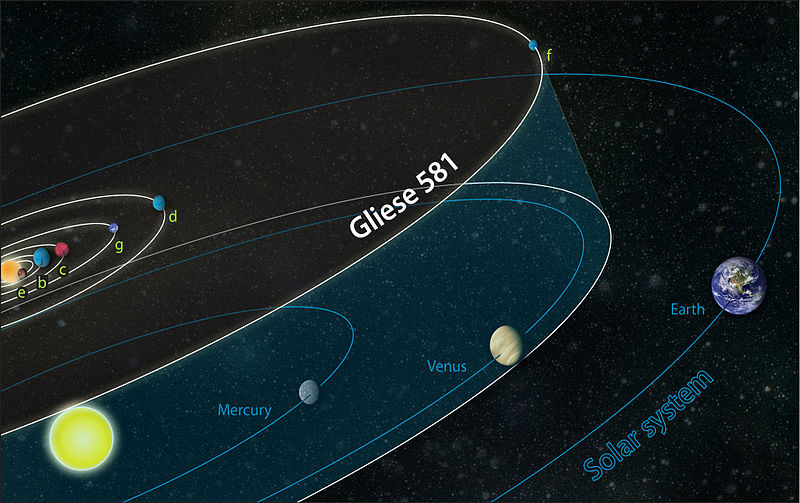
Researchers have recently identified a planet they say is in the “habitable zone” around its star—a planet at the right distance from its star to have liquid water on the surface.1 Dubbed Gliese 581g,2 it orbits around the Red Dwarf star Gliese 581, which is about 20 light-years from Earth. The planet is about 3–4 times the mass of Earth (estimated to be 1.1–1.7 times Earth’s gravity1) and is about 0.15 AU3 from Gliese 581, which is said to be within the estimated habitable zone for planets around Gliese 581.
This discovery has been paraded in the media as proof of life elsewhere in the universe.4 However, the media is not the source of the sensationalism. The massive publicity around the discovery of Gliese 581g stems from the comments of Steve Vogt, professor of astronomy and astrophysics at the University of California, Santa Cruz, and lead researcher for this discovery. He said:
“Personally, given the ubiquity and propensity of life to flourish wherever it can, I would say, my own personal feeling is that the chances of life on this planet are 100 percent,”4
These are amazing comments to hear from a lead researcher, even if only his “personal feelings”. There’s no evidence of life on this planet—only that the Gliese 581g appears to be the closest thing to a habitable extrasolar planet found so far. It has even lead one scientist, Ragbir Bhathal, astronomer at the University of Western Sydney, to claim that Gliese 581g is the source of an “alien signal” he detected two years ago.5 However, most scientists, including SETI pioneer Frank Drake, are skeptical of the findings: “I know the scientist, and when he first announced it, I asked him for the details, and he wouldn’t send them to me. I’m very suspicious.”
Is there really “almost no doubt about it”?4
Can we be 100% sure of life according to evolution?
Let’s assume, for the sake of argument, that naturalism is true; i.e. that the big bang, abiogenesis, and molecules-to-man evolution are all true. Assuming this, could we then say with Vogt, “that the chances of life on this planet are 100 percent”? Even Vogt’s colleague and co-author, experienced planet-hunter and evolutionist Paul Butler, though optimistic life might be found, was hesitant to put a probability on it.4
This isn’t the first time researchers have been optimistic about finding a habitable planet in the Gliese 581 system. Gliese 581c was the source of much hype three years ago (See Hosing down the hype). However, it has subsequently been discarded as a candidate for hosting life. If Gliese 581c had such a short shelf-life as a “habitable planet”, why should this find be so exciting?
We’ve only ever observed life on one planet—Earth. There is no evidence for life anywhere else in the universe. That could theoretically change (though it’s not likely), but it should still make us stop before we say that the chances of finding life on any other planet is 100%. This also means comparing life as we know it to what life elsewhere may be like is baseless speculation—we have nothing to compare to life as we know it.
There is no reason to assume that just because a planet is possibly in a habitable zone that it will necessarily be inhabited. There is nothing inherent in the laws of physics and chemistry that says life must come from non-life wherever there is liquid water.
The planet has only been inferred from observations of the star; the planet hasn’t been directly observed. This doesn’t mean it isn’t there, but it means there are many things we don’t know about it: chemical composition (e.g., is there any water?), albedo, surface temperature, atmosphere (either its presence or composition), geological activity on the surface, etc. All of these factors will affect whether life as we know it is even possible. How can we be 100% sure we’ll find life on this planet from estimates of just its size and orbit?
The habitable zone of a red dwarf star like Gliese 581 is closer to it than Mercury is to our Sun (figure 1), which means Gliese 581g would very likely be tidally locked (See The sun: our special star).6 In such a situation a stable atmosphere is not a given: the extreme temperature gradients may cause atmospheric gases to condense on the dark side of the planet.7 This would create a massive pressure difference between the light and dark sides, with the wind blowing to the dark side until gases such as water vapour and CO2 are drawn out of the atmosphere. Therefore, the atmosphere would be very different from what we have on Earth, not very friendly to life as we know it.
Finally, Vogt et al., warn readers in the original research report:
“Finally, it is important to keep in mind that, though … the entire 6-planet system is consistent with the combined data set from both teams, caution is warranted as most of the signals are small [emphasis added].”1
Why would “caution be warranted” if Vogt, the lead researcher, personally believes “the chances of life on this planet are 100 percent”? Presumably the former is professional opinion, and the latter is his personal opinion or wishful thinking. The problem is that these opinions are diametrically opposed to one another. Either “caution is warranted” or we can be 100% sure Gliese 581g is inhabited.8 Vogt’s comments about life to the press were at best wishful thinking; at worst they were a self-serving and deceptive publicity stunt.
Claims of life dead in the water
Vogt’s naturalism was the basic reason he said the chances of life on Gliese 581g were 100%. There is good reason, however, to believe that naturalism cannot explain the origin and history of life. The origin of life requires a vast amount of information to be created by chance from simple chemical building blocks. It is simple to show that not even one functional protein would ever form, let alone a whole microbe, even the simplest conceivable one (see Hawking claims that life can form by chance. Undirected physics and chemistry also break down the building blocks of life. Vogt’s confidence probably reflects his ignorance of biology more than the reality of what they found. Evolution from microbes to man also requires massive increases in information, which has never been observed, but information is constantly getting scrambled by mutations (See The evolution train’s a-comin’).9 Finally, and most importantly, we have God’s eyewitness testimony against abiogenesis; the book of Genesis. God created life.
Could life possibly be found on Gliese 581g (or any other planet)? Biblically speaking, probably not. When God creates he does so with purpose. There doesn’t seem to be any purpose for creating life on other planets in this universe (which is the one God created!).10 Such life would also have been affected by the Fall because the extent of the Fall was cosmic (Romans 8:18–23).11
There is good reason not to trust the hype, whether one believes the Bible or not. There is no scientific reason whatsoever to believe that there is life on Gliese 581g. When we do start from Scripture, though, we readily see that these claims are nothing more than the usual parade of the emperor in his new imaginary clothes.
Stop press! Evidence presented at the International Astronomical Union Symposium 276 on 11 October contradicts the claims of Vogt et al., suggesting that Gliese 581g may not even exist (the evidence for its existence is not significantly different to the background noise in the measurements)! If the existence of the planet is unconfirmed, then can anyone be 100% sure that it has life?
References
- Vogt, S.S., Butler, R.P., Rivera, E.J., et al., The Lick-Carnegie Exoplanet Survey: A 3.1 M_Earth Planet in the Habitable Zone of the Nearby M3V Star Gliese 581, Astrophysical Journal, (in press), 2010. Return to text.
- It is the 6th planet discovered around the star Gliese 581. Return to text.
- I.e. astronomical units. An astronomical unit is the distance between Earth and the Sun, which is about 150 million km (92 million miles). Return to text.
- E.g. Bryner, J., Planet’s life odds “100 Percent”, astronomer says, Livescience.com, 29 September 2010; Shiga, D., Found: first rocky exoplanet that could host life, New Scientist, 29 September 2010; Newly discovered planet may be the first truly habitable exoplanet, ScienceDaily.com, 29 September 2010. Return to text.
- Chow, D., Claim of alien signal from planet Gliese 581g called “very suspicious”, Space.com, 11 October 2010. Return to text.
- That means a planet always has one side facing its sun. Return to text.
- There would also be a massive inherent temperature difference between the light and dark side of the planet. Nevertheless, the winds may be enough to heat the dark side of the planet and stabilize the atmosphere. However, we’re not certain, and that’s the main point. Return to text.
- I.e. it’s not just that it’s able to support life—he said we can be sure to find life on the planet. Return to text.
- Sanford, J., Genetic Entropy and the Mystery of the Genome, 3rd edn, FMS Publications, New York, 2008. Return to text.
- Sentient life that could fly to earth in spaceships is even less likely because that would mean God created corporeal beings much smarter than humans. If humans were created in God’s image (Genesis 1:26–27), it would be bizarre if aliens who were smarter than us were not. They would then have been unjustly affected by the Fall, which was cosmic in scope (Romans 8:18–23). God doesn’t submit sinless creatures of the intelligence and will of humans and angels to a Curse because it would be unjust. See also Bates, G., Did God create life on other planets? Creation 29(2):12–15, 2007. Return to text.
- Smith, H.B. Jr., Cosmic and universal death from Adam’s Fall: an exegesis of Romans 8:19–23a, Journal of Creation 21(1):75–85, 2007. Return to text.


Readers’ comments
Comments are automatically closed 14 days after publication.