
Is our ‘goodness’ good enough for God?
Genesis … the roots of the gospel
When Christians are witnessing, should they just stick to the New Testament where the life and saving work of Jesus is discussed, or would including parts of the book of Genesis be helpful? Regardless of what witnessing material is used, a number of basic truths need to be explained to a non-Christian. The diagram here is based on a common type of Gospel tract.1
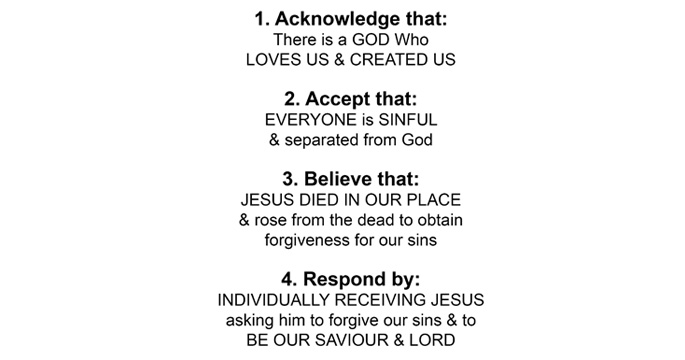
After acknowledging that there is a creator God who loves us, a person must accept that they are a sinner separated from God by their sin. However, many people are reluctant to take this second step. Some people believe that right and wrong are relative, so God will be satisfied if they do what they believe is right for them. Others believe in a ‘Santa Claus’ God who bestows blessings on everyone.
Many people claim that behaviours like selfishness, lying, and cheating to get ahead in life are not sin but merely part of our nature, since mankind evolved through the ‘survival of the fittest’. Many others believe that they are ‘good enough’ to be accepted by God. And so on.
My personal experience
The difficulty often faced by ‘good’ people is illustrated by my parents. They were honest, hard-working, loving, and caring. Our home was harmonious and safe. My parents made sacrifices to give my brother and me a far better education than their own. My parents were frugal but not miserly and our genuine needs were always met. They unselfishly gave up their own interests while my brother and I were young, choosing instead to help organize activities in which we were involved. Family holidays were extremely enjoyable and educational.
My parents prepared us for later life by teaching both of us skills inside and outside the home. They sent us to Sunday school to reinforce the good moral values of our home. They were ‘good’ parents and ‘good’ citizens, so surely they were good enough for God?

Both of my parents saw in nature (Psalm 19:1, Romans 1:20) clear evidence of a Creator God, the great architect of the universe. They believed that God was loving because He had ‘rewarded’ my ‘good’ family with close relationships and fulfilling lives. However, the next step towards becoming a Christian presented a problem.
Because of their ‘goodness’, neither of my parents could recognize that they were sinners separated from God. They believed that a loving God would allow each baby born to start with a ‘clean slate’, and from there, stay acceptable to Him provided their good works outweighed their bad deeds (see Diagram 2). A great many people share this same view.2
This incorrect thinking may stem from ignoring some parts of the Bible (especially the story of Adam and Eve which gives a proper understanding of sin) and misinterpreting other parts (e.g. the life of King David, as we shall see).
Definition and origin of sin
Initially, Adam and Eve enjoyed an intimate personal relationship with God and were sinless. Perhaps because God wanted people to love and obey Him by choice not default, He gave Adam and Eve a choice between obedience and disobedience. He told them not to eat from “the tree of knowledge of good and evil”.3 They chose disobedience—rebellion against God, which is the definition of sin. Thus sin originated through the actions and attitudes of Adam and Eve in the Garden of Eden (Genesis 3:8–13; Romans 5:12).4
Sin’s consequences
As God is holy and cannot look upon evil (Habbakuk 1:13), Adam and Eve’s sin had to have consequences. Creation ceased being “very good” (Genesis 1:31), and became “in bondage” to death and decay (Romans 8:19–22, Isaiah 51:6). Adam and Eve were sent from the Garden of Eden (Genesis 3:23–24) where all their needs had been catered for. Along with their descendants, they had to continually endure hard work and pain (Genesis 3:16–19) from then on.
However, by far the most severe consequence of Adam and Eve’s disobedience was death. Spiritual death, i.e. the severing of the perfect relationship with God, came immediately (Genesis 3:8–11). Physical death occurred later5 (Romans 5:12), but they began to die from that point.6
Transmission of sinfulness to all mankind
Initially, Adam and Eve were unaware of evil. However, once they ate from the “tree of knowledge of good and evil”, that changed. Unfortunately, they succumbed to temptation and sinned by disobeying God (Genesis 3:6). They then tried to shift the blame for their actions (3:12–13), and they experienced shame and fear (3:7,10).
Adam and Eve could not then ‘un-learn’ what they had now experienced and return to their previous state of innocence. Their broken relationship with God left them powerless to overcome sin, so sinful attitudes and actions became a permanent part of their lives, i.e. they acquired a ‘sin nature’ (Romans 8:5–8).

God’s desire to be obeyed willingly also applied to every person yet to be born (i.e. all the descendants of Adam and Eve—Acts 17:26). Like Adam and Eve after the Fall, every subsequent person has had to live with the knowledge of evil, the resulting temptation, and powerlessness to overcome it consistently without a right relationship with God. Therefore, each person has inherited this ‘sin nature’ (Romans 5:12) and has this nature right from birth (Psalm 51:5) even though they themselves have not actually committed sin yet (see also Psalm 58:3).
Contrary to popular thinking, psychology Professor Paul Bloom from Yale University states: “A growing body of evidence suggests that humans do have a rudimentary moral sense from the very start of life.”7
And that: “Some sense of good and evil seems to be bred in the bones.” As the Apostle Paul wrote, people “show that the requirements of the law are written on their hearts” (Romans 2:15).
Tragically, no-one can be born with a ‘clean slate’ and, even if they were, no-one could keep it that way. Because of their ‘sin nature’, each person inevitably chooses evil over good despite their best intentions (Romans 7:19) and thus is a sinner condemned by our Holy God (Romans 3:23). Our ‘good’ (however much) counts for nothing as our Holy God cannot countenance any sin at all (however little) (Habbakuk 1:13). (See Diagram 3)
Misinterpretations

On the surface, King David’s life seems to imply that our good can outweigh our sin. When David saw a beautiful woman, lust filled his heart, he committed adultery, and then arranged to have her husband killed (2 Samuel 11). However, this episode was “a stain on a character otherwise fair and wondrously to the glory of God”8 and God called David “a man after My own heart” (1 Sam 13:14; Ac 13:22 & 7:46). While David’s “good” appears to have outweighed his sin, was this the reason for his acceptance by God? Not at all!
When the prophet Nathan challenged David and condemned him for what he had done (2 Sam 12), David confessed his sin and wholeheartedly sought God’s forgiveness. This was the real reason that God forgave David’s sin (2 Sam 12:13; Ps 32:5 & Ps 51:1). (See Diagram 4)
If correctly interpreted, the lives of King David and many other Bible characters clearly contradict the view that our ‘goodness’ can outweigh our sin in God’s eyes.
Necessity of a real Adam and a real Fall
Romans 5:14–19 and 1 Corinthians 15:21–23 make it clear that our predicament is just the same as that of Adam. If then Adam and his predicament of being a sinner under God’s condemnation were not real, is our same predicament real? The two are inseparable.
Evolution suggests explanations of both ‘sin’ and the beginning of mankind without Adam. But, if God formed mankind as violent, self-focused animals without a relationship with Him, would He condemn us for being the way He made us? It would not be just to do so. If God formed mankind as ‘sinners’ separated from Him, we would not need God’s forgiveness—a total contradiction of the Gospel message.
Jesus himself spoke of Adam as a real person, as did Paul, Luke, Jude, Hosea and the writer of Chronicles.9 When speaking of the marriage bond (Matthew 19:4; Mark 10:6), Jesus states that it is just as it was “at the beginning of creation”10, where God made “a woman” (i.e. Eve, Genesis 2:22) to be the wife of “the man” (i.e. the one and only man, Adam, Genesis 2:7,15–22).
Paul repeatedly speaks of Adam and Eve as real people (1 Corinthians 15:45;11 2 Corinthians 11:3) whose disobedience of God brought sin (Romans 5:12) and death (1 Corinthians 15:21–22) into the world. Similarly, Paul writes of a real Adam and Eve created by God as individuals (1 Timothy 2:13) and of the beginning of sin in the Garden of Eden (1 Timothy 2:13–14). The Bible lists the actual names in the male line of descent from Adam down to King David (1 Chronicles), and from Adam to Jesus’ earthly ‘father’ Joseph (Luke 3:23–38).12 Jude v.14 and Hosea 6:7 also speak of a real Adam. Thus, if Adam were not real, then the Bible would be full of mistakes and lies which would totally destroy its authority.
Conclusion
Whatever reason a person may have for not admitting that they are a sinner, the solution is the same—by gaining the correct understanding of sin, people are able to recognize that they personally are a sinner separated from God, and that they can do nothing by themselves to restore fellowship with God.
The only solution to our predicament is to be forgiven by God. This involves believing that Jesus is our saviour who died to obtain forgiveness for our sins.
References
- Adapted from Knowing God Personally, tract produced by Campus Crusade for Christ, Australia (wording not identical). Return to text.
- Unfortunately, there are some quasi-religious organizations that teach of a loving creator God and emphasize being a ‘good’ person, but make no mention of sin or a saviour. This misleads many of their members into believing that their own ‘goodness’ is sufficient to make them acceptable to God. Return to text.
- There was nothing wrong with the fruit itself as everything was “very good” (Genesis 1:31) before Adam and Eve sinned. The problem was disobedience. Return to text.
- Eve ate the fruit because she was deceived; Adam knew what he was doing but chose to please his wife rather than obey God (Genesis 3; see also 1 Timothy 2:14). Return to text.
- Had physical death been immediate, then the human race would have ended right then as Adam and Eve’s first child had not yet been born. Return to text.
- The Hebrew reads as “dying, you shall die”. Return to text.
- “Babies know the difference between good and evil at six months, study reveals”, www.dailymail.com.uk, 9 May 2010. Return to text.
- J.D. Douglas, N. Hillyer, F.F. Bruce, et al. (Eds.) New Bible Dictionary, 2nd ed. Leicester, UK: IVP, p.268. Return to text.
- When Adam is discussed in the Bible, it is always taken for granted that he is a real person. The idea that he may only be symbolic does not occur. Return to text.
- Thus mankind did not appear towards the end of a billions-of-years creation process. Since the Bible only permits thousands of years for the genealogies of Adam’s descendants, these words of Jesus Himself indicate that the “beginning of creation” was only thousands of years ago, too. Return to text.
- Here Paul quotes Genesis 2:7. Return to text.
- If Adam were not a real person, these genealogies would be fakes, i.e. deliberate lies. Return to text.


Readers’ comments
Comments are automatically closed 14 days after publication.