
Natural selection cannot explain the origin of life
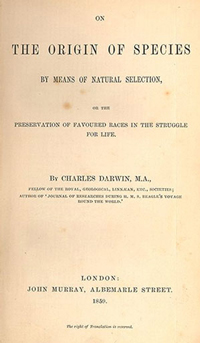
While Charles Darwin’s On the Origin of Species has been described as “a grand narrative—a story of origins that would change the world”,1 ironically his book very pointedly avoided the question of the origin of life itself.
This ought not be surprising. Darwin’s theory of the origin of species “by means of natural selection”2 presupposes self-reproduction, so can’t explain the origin of self-reproduction.
Unfortunately, many proponents of evolution seem unaware of that. They don’t acknowledge that natural selection requires pre-existing life. As leading 20th century evolutionist Theodosius Dobzhansky lamented:
‘In reading some other literature on the origin of life, I am afraid that not all authors have used the term [natural selection] carefully. Natural selection is differential reproduction, organism perpetuation. In order to have natural selection, you have to have self-reproduction or self-replication and at least two distinct self-replicating units or entities. … I would like to plead with you, simply, please realize you cannot use the words “natural selection” loosely. Prebiological natural selection is a contradiction of terms.’3
So, natural selection could only work on a living organism that could produce offspring. By its very definition natural selection could not work on non-living chemicals. Emphasizing the same point that Dobzhansky makes above, the famous philosopher Antony Flew (long known as a leading proponent of atheism until abandoning that belief in the light of increasing knowledge about the cell’s amazing complexity—see “Atheism in decline”) explained:
‘It seems to me that Richard Dawkins [a fanatical advocate for all things Darwinian] constantly overlooks the fact that Darwin himself, in the fourteenth chapter of The Origin of Species, pointed out that his whole argument began with a being which already possessed reproductive powers. This is the creature the evolution of which a truly comprehensive theory of evolution must give some account.
‘Darwin himself was well aware that he had not produced such an account. It now seems to me that the findings of more than fifty years of DNA research have provided materials for a new and enormously powerful argument to design.’4

Some people might be surprised at Flew’s comment that Darwin himself was aware he had not produced a “comprehensive theory of evolution” that could account for the supposed primordial first life. But Flew is correct—in his Origin of Species, Darwin concentrated on the origin of the diversity of life.5 In the final chapter, Darwin wrote: “I should infer from analogy that probably all the organic beings which have ever lived on this earth have descended from some one primordial form … .”6 In a letter to botanist Joseph Hooker in 1863, Darwin lamented having pandered to public opinion in writing in Origin, of the first life form, “into which life was first breathed”6 (as if he believed in divine creation):
“It will be some time before we see ‘slime, protoplasm, &c.’ generating a new animal. But I have long regretted that I truckled to public opinion, and used the Pentateuchal term of creation, by which I really meant ‘appeared’ by some wholly unknown process.”7
Yet he then conceded:
“It is mere rubbish thinking at present of the origin of life; one might as well think of the origin of matter.”7,8
However, in 1871, just eight years later, consistent with his drive to explain origins entirely materialistically, he speculated:
“ … if (and Oh! what a big if!) we could conceive in some warm little pond, with all sorts of ammonia and phosphoric salts, light, heat, electricity, etc., present, that a proteine [sic] compound was chemically formed ready to undergo still more complex changes … ”7
However, how do you get a living cell capable of self-reproduction from a “protein compound … ready to undergo still more complex changes”? Today’s knowledge of the staggering complexity of the cell and more than 50 years of DNA research has convinced the likes of Antony Flew to acknowledge design (and therefore a Designer).
A key problem for the “warm pond” idea is that it equates life to a mere assemblage of chemicals.9 But as renowned physicist Paul Davies, certainly no friend to creationists or Christians in general, has pointed out, the living cell would be more meaningfully equated to an incredibly powerful supercomputer. That’s because the secret of life lies not with the chemical ingredients, but with the organizational arrangement of the molecules. In Davies’ words, the living cell is “an information processing and replicating system of astonishing complexity.”10 Davies continued:
“DNA is not a special life-giving molecule, but a genetic databank that transmits its information using a mathematical code. Most of the workings of the cell are best described, not in terms of material stuff — hardware — but as information, or software. Trying to make life by mixing chemicals in a test tube is like soldering switches and wires in an attempt to produce Windows 98. It won’t work because it addresses the problem at the wrong conceptual level.”9
So, in today’s terminology, Darwin seems to have been thinking of life only as hardware, not software. But as Davies recognized, life’s information content from a naturalistic origin-of-life perspective …
“ … leaves us with a curious conundrum. How did nature fabricate the world’s first digital information processor—the original living cell—from the blind chaos of blundering molecules? How did molecular hardware get to write its own software?”10
Thus the origin of life by chemical evolution (sometimes called “abiogenesis”) remains intractable. No wonder many modern evolutionists have been eager to try to divorce the origin-of-life problem from their defence of evolutionary theory. But their fellow evolutionist Gordy Slack rebukes them for that:
“I think it is disingenuous to argue that the origin of life is irrelevant to evolution. It is no less relevant than the Big Bang is to physics or cosmology. Evolution should be able to explain, in theory at least, all the way back to the very first organism that could replicate itself through biological or chemical processes. And to understand that organism fully, we would simply have to know what came before it. And right now we are nowhere close.”11
Slack is right, and evolutionists should be reminded that the September 1978 issue of Scientific American was specially devoted to evolution, and one major article was ‘Chemical Evolution and the Origin of Life’.12 This stated:
“‘J.B.S. Haldane, the British biochemist, seems to have been the first to appreciate that a reducing atmosphere, one with no free oxygen, was a requirement for the evolution of life from non-living organic matter.” [Emphasis added]
It’s also notable that Dawkins, cited above by Flew, always included some desperate theories about the origin of life in his evolutionary books. In his latest book, The Greatest Show on Earth, he admits:
“The truth is that there is no overwhelming consensus. Several promising ideas have been suggested, but there is no decisive evidence pointing unmistakeably to any one.” (p. 419).
He further tacitly admits that chemical evolution is a problem, but tries to twist this in his favour:
“The theory we seek, of the origin of life on this planet, should therefore positively not be a plausible theory! If it were, then life should be common in the galaxy. Maybe it is common, in which case a plausible theory is what we want. But we have no evidence that life exists outside this planet, and at very least we are entitled to be satisfied with an implausible theory.” (p. 422).
Dawkins’ atheistic faith must be strong indeed, to be satisfied with an implausible theory. He proves the point made by non-creationist information theorist Hubert Yockey 30 years ago:
“Research on the origin of life seems to be unique in that the conclusion has already been authoritatively accepted … . What remains to be done is to find the scenarios which describe the detailed mechanisms and processes by which this happened.”13
Re-featured on homepage: 31 March 2021
References and notes
- Fathom media, The Voyage that Shook the World, 2009, now available on DVD and Blu-ray. Return to text.
- The full title of Darwin’s 1859 book was: On the Origin of Species by Means of Natural Selection, or the Preservation of Favoured Races in the Struggle for Life. Return to text.
- Dobzhansky, T.G., Discussion of Synthesis of Nucleosides and Polynucleotides with Metaphoric Esters, by George Schramm, in Fox, S.W., ed., The Origins of Prebiological Systems and of Their Molecular Matrices, Proceedings of a Conference Conducted at Wakulla Springs, Florida, pp. 309–310, 27–30 October 1963, Academic Press, NY, 1965. Return to text.
- Flew went on to say that such DNA research “has shown, by the almost unbelievable complexity of the arrangements which are needed to produce (life), that intelligence must have been involved”. My Pilgrimage from Atheism to Theism: an exclusive interview with former British atheist Professor Antony Flew by Gary Habermas, Philosophia Christi, Winter 2005. Return to text.
- Note, however, that even with the 20th century addition of mutations to the “modern synthesis” of evolution (see Would Darwin be a Darwinist today?), natural selection still cannot account for the diversity of life on earth. And natural selection can only select what mutations throw up, so it is not creative, but conservative, at best only able to weed out the organisms that are less fit to survive because of the mutations they have suffered. So Darwin was wrong about natural selection being able to explain the diversity of life. Return to text.
- Darwin, C., On the Origin of Species, 1st ed., 1959; page 484. Return to text.
- The Life and Letters of Charles Darwin, edited by his son Francis Darwin, London: John Murray, 1887, Vol. 3, p. 18, accessed via: The Complete Work of Charles Darwin Online, Darwin-online.org.uk. Return to text.
- Or as he expressed it elsewhere “our ignorance is as profound on the origin of life as on the origin of force or matter.” Darwin, C., The doctrine of heterogeny and modification of species, Athenaeum 1852:554–555, 1863. Return to text.
- There are numerous chemical problems quite aside from the information problem stressed in this article, e.g. not all the building blocks are formed, and they would react in many wrong ways that would destroy life or decompose; they are formed as an equal mixture of “left-” and “right-handed” molecules, whereas life must be 100% one-handed, and water would prevent small molecules combining into the big molecules required for life, and would break down any big molecules formed over the alleged evolutionary time. Return to text.
- Davies, P., How we could create life—The key to existence will be found not in primordial sludge, but in the nanotechnology of the living cell, The Guardian, 11 December 2002, www.guardian.co.uk/education/2002/dec/11/highereducation.uk. Return to text.
- Slack, G., What neo-creationists get right—an evolutionist shares lessons he’s learned from the Intelligent Design camp, The Scientist, http://www.the-scientist.com/templates/trackable/display/news.jsp?type=news&o_url=news/display/54759&id=54759, 20 June 2008. Return to text.
- Dickerson, R.E., Chemical Evolution and the Origin of Life, Scientific American 239(3):62–102, September 1978. Return to text.
- Yockey, H.P., A calculation of the probability of spontaneous biogenesis by information theory, Journal of Theoretical Biology 67:377–398, 1977. Return to text.


Readers’ comments
Comments are automatically closed 14 days after publication.