

The way it really is: little-known facts about radiometric dating
Long-age geologists will not accept a radiometric date unless it matches their pre-existing expectations.
Many people think that radiometric dating has proved the Earth is millions of years old. That’s understandable, given the image that surrounds the method. Even the way dates are reported (e.g. 200.4 ± 3.2 million years) gives the impression that the method is precise and reliable (box below).
However, although we can measure many things about a rock, we cannot directly measure its age. For example, we can measure its mass, its volume, its colour, the minerals in it, their size and the way they are arranged. We can crush the rock and measure its chemical composition and the radioactive elements it contains. But we do not have an instrument that directly measures age.
Before we can calculate the age of a rock from its measured chemical composition, we must assume what radioactive elements were in the rock when it formed.1 And then, depending on the assumptions we make, we can obtain any date we like.
It may be surprising to learn that evolutionary geologists themselves will not accept a radiometric date unless they think it is correct—i.e. it matches what they already believe on other grounds. It is one thing to calculate a date. It is another thing to understand what it means.
So, how do geologists know how to interpret their radiometric dates and what the ‘correct’ date should be?
Field relationships
A geologist works out the relative age of a rock by carefully studying where the rock is found in the field. The field relationships, as they are called, are of primary importance and all radiometric dates are evaluated against them.
For example, a geologist may examine a cutting where the rocks appear as shown in Figure 1. Here he can see that some curved sedimentary rocks have been cut vertically by a sheet of volcanic rock called a dyke. It is clear that the sedimentary rock was deposited and folded before the dyke was squeezed into place.

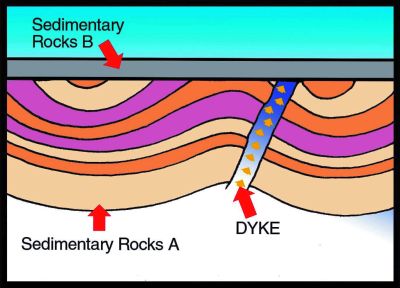
By looking at other outcrops in the area, our geologist is able to draw a geological map which records how the rocks are related to each other in the field. From the mapped field relationships, it is a simple matter to work out a geological cross-section and the relative timing of the geologic events. His geological cross-section may look something like Figure 2.
Clearly, Sedimentary Rocks A were deposited and deformed before the Volcanic Dyke intruded them. These were then eroded and Sedimentary Rocks B were deposited.
The geologist may have found some fossils in Sedimentary Rocks A and discovered that they are similar to fossils found in some other rocks in the region. He assumes therefore that Sedimentary Rocks A are the same age as the other rocks in the region, which have already been dated by other geologists. In the same way, by identifying fossils, he may have related Sedimentary Rocks B with some other rocks.
Creationists would generally agree with the above methods and use them in their geological work.
From his research, our evolutionary geologist may have discovered that other geologists believe that Sedimentary Rocks A are 200 million years old and Sedimentary Rocks B are 30 million years old. Thus, he already ‘knows’ that the igneous dyke must be younger than 200 million years and older than 30 million years. (Creationists do not agree with these ages of millions of years because of the assumptions they are based on.2)
Because of his interest in the volcanic dyke, he collects a sample, being careful to select rock that looks fresh and unaltered. On his return, he sends his sample to the laboratory for dating, and after a few weeks receives the lab report.
Let us imagine that the date reported by the lab was 150.7 ± 2.8 million years. Our geologist would be very happy with this result. He would say that the date represents the time when the volcanic lava solidified. Such an interpretation fits nicely into the range of what he already believes the age to be. In fact, he would have been equally happy with any date a bit less than 200 million years or a bit more than 30 million years. They would all have fitted nicely into the field relationships that he had observed and his interpretation of them. The field relationships are generally broad, and a wide range of ‘dates’ can be interpreted as the time when the lava solidified.
What would our geologist have thought if the date from the lab had been greater than 200 million years, say 350.5 ± 4.3 million years? Would he have concluded that the fossil date for the sediments was wrong? Not likely. Would he have thought that the radiometric dating method was flawed? No. Instead of questioning the method, he would say that the radiometric date was not recording the time that the rock solidified. He may suggest that the rock contained crystals (called xenocrysts) that formed long before the rock solidified and that these crystals gave an older date.3 He may suggest that some other very old material had contaminated the lava as it passed through the earth. Or he may suggest that the result was due to a characteristic of the lava—that the dyke had inherited an old ‘age’.
The error is not the real error

The convention for reporting dates (e.g. 200.4 ± 3.2 million years) implies that the calculated date of 200.4 million years is accurate to plus or minus 3.2 million years. In other words, the age should lie between 197.2 million years and 203.6 million years. However, this error is not the real error on the date. It relates only to the accuracy of the measuring equipment in the laboratory. Even different samples of rock collected from the same outcrop would give a larger scatter of results. And, of course, the reported error ignores the huge uncertainties in the assumptions behind the ‘age’ calculation. These include the assumption that decay rates have never changed. In fact, decay rates have been increased in the laboratory by factors of billions of times.1 Creationist physicists point to several lines of evidence that decay rates have been faster in the past, and propose a pulse of accelerated decay during Creation Week, and possibly a smaller pulse during the Flood year.2
References
- Woodmorappe, J., Billion-fold acceleration of radioactivity demonstrated in laboratory, TJ 15(2):4–6, 2001.
- Vardiman, L., Snelling, A.A. and Chaffin, E.F., Radioisotopes and the age of the Earth, Institute for Creation Research, El Cajon, California and Creation Research Society, St. Joseph, Missouri, USA, 2000. Text is available at icr.org/rate.
What would our geologist think if the date from the lab were less than 30 million years, say 10.1 ± 1.8 million years? No problem. Would he query the dating method, the chronometer? No. He would again say that the calculated age did not represent the time when the rock solidified. He may suggest that some of the chemicals in the rock had been disturbed by groundwater or weathering.4 Or he may decide that the rock had been affected by a localized heating event—one strong enough to disturb the chemicals, but not strong enough to be visible in the field.
No matter what the radiometric date turned out to be, our geologist would always be able to ‘interpret’ it. He would simply change his assumptions about the history of the rock to explain the result in a plausible way. G. Wasserburg, who received the 1986 Crafoord Prize in Geosciences, said, ‘There are no bad chronometers, only bad interpretations of them!’5 In fact, there is a whole range of standard explanations that geologists use to ‘interpret’ radiometric dating results.
Why use it?
Someone may ask, ‘Why do geologists still use radiometric dating? Wouldn’t they have abandoned the method long ago if it was so unreliable?’ Just because the calculated results are not the true ages does not mean that the method is completely useless. The dates calculated are based on the isotopic composition of the rock. And the composition is a characteristic of the molten lava from which the rock solidified. Therefore, rocks in the same area which give similar ‘dates’ are likely to have formed from the same lava at about the same time during the Flood. So, although the assumptions behind the calculation are wrong and the dates are incorrect, there may be a pattern in the results that can help geologists understand the relationships between igneous rocks in a region.
Contrary to the impression that we are given, radiometric dating does not prove that the Earth is millions of years old. The vast age has simply been assumed.2 The calculated radiometric ‘ages’ depend on the assumptions that are made. The results are only accepted if they agree with what is already believed. The only foolproof method for determining the age of something is based on eyewitness reports and a written record. We have both in the Bible. And that is why creationists use the historical evidence in the Bible to constrain their interpretations of the geological evidence.
What if the rock ages are not ‘known’ in advance—does radio-dating give coherent results?
Recently, I conducted a geological field trip in the Townsville area, North Queensland. A geological guidebook,1 prepared by two geologists, was available from a government department.
The guidebook’s appendix explains ‘geological time and the ages of rocks.’ It describes how geologists use field relationships to determine the relative ages of rocks. It also says that the ‘actual’ ages are measured by radiometric dating—an expensive technique performed in modern laboratories. The guide describes a number of radiometric methods and states that for ‘suitable specimens the errors involved in radiometric dating usually amount to several percent of the age result. Thus … a result of two hundred million years is expected to be quite close (within, say, 4 million) to the true age.’

This gives the impression that radiometric dating is very precise and very reliable—the impression generally held by the public. However, the appendix concludes with this qualification: ‘Also, the relative ages [of the radiometric dating results] must always be consistent with the geological evidence. … if a contradiction occurs, then the cause of the error needs to be established or the radiometric results are unacceptable’.
This is exactly what our main article explains. Radiometric dates are only accepted if they agree with what geologists already believe the age should be.
Townsville geology is dominated by a number of prominent granitic mountains and hills. However, these are isolated from each other, and the area lacks significant sedimentary strata. We therefore cannot determine the field relationships and thus cannot be sure which hills are older and which are younger. In fact, the constraints on the ages are such that there is a very large range possible.
We would expect that radiometric dating, being allegedly so ‘accurate,’ would rescue the situation and provide exact ages for each of these hills. Apparently, this is not so.
Concerning the basement volcanic rocks in the area, the guidebook says, ‘Their exact age remains uncertain.’ About Frederick Peak, a rhyolite ring dyke in the area, it says, ‘Their age of emplacement is not certain.’ And for Castle Hill, a prominent feature in the city of Townsville, the guidebook says, ‘The age of the granite is unconfirmed.’
No doubt, radiometric dating has been carried out and precise ‘dates’ have been obtained. It seems they have not been accepted because they were not meaningful.
Reference
- Trezise, D.L. and Stephenson, P.J., Rocks and landscapes of the Townsville district, Department of Resource Industries, Queensland, 1990.
Re-posted on homepage: 23 June 2021
References and notes
- In addition to other unprovable assumptions, e.g. that the decay rate has never changed. Return to text.
- Evolutionary geologists believe that the rocks are millions of years old because they assume they were formed very slowly. They have worked out their geologic timescale based on this assumption. This timescale deliberately ignores the catastrophic effects of the Biblical Flood, which deposited the rocks very quickly. Return to text.
- This argument was used against creationist work that exposed problems with radiometric dating. Laboratory tests on rock formed from the 1980 eruption of Mt St Helens gave ‘ages’ of millions of years. Critics claimed that ‘old’ crystals contained in the rock contaminated the result. However, careful measurements by Dr Steve Austin showed this criticism to be wrong. See Swenson, K., Radio-dating in rubble, Creation 23(3):23–25, 2001. Return to text.
- This argument was used against creationist work done on a piece of wood found in sandstone near Sydney, Australia, that was supposed to be 230 million years old. Critics claimed that the carbon-14 results were ‘too young’ because the wood had been contaminated by weathering. However, careful measurements of the carbon-13 isotope refuted this criticism. See Snelling, A.A., Dating dilemma: fossil wood in ‘ancient’ sandstone, Creation 21(3):39–41, 1999. Return to text.
- Wasserburg, G.J., Isotopic abundances: inferences on solar system and planetary evolution, Earth and Planetary Sciences Letters 86:129–173, 150, 1987. Return to text.


Readers’ comments
Comments are automatically closed 14 days after publication.