
Feedback archive → Feedback 2008

Unfair to Islam?
A constructive critic, Andrew C, a teacher of Philosophy and Religious Studies from the UK, takes us to task for our comments on Islamic terrorism in our article on ‘Fundamentalism’ in Creation 30(4). Jonathan Sarfati explains why we said what we said, and some major differences between the Bible and Koran ‘proof texts’.
Dear Editors
As a teacher of Philosophy and Religious Studies, I have to protest at your treatment of Islam in the latest Creation magazine 30(4) p. 16 [Anyone for fundamentalism? by Russell Grigg pp. 15–17].
You have taken a few proof-texts from the Qur’an and claimed that Islamist terrorists are acting in accordance with the teaching of Muhammad. However, you have ignored the fact that the Qur’an and Hadiths (Islamic tradition) clearly outline rules of engagement, comparable to and in some ways stricter than the Christian ‘Just War Theory’. For example, Surah 2:190 says, ‘Fight in the way of Allah against those who fight against you, but begin not hostilities. Allah loves not aggressors.’ Surah 2:193 goes on to say, ‘But if they desist, then let there be no hostility except against wrongdoers.’ Other places state that warfare must not hurt women and children, animals, the environment or a population’s means of sustenance.
However, Muslims have a doctrine called Naskh (نسخ) or ‘abrogation’, where if there is a conflict, passages written later supersede earlier ones. The problem in our society is explained by John Burton in Encyclopedia of Islam:
‘Many verses counsel patience in the face of the mockery of the unbelievers, while other verses incite to warfare against the unbelievers. The former are linked to the [chronologically anterior] Meccan phase of the mission when the Muslims were too few and weak to do other than endure insult; the latter are linked to Medina where the Prophet had acquired the numbers and the strength to hit back at his enemies. The discrepancy between the two sets of verses indicates that different situations call for different regulations.’
Answering-Islam.org explains in Jihad in Islam: Is Islam Peaceful or Militant?
The well known Egyptian scholar, Sayyid Qutb, notes four stages in the development of jihad: 1. While the earliest Muslims remained in Mecca before fleeing to Medina, God did not allow them to fight; 2. Permission is given to Muslims to fight against their oppressors; 3. God commands Muslims to fight those fighting them; 4. God commands the Muslims to fight against all polytheists. He views each stage to be replaced by the next stage in this order, the fourth stage to remain permanent.
Islamic teaching on jihad is that physical warfare is only a part—and the least honourable part—of jihad, which means ‘struggle’ not ‘holy war’. The Hadith teaches that ‘The most excellent jihad is the uttering of truth in the presence of an unjust ruler.’
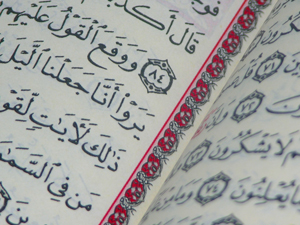
Yet Jihad in Islam: Is Islam Peaceful or Militant? continues:
The majority of the Qur’an’s texts themselves clearly identify jihad as physical warfare in Islam and, Islamically, God’s way of establishing the Kingdom of God on earth. They hardly require to be interpreted metaphorically. Likewise, from the Hadith and the earliest biographies of Muhammad it is just as evident that the early Muslim community understood these Quranic texts to be taken literally. Historically, therefore, from the time of Muhammad onwards, jihad as physical warfare in support of the message of Islam has been a reality for the Muslim community. Hence it comes as no surprise when even terrorists easily appeal to these source materials to justify their actions, not to speak of their teachers who teach the theory and the art of terrorism.
I am not claiming that Islam has no case to answer when it comes to promoting violence. However, this is a very complex issue, debated widely within Islam and in the Islamic Studies departments of universities, with no single clear line of teaching. What we can say, though, is that the vast majority of Muslims do not regard terrorist atrocities as authentic jihad.
Indeed, I know some anti-terrorist Muslims myself. But even if 99% of the world’s 1.2 billion Muslims were anti-terrorist, that still leaves 12 million who aren’t. And former Muslim Daniel Shayesteh has testified publicly, from personal experience, that ‘the difference between a nominal Muslim and a fundamentalist one is just 15 minutes.’ In Shayesteh’s case, just 15 minutes was needed to persuade him that violence was an integral part of his jihadist duty. A large proportion of Muslims are unfamiliar with much of the content of the Qur’an—so when shown what the Qur’an actually says (e.g. Surah 8:12—‘ … instill terror in the hearts of the Unbelievers: Smite ye above their necks … ’), why wouldn’t obedient Muslims follow the teachings of their religion? Another article on the Answering Islam site, The Two Faces of Islam Still Smiling: Why All Muslims Benefit From Terrorism, said:

I’m very happy that most Muslims are willing to live in peace with their neighbors. Yet we have to be honest here. Benevolent Muslims aren’t peaceful because they are following the example set by Muhammad. They are peaceful because they’ve chosen to do what’s right, and because they are willing to live far better lives than Muhammad himself lived. In fact, many Muslims are such kind, peaceful, and gentle people that they seem to be following the example set by another great religious leader—one who died on the cross for the sins of the world and rose from the dead to prove his message.
Economist and author Dr Walter Williams argued that the peaceful Muslim majority is irrelevant. He compared the current constant hectoring about this with WW2:
Think back to the 1930s when the Japanese murdered an estimated 3 million to 10 million people in China, Indonesia, Korea, Philippines and Indochina; and on December 7, 1941 when they attacked Pearl Harbor, killing over 2,400 Americans. I’m betting that most of Japan’s at-the-time 60 million population were peace-loving people and would have wanted nothing to do with the brutal slaughter in China and the attack on the U.S. In formulating our response to the attack, should President Roosevelt have taken into account the fact that most Japanese are peace-loving people ruled by fanatics? Should our military have only gone after the Japanese pilots and their naval armada? I’d also wager that most Germans were peace-loving people and not part of the Nazi sadists wanting to wage war on their neighbors and exterminate the Jews. Again, should Roosevelt and Churchill have taken that into account in their response to German militarism? My answer is no and thank G-d it was their answer as well. Whether most Germans, Italians or Japanese were peace-loving or not was entirely irrelevant in formulating the Allied response to their militarism.
Then Williams pointed out that the radicals couldn’t exist without at least tacit support from a large number of moderates:
At this particular time, fanatical jihadists are calling the terrorism shots in many Muslim countries. Their success in committing terrorist acts is in no small part the result of the actions by the millions of peace-loving fellow Muslims. First, there is not enough condemnation of their terrorist acts by the Muslim community. More important is the direct or indirect assistance terrorists receive through the silence of their fellow Muslims. There is no way terrorists can carry on their operations, obtain explosive materials, run terrorist training camps, raise money without the knowledge of other Muslims, whether they’re government officials, bankers, family members, friends or neighbors.
Williams points out in Will the West survive? (http://walterewilliams.com/will-the-west-survive/)
By no means are all Muslims murderers. But on the other hand, I’ve never heard broad Muslim condemnation of their fellow Muslims’ murderous acts committed in the name of their god. If anything, there has been jubilation and dancing in the streets in the wake of Muslim attacks on Westerners. Contrast their response to the widespread Western condemnation of the, mild by comparison, behavior of a few coalition forces in Iraq’s Abu Ghraib prison.
To quote a few proof texts and claim that the Qur’an promotes violence is a very low blow. How would you respond if someone quoted 1 Samuel 15:3, Joel 3:9–10 and Matthew 10:34–36 (and many others) in a similar argument against Christianity? You would accuse them of twisting the text and treating Christianity unfairly—yet you have done exactly the same to Muslims in this article.
Except that it’s not exactly the same, but quite the opposite. While the contrast between ‘Old Testament God of Judgement’ and ‘New Testament God of Love’ is absurd (see Does God Differ From the OT to the NT?1), it’s notable that the most warlike passages are in the Old Testament. If there is any ‘abrogation’, it is in the opposite direction to the Qur’an’s, since Christian believers have a resource not available to the Israelites: the indwelling Holy Spirit and knowledge that the Messiah has already come, saying: ‘Love your enemies’ (Matthew 5:44). (You won’t find that commandment anywhere in the Qur’an!) Indeed, just consider the huge difference between Jesus and Muhammad about how to spread their respective messages—this alone suffices to defeat the ‘moral equivalence’ arguments.
As for how we would respond, we would answer specifically and contextually, and refute the moral equivalence.
1 Samuel 15:3 dealt with a deadly and unrepentant enemy of the Israelite nation, the Amalekites—see Shouldn’t the butchering of the Amalekites children be considered war crimes?
Joel 3:9–10 is a case in point: a passage for the Israelite nation surrounded by warlike pagan nations.
With the only New Testament passage cited, I would show that Jesus reference to a sword refers to personal spiritual division not a literal blade, by citing the context (Matthew 10:32–40):
So everyone who acknowledges me before men, I also will acknowledge before my Father who is in heaven, but whoever denies me before men, I also will deny before my Father who is in heaven.
Do not think that I have come to bring peace to the earth. I have not come to bring peace, but a sword. For I have come to set a man against his father, and a daughter against her mother, and a daughter-in-law against her mother-in-law.
And a person’s enemies will be those of his own household.
Whoever loves father or mother more than me is not worthy of me, and whoever loves son or daughter more than me is not worthy of me.
And whoever does not take his cross and follow me is not worthy of me.
Whoever finds his life will lose it, and whoever loses his life for my sake will find it.
Whoever receives you receives me, and whoever receives me receives him who sent me.
Not only that, but you have done so in a forum where Muslims will have limited ability to respond,
That’s ironic—there isn’t a Christianized country in the West where Muslims are not free to practice their religion peacefully and proselytize, while there is not a single Islamic country that allows the same for Christians. Many even have the death penalty for Muslims who apostatize from Islam.
and you have simply supplied ammunition to incite additional prejudice in a Western culture already quite hostile to (or at least fearful of) Muslims in the present political climate.
I doubt that we need to incite any fear; far too many do a good job of that all by themselves. And there seems to be no end of assurances in newspapers, radio and television commentaries that most Muslims are peaceful. Several of my favorite television crime shows featuring a Muslim terrorist have gone out of their way to tell their viewers that Islam is really a peaceful religion distorted by the terrorists.
But within a few weeks, there is an episode about a pro-lifer blowing up an abortuary or some such, with not the slightest disclaimer that this is such a tiny minority that you could count them on your fingers, and the pro-life groups universally condemn them. Reconstructionist Gary North wrote a harsh letter denouncing Paul Hill, who killed an abortionist; Hill had previously been excommunicated by his church for talking about what he later did.
Another example is the BBC in Andrew C’s own country. The article Yes, we are biased on religion and politics, admit BBC executives (22 October 2006) reports:
Senior figures admitted that the BBC is guilty of promoting Left-wing views and an anti-Christian sentiment. They also said that as an organisation it was disproportionately over-represented by gays and ethnic minorities.
During the meeting, hosted by Sue Lawley, executives admitted they would happily broadcast the image of a Bible being thrown away — but would not do the same for the Koran.
Muslim leaders, to their credit, condemned such disrespect for the Bible.
Jesus said, ‘Do to others as you would have them do to you,’ but you have failed to abide by this teaching in your article. I think you would be best advised to print a retraction of this section of the article.
I still fail to see why. The bottom line is to look at the history of both religions, e.g. in Robert Spencer’s books such as The Politically Incorrect Guide to Islam (and the Crusades) and Religion of Peace? Why Christianity Is and Islam Isn’t.

The Muslims quickly conquered the Iberian Peninsula well before the Crusades. They probably would have almost certainly conquered Europe if the Frankish king Charles Martel’s infantry had not defeated the Muslim cavalry at the Battle of Tours/Poitiers in a brilliant defensive strategy.
Also, just think about the historic centres of Christianity such as Jerusalem, Antioch, Alexandria and the rest of North Africa—they are now Muslim lands, converted at the point of the sword. And after the crusades, the Muslim Turks conquered the ancient land of Asia Minor, the birthplace of the Apostle Paul, the site of many of his missionary journeys and home of the Seven Churches of the book of Revelation. Furthermore, when they conquered Constantinople (now Istanbul) in 1453, they turned Hagia Sophia (Holy Wisdom), the world’s biggest church of its day and centre of Eastern Orthodoxy, into a mosque.
One thing we might agree upon though: CMI’s major emphasis with Muslims is on the deity of Christ, and foundational; the differences about other issues are derivative. And as a creation ministry, we point out the superiority of the creation accounts in Genesis to those of the Qur’an—see the wide-ranging article, The Koran (Qur’an) vs Genesis.
With regard to the main point of the article, about the use of the term ‘fundamentalist’, however, I agree. I always discourage my students from using this word at all, and insist that they define it carefully if they do use it. When a term such as this becomes used only as a pejorative label it ceases to be useful in the study of Philosophy and Religion.
On this we heartily agree.
Yours in Christ,
Andrew C.
Yours in Christ
Jonathan Sarfati
Update: see further feedback on this one: Unfair to Islam? Round 2.
References
- See also Gleason Archer, Encyclopedia of Bible Difficulties, ‘Doesn’t the Old Testament present a different kind of God than the New Testament?’, pp. 309–310, Zondervan, 1982. Return to text.

Readers’ comments
Comments are automatically closed 14 days after publication.