

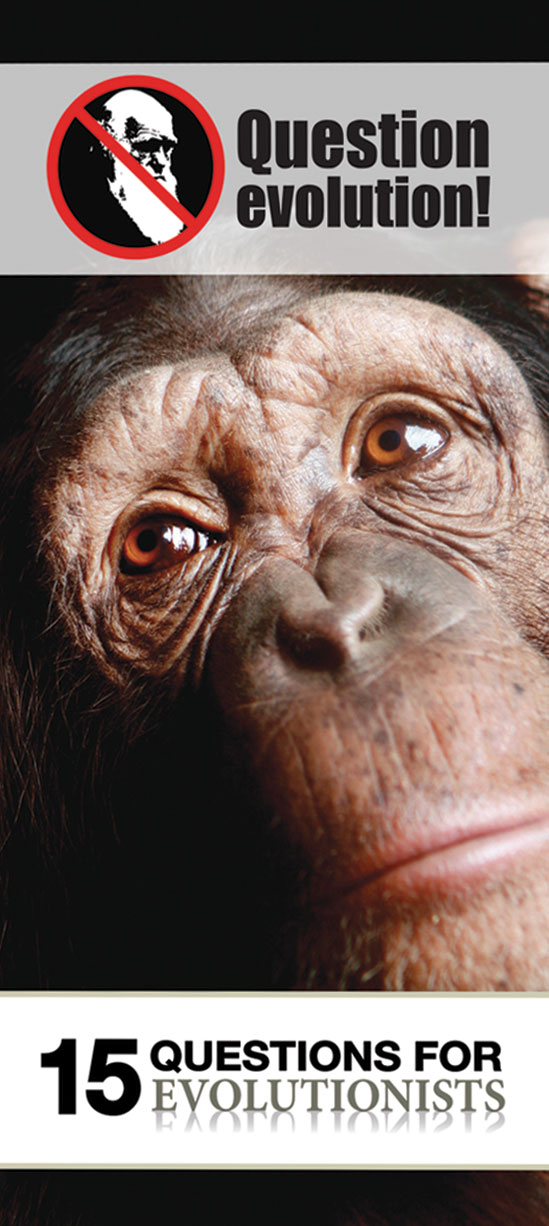
15 Questions for Evolutionists
Evolution: the naturalistic origin of life and its diversity
(The General Theory of Evolution, as acknowledged by prominent evolutionists, includes the origin of life; see introduction to Origin of life.)
How did life originate? Evolutionist Professor Paul Davies admitted, “Nobody knows how a mixture of lifeless chemicals spontaneously organized themselves into the first living cell.”1 Andrew Knoll, professor of biology, Harvard, said, “we don’t really know how life originated on this planet”.2 A minimal cell needs several hundred proteins. Even if every atom in the universe were an experiment with all the correct amino acids present for every possible molecular vibration in the supposed evolutionary age of the universe, not even one average-sized functional protein would form. So how did life with hundreds of proteins originate just by chemistry without intelligent design?
See:How did the DNA code originate? The code is a sophisticated language system with letters and words where the meaning of the words is unrelated to the chemical properties of the letters—just as the information on this page is not a product of the chemical properties of the ink (or pixels on a screen). What other coding system has existed without intelligent design? How did the DNA coding system arise without it being created?
See:How could mutations—accidental copying mistakes (DNA ‘letters’ exchanged, deleted or added, genes duplicated, chromosome inversions, etc.)—create the huge volumes of information in the DNA of living things? How could such errors create 3 billion letters of DNA information to change a microbe into a microbiologist? There is information for how to make proteins but also for controlling their use—much like a cookbook contains the ingredients as well as the instructions for how and when to use them. One without the other is useless. See: Meta-information: An impossible conundrum for evolution. Mutations are known for their destructive effects, including over 1,000 human diseases such as hemophilia. Rarely are they even helpful. But how can scrambling existing DNA information create a new biochemical pathway or nano-machines with many components, to make ‘goo-to-you’ evolution possible? E.g., How did a 32-component rotary motor like ATP synthase (which produces the energy currency, ATP, for all life), or robots like kinesin (a ‘postman’ delivering parcels inside cells) originate?
See:Why is natural selection, a principle recognized by creationists, taught as ‘evolution’, as if it explains the origin of the diversity of life? By definition it is a selective process (selecting from already existing information), so is not a creative process. It might explain the survival of the fittest (why certain genes benefit creatures more in certain environments), but not the arrival of the fittest (where the genes and creatures came from in the first place). The death of individuals not adapted to an environment and the survival of those that are suited does not explain the origin of the traits that make an organism adapted to an environment. E.g., how do minor back-and-forth variations in finch beaks explain the origin of beaks or finches? How does natural selection explain goo-to-you evolution?
See:How did new biochemical pathways, which involve multiple enzymes working together in sequence, originate? Every pathway and nano-machine requires multiple protein/enzyme components to work. How did lucky accidents create even one of the components, let alone 10 or 20 or 30 at the same time, often in a necessary programmed sequence? Evolutionary biochemist Franklin Harold wrote, “we must concede that there are presently no detailed Darwinian accounts of the evolution of any biochemical or cellular system, only a variety of wishful speculations.”3
See:- Design in living organisms (motors: ATP synthase) (includes animation).
- Video on Question 5
Living things look like they were designed, so how do evolutionists know that they were not designed? Richard Dawkins wrote, “biology is the study of complicated things that have the appearance of having been designed with a purpose.”4 Francis Crick, the co-discoverer of the double helix structure of DNA, wrote, “Biologists must constantly keep in mind that what they see was not designed, but rather evolved.”5 The problem for evolutionists is that living things show too much design. Who objects when an archaeologist says that pottery points to human design? Yet if someone attributes the design in living things to a designer, that is not acceptable. Why should science be restricted to naturalistic causes rather than logical causes?
See:How did multi-cellular life originate? How did cells adapted to individual survival ‘learn’ to cooperate and specialize (including undergoing programmed cell death) to create complex plants and animals?
See:How did sex originate? Asexual reproduction gives up to twice as much reproductive success (‘fitness’) for the same resources as sexual reproduction, so how could the latter ever gain enough advantage to be selected? And how could mere physics and chemistry invent the complementary apparatuses needed at the same time (non-intelligent processes cannot plan for future coordination of male and female organs).
See:Why are the (expected) countless millions of transitional fossils missing? Darwin noted the problem and it still remains. The evolutionary family trees in textbooks are based on imagination, not fossil evidence. Famous Harvard paleontologist (and evolutionist), Stephen Jay Gould, wrote, “The extreme rarity of transitional forms in the fossil record persists as the trade secret of paleontology”.6 Other evolutionist fossil experts also acknowledge the problem.
See:How do ‘living fossils’ remain unchanged over supposed hundreds of millions of years, if evolution has changed worms into humans in the same time frame? Professor Gould wrote, “the maintenance of stability within species must be considered as a major evolutionary problem.”7
See:How did blind chemistry create mind/ intelligence, meaning, altruism and morality? If everything evolved, and we invented God, as per evolutionary teaching, what purpose or meaning is there to human life? Should students be learning nihilism (life is meaningless) in science classes?
See:Why is evolutionary ‘just-so’ story-telling tolerated? Evolutionists often use flexible story-telling to ‘explain’ observations contrary to evolutionary theory. NAS(USA) member Dr Philip Skell wrote, “Darwinian explanations for such things are often too supple: Natural selection makes humans self-centered and aggressive—except when it makes them altruistic and peaceable. Or natural selection produces virile men who eagerly spread their seed—except when it prefers men who are faithful protectors and providers. When an explanation is so supple that it can explain any behavior, it is difficult to test it experimentally, much less use it as a catalyst for scientific discovery.”8
See:Where are the scientific breakthroughs due to evolution? Dr Marc Kirschner, chair of the Department of Systems Biology, Harvard Medical School, stated: “In fact, over the last 100 years, almost all of biology has proceeded independent of evolution, except evolutionary biology itself. Molecular biology, biochemistry, physiology, have not taken evolution into account at all.”9 Dr Skell wrote, “It is our knowledge of how these organisms actually operate, not speculations about how they may have arisen millions of years ago, that is essential to doctors, veterinarians, farmers … .”10 Evolution actually hinders medical discovery.11 Then why do schools and universities teach evolution so dogmatically, stealing time from experimental biology that so benefits humankind?
See:Science involves experimenting to figure out how things work; how they operate. Why is evolution, a theory about history, taught as if it is the same as this operational science? You cannot do experiments, or even observe what happened, in the past. Asked if evolution has been observed, Richard Dawkins said, “Evolution has been observed. It’s just that it hasn’t been observed while it’s happening.”12
See:Why is a fundamentally religious idea, a dogmatic belief system that fails to explain the evidence, taught in science classes? Karl Popper, famous philosopher of science, said “Darwinism is not a testable scientific theory, but a metaphysical [religious] research programme ….”13 Michael Ruse, evolutionist science philosopher admitted, “Evolution is a religion. This was true of evolution in the beginning, and it is true of evolution still today.”14 If “you can’t teach religion in science classes”, why is evolution taught?
See:
Thanks to “Cowboy Bob” Sorensen for this ‘YouTube’ version of the 15 questions brochure.


References
- Davies, Paul, Australian Centre for Astrobiology, Sydney, New Scientist 179(2403):32, 2003. Return to text.
- Knoll, Andrew H., PBS Nova interview, How Did Life Begin? July 1, 2004. Return to text.
- Harold, Franklin M. (Prof. Emeritus Biochemistry, Colorado State University) The way of the cell: molecules, organisms and the order of life, Oxford University Press, New York, 2001, p. 205. Return to text.
- Dawkins, R., The Blind Watchmaker, W.W. Norton & Company, New York, p. 1, 1986. Return to text.
- Crick, F., What mad pursuit: a Personal View of Scientific Discovery, Sloan Foundation Science, London, 1988, p. 138. Return to text.
- Gould, Stephen Jay, Evolution’s erratic pace, Natural History 86(5):14, May 1977. Return to text.
- Gould, S.J. and Eldredge, N., Punctuated equilibrium comes of age. Nature 366:223–224, 1993. Return to text.
- Skell, P.S., Why Do We Invoke Darwin? Evolutionary theory contributes little to experimental biology, The Scientist 19(16):10, 2005. Return to text.
- As quoted in the Boston Globe, 23 October 2005. Return to text.
- Skell, P.S., The Dangers Of Overselling Evolution; Focusing on Darwin and his theory doesn’t further scientific progress, Forbes magazine, 23 Feb 2009; http://www.forbes.com/2009/02/23/evolution-creation-debate-biology-opinions-contributors_darwin.html. Return to text.
- E.g. Krehbel, M., Railroad wants monkey off its back, Creation 16(4):20–22, 1994; creation.com/monkey_back. Return to text.
- pbs.org/moyers/journal/archives/dawkins_now.html, 3 December 2004, accessed 4 May 2022. Return to text.
- Popper, K., Unended Quest, Fontana, Collins, Glasgow, p. 151, 1976. Return to text.
- Ruse, M., How evolution became a religion: creationists correct? National Post, pp. B1,B3,B7 May 13, 2000. Return to text.


Readers’ comments
Comments are automatically closed 14 days after publication.