
An ‘impossible’ dream—for an atheist
By the third time that I’d had this dream (in my early twenties), the details were very firmly etched in my mind. It was always the same. In the dream I was walking on a hot day along a dusty rough vehicular track, dodging the muddy potholes—evidence of past rain (I guessed), though not for a while it seemed, as the sides of the potholes had dried out and caked hard. The air smelt of a curious mixture of dry dust and drying mud.
Apart from the bare wheel ruts, the track was overgrown with weedy plants, many of which were in flower—their fragrance along with the smell of mud and airborne dust was unforgettably distinctive. It was obviously a rural area, as to my left and right, i.e. on the other side of each of the barbed wire fences lining the road, cattle—a beautiful chestnut-coloured type, with white legs, which I’d never seen before—were grazing. The air was so still and quiet in the midday heat that I could very clearly hear the cattle crunching on the stubble they were grazing.
At that exact moment, a cloud suddenly provided me with some welcome shady respite from the fierce heat of the midday sun directly overhead. At this point in the dream, I remember noting:
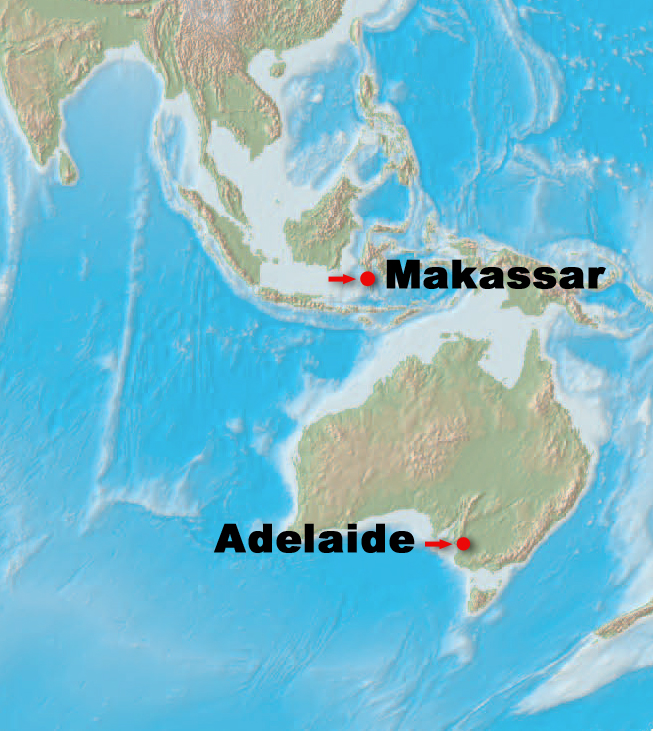
- the sun was indeed directly overhead—something I’d never seen before, having spent all my life (up to that point) at southern latitudes (I grew up in Adelaide, South Australia, which is where I had this recurring dream)
- the cloud was obviously very small and the only cloud in the sky, because the land just a short distance away from me (in all directions) was still bathed in sunlight, including in front of me just off to my left a cluster of small greyish white concrete buildings constructed in a style I’d never seen before.
While I was absorbing all this, the silence was suddenly broken by the sound of a chainsaw, coming from a distant stand of trees off to my right.
It was always at this point in the dream that I woke up to find it was morning, in Adelaide, and time for me to go off to school/university. Given that I was an atheist at the time, I simply dismissed the recurring ‘dream’ as an involuntary product of my brain doing whatever it is that brains do to process and file away information picked up from what our eyes, ears, etc., saw, heard or read during our waking hours. After all (I reasoned at the time), we’re just a collection of chemicals, and our brain is really just a bunch of chemical reactions—so our sleep is an opportunity for the body to reorganize/reverse the brain’s chemical reactions ready for a new day—akin to recharging batteries overnight.
Or so I thought—back then. (Today, as a Christian, I have a very different view.)
Journey to Indonesia
Time passed, and at 23 years of age I accepted an opportunity to work in Indonesia on an intergovernmental (Australia–Indonesia) cooperative agricultural research project.

I was based at a research station in a rural district about 30 km from Makassar,1 in South Sulawesi, arriving there towards the end of the wet season in early 1983.
I’d never been to the tropics before, and I’d certainly never seen a true ‘wet season’—Adelaide’s winter of drizzling ‘rain’ was nothing like this torrential rain I was now seeing bucketing down from the sky! The 700 metres or so of unformed ‘road’ that I used to walk each day from my living quarters to my field research site was completely sodden—the occasional few vehicles which used the road (to take goods to and from the local ‘kampung’ (village)) often became bogged in the mud.

But over the subsequent weeks, as the wet season began to ease, giving way to afternoon storms, then to mostly fine weather, the road began to dry out.
So too did the surrounding land under its crops (predominantly maize) and it wasn’t long before dozens of workers dotted the local fields, as they laboured to bring in the harvest (by hand—the old-fashioned way!).

One day, after I had spent a particularly hot morning working at my field research site, I headed back to my living quarters for the midday meal. I felt somewhat weary, and was really looking forward to lunch and a nice cool drink.
The road was now almost dry, apart from the deeper potholes which were still muddy at the bottom, but it obviously wouldn’t be too much longer before they dried out too. Just as well only a few vehicles used this road, I thought, because every time a vehicle went past (as one had done only about 20 minutes earlier), it stirred up clouds of very fine dust, which hung in the air for ages afterwards.
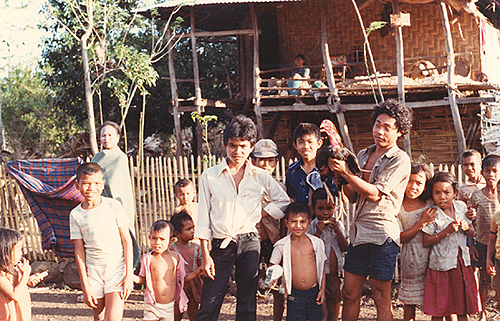
With the fierce tropical sun blazing overhead out of a cloudless sky, I deftly skipped around a couple of the deeper potholes as I hurried home for lunch.
But quite suddenly, the sting went out of the sun—I was in shadow! I glanced up and saw that ‘out of the blue’ a small cloud had formed exactly between me and the sun directly overhead—and I stopped dead in my tracks. Because (as you’ve probably guessed), I immediately recognized that I’d been here before.

Of course, I don’t just mean that I’d been at that point of the road before—having walked this way several times a day for months I now knew this 700-metre stretch of road like the back of my hand. What I mean is, I’d been at that moment before. And I was shaken to the core.
Because everything fitted with the recurring dream of years earlier. The distinctive fragrance of the flowering weeds along the road mixed with dust and the smell of drying mud, the cloud between me and the sun in an otherwise cloudless sky, the sun illuminating the ‘strange’ buildings off to the left in front of me—but of course the greyish-white concrete buildings were no longer strange but very familiar to me, because they were the buildings on the government research station, and I now lived in one!

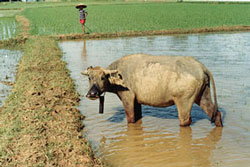
What’s more, the cattle were now here too. This was the first time since my arrival that cattle had been allowed into the cropping land alongside this road. With the harvest only finished yesterday, today the distinctive ‘sapi Bali’ (Balinese cattle—specifically a breed of Bos javanicus) had been brought in to graze the stubble.
And as I stood stock still listening to them crunching on the stubble on this windless day, I was in deep shock. Because I was trying to work out how it could possibly be that my brain could have known years in advance of this exact moment.
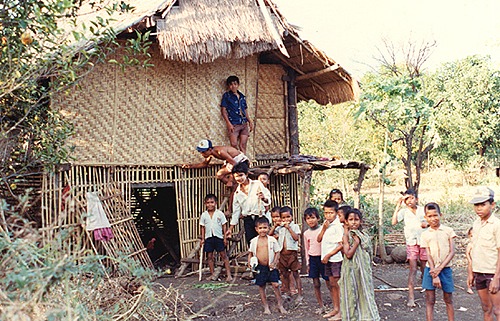
And my shock was further magnified when the rural quiet was shattered by the sound of a chainsaw starting up (just as in the dream), coming from a distant stand of trees which I now knew (from having explored the area at weekends) concealed another local kampung. (This was the first time I’d heard a chainsaw in Indonesia, but I soon learnt it was a common sound in that area during the dry season—the time of year for cutting regrowth from teak tree stumps.)
I must have stood rooted to that spot for at least ten minutes, absorbing it all in absolute amazement, and trying to make sense of it. At length, the cloud moved (or dissipated—I was too preoccupied to note which), and, reluctantly driven by the stinging heat of the tropical sun, I ambled very slowly towards my living quarters, deep in thought.
An experience too confronting to confront
As I neared my building, a neighbouring staff resident came out to meet me, looking at me very curiously, and asking if I was all right. I replied that there was no problem—but the truth was that I was very badly shaken, and trying to find a rational answer for what I’d just experienced. A ‘rational’ answer, that is, that fitted with my atheistic worldview, a worldview that is dismissive of anything that might hint at the existence of a spiritual realm, or supernatural occurrences. Going through my head at that moment were claims I’d heard about ESP, horoscopes and fortune-telling—but I dismissed them all. Nevertheless I continued to mentally wrestle with all this for some hours, until at about three o’clock in the afternoon, I simply put it all out of my mind and got on with my life.
In other words, I simply forgot about it. Totally. Don’t ask me how—I just don’t know.

Even though I traversed that road who-knows-how-many times during the following three years, I never (i.e. for the duration of my stay in Indonesia) had the slightest recollection of what had happened to me that day. (Nor have I ever had that dream again.)
In hindsight, I think my putting it ‘out of mind’ is similar to what has happened on occasion in the scientific community. From time to time, certain findings which contradict scientists’ expectations are set aside (dismissed) as ‘outliers’, i.e. regarded as one-off aberrations due to some fault in the experimental set-up or similar factor. Eventually, after many such ‘outliers’ are observed, the scientific community will change their paradigm to fit the new evidence (though often reluctantly, and not without stubborn rearguard resistance from diehard supporters of the old paradigm—see box: Science’s blind side).
In my case, my ‘dream-come-true’ did not fit with my evolutionary there-is-no-spirit-realm paradigm, and I conveniently forgot about it. Until, that is, I had a complete change of worldview—I abandoned atheism and became a Christian—and read something in the Bible that I believe relates directly to my dramatic moment on that Indonesian road when the recurring dream of my youth became reality.

Note that my experience was not a factor in my conversion—which happened a bit over two years after that cloud shaded me at that spot on the road (i.e. while I was still in Indonesia, but that’s another story). As I said, I had completely forgotten about my ‘fulfilled dream’ until I happened to be reading a certain passage in the Bible a full 16 years after the experience, and 14 years after I received Jesus Christ as my Lord and Saviour.
That passage is in the Apostle Paul’s famous address to the people of Athens at the Areopagus, where he says:
‘From one man he made every nation of men, that they should inhabit the whole earth; and he determined the times set for them and the exact places where they should live.’ Acts 17:26, NIV
It hit me like a bombshell: ‘and he determined the times set for them and the exact places where they should live’. God knew not only the exact place where I would be but also the precise time as well! There’s no other way that I could have dreamed such a dream: the appearance of the cattle, buildings, the fragrance of the flowering weeds, the sun directly overhead—I could not have known such details on the basis of my own experience and knowledge prior to going to Indonesia (i.e. years after the recurring dream). And note that despite my walking several times each day over that exact place on the road for some months beforehand it was only when the precise time matched with the scene in my dream that I recognized it.
Why would God have done such a thing? For me, I have no doubt—I believe the Apostle Paul explained why in the very next thing he said to the Athenians:
‘God did this so that men would seek him and perhaps reach out for him and find him, though he is not far from each one of us. “For in him we live and move and have our being.”’ Acts 17:27–28a, NIV
Just look at that: so that men would seek Him and perhaps reach out for Him and find Him.
Today, I look at those words with a mixture of gratitude and yet quite some sadness. Because at that time I did not seek Him, nor reach out for Him—I made no effort to find Him whatsoever, despite the fact that, as I now recognize, He is indeed ‘not far from each one of us’. (Perhaps if I had sought Him at that time, I would not have had such a difficult time of things during the following two years.)
Consequently, despite my ‘impossible’ dream-come-true having left me profoundly shaken, I ignored it, and therefore at that time was none the wiser for having had the experience.
But today, I’ve put this into print so that hopefully anyone reading this who has not yet taken to heart Jesus’ promise that ‘seek and you shall find’ (Matthew 7:7), might learn from what happened to me. Because, as the Apostle Paul said, it really is true—it’s only in God, our Creator, the One Who gives us life and breath and everything else (Acts 17:25), that we live and move and have our being.
Apart from God, any dreams we might have are meaningless. He has revealed in His written Word, the Bible, everything that we need for salvation (2 Timothy 3:15–17). All experience must be interpreted by the light of Scripture, not vice versa.
Science’s blind side
The public perception of science is often that ‘science is neutral’, but in practice, the ruling ‘paradigm’ can be so strong that conflicting data and anomalies are often ignored.Of course, when this is pointed out, there is frequently denial and resistance from certain quarters in the scientific community (especially in relation to the origin-of-life issue). It has been reported that: ‘Kuhn2 aroused the ire of many scientists when he argued that paradigms have philosophical and psychological components and are not readily discarded in the face of anomalous evidence.’3
One such scientist who, in the context of the creation/evolution debate, would like the public to view science as being truly objective is renowned anti-creationist Ian Plimer. He has written:
‘If new evidence disproves a scientific theory, then the existing theory is rejected or undergoes revision in the light of the new evidence.’4
If Dr Plimer actually believes that, then his view is naïve in the extreme. In reality, scientists are often in the grip of the prevailing paradigm (i.e. belief system) of the day. (Something that, as one of the few voices railing against the current global warming alarmism paradigm, Ian Plimer has recently experienced first-hand.)
The philosopher of science Thomas Kuhn (mentioned above) demonstrated the stifling hold that the prevailing ‘accepted’ view can have on researchers in his influential book The Structure of Scientific Revolutions. He described true scientific revolutions as being nothing less than wholesale paradigm shifts. But these are rare, and Kuhn described how science in the grip of a widely-accepted paradigm tolerates anomalies and some contrary evidence for some time in the hope of solving them within the paradigm.5
Also noteworthy is the fact that, as Professor Evelleen Richards, a non-creationist historian of science at the University of New South Wales, Australia, has pointed out, scientists challenging the ruling paradigm find it hard to get published or receive research grants—see this quote.
And here’s another key observation from a non-creationist, Hubert Yockey, regarding the stranglehold a paradigm can have, especially in the absence of any known alternative:
‘The history of science shows that a paradigm, once it has achieved the status of acceptance (and is incorporated in textbooks) and regardless of its failures, is declared invalid only when a new paradigm is available to replace it.’6,7
Another philosopher of science, Imre Lakatos, pointed out that the ruling paradigm can be further protected with auxiliary hypotheses. Any contrary evidence is blamed on the failure of one of these hypotheses, which is then sacrificed to protect the core theory. See how this works in practice with the big bang paradigm.
Re-featured on homepage: 3 May 2023
References
- Makassar has also been known by the alternative name ‘Ujung Pandang’. Return to text.
- Kuhn, T., The Structure of Scientific Revolutions (3rd edition), University of Chicago Press, Chicago, 1996. Return to text.
- From an essay by Jonathan Wells in: Dembski, WA, ed., Mere Creation—Science, Faith & Intelligent Design, with Contributions by Michael Behe, David Berlinski, Phillip Johnson, Hugh Ross and others, InterVarsity Press, Downers Grove, Illinois, p. 66, 1998. Return to text.
- See: More nonsense from Ian Plimer Return to text.
- David Catchpoole comments: ‘That’s clearly what I was trying to do until about 3 pm on the day of the “dream-come-true”—i.e. I was trying to solve the obvious anomaly from within the atheistic/evolutionary paradigm.’ Return to text.
- Hubert P. Yockey, Information Theory and Molecular Biology, Cambridge University Press, UK, 1992, p. 336. For a longer extract see: Quotable quote: Primeval soup failed paradigm Return to text.
- David Catchpoole comments: ‘So, despite my dream experience [main text], in the absence of a new paradigm that did not invoke a spiritual realm, I simply tolerated (ignored) the anomaly, and did not seriously question my atheistic/evolutionary paradigm.’ Return to text.


Readers’ comments
Comments are automatically closed 14 days after publication.