
Feedback archive → Feedback 2008
Call to censor public information at the Giant’s Causeway, UK

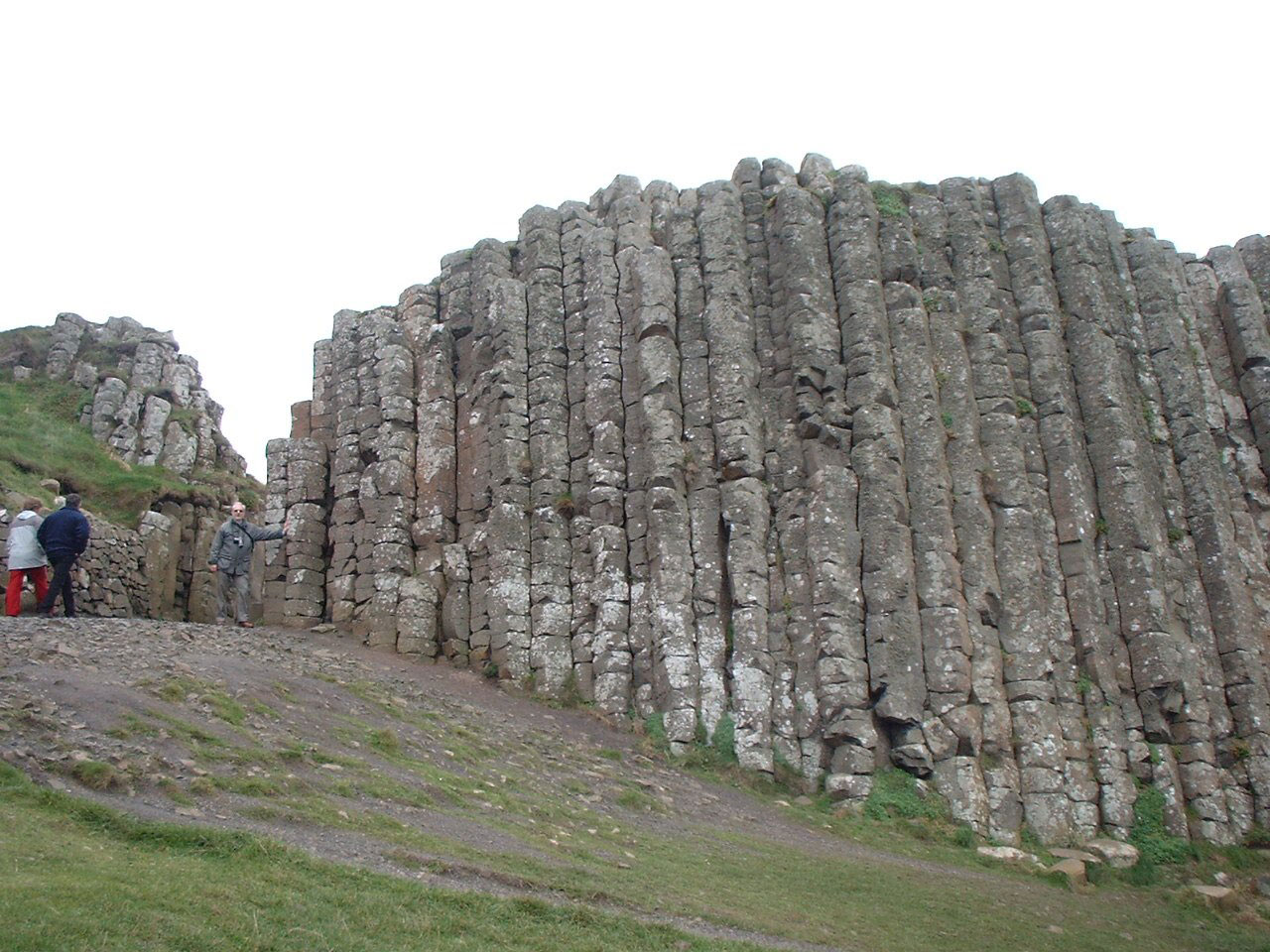
This week's feedback responds to a public claim by geologists Jan Zalasiewicz and Tony Bazley that the creationist view of the origin of Giant’s Causeway, Northern Ireland, is manifestly untrue and should not be given any sort of an airing at the new interpretive centre. Writing in Geoscientist,1 the monthly fellowship magazine of the Geological Society of London, in reaction to calls for the creationist view to be given a fair exposure,2 they say the development is worrying and any discussion of the creationist view should be kept within ‘church halls’. Yet they give no valid reasons for why their traditional long-age view should be given sole exposure at the publicly funded centre, to the exclusion of the biblical creationist explanation.
We reproduce here the call for censorship by Zalasiewicz et al. interspersed with responses by CMI staff geologist Dr Tasman Walker.
Giant’s Causeway—myth and reality
Jan Zalasiewicz*, Tony Bazley** and the Stratigraphy Commission are exercised about a possible eruption of Young Earth Creationism at a World Heritage Site in Northern Ireland
Geoscientist 18.4 April 2008
The Giant’s Causeway is one of the geological wonders of this planet, formed from lava erupted some 60 million years ago, and now marvellously sculpted by ice, by the weather and by the sea. It is an iconic landscape, and fully deserves its status as a World Heritage Site.
Replace ‘60 million years’ with ‘4,500 years’ and creationists would agree with this statement. Zalasiewicz et al. have not proved anything. They are simply describing the Causeway from the perspective of their worldview.
Building the new Visitors’ Centre nearby is vital to help explain its history and significance to the Irish landscape.
Interpretive centres are provided because evidence does not speak for itself—it has to be interpreted. The question is, ‘Which worldview will be used?’
But there have been demands from a local pressure group, the ‘Causeway Creation Committee’, that any new Centre include an account alleging the Causeway to be no more than 5000 years old, in accordance with a literal interpretation of Old Testament chronology.
Zalasiewicz et al. acknowledge here that a ‘literal’ reading of the Bible requires a young earth, although we would use more accurate terms such as straightforward, originalist or grammatical-historical—see also Should Genesis be taken literally? Pioneers of geology, such as Nicholas Steno, were young-earth creationists, and used that worldview to guide their geological thinking and research.
Giving in to these demands would be utterly wrong.
Quite the opposite. Censoring the biblical worldview is what would be wrong. In a democracy, government should not use public funds, extracted as taxes by compulsion, to support one particular religion. Thus government should not promote any one particular philosophy, especially one that is known to be opposed to the religious beliefs of a significant proportion of the population.
Government could try to be worldview neutral by removing all reference to dates and times and qualifying any interpretations that are time dependent (such as soil horizons, as discussed later). Timing, chronology and earth history are central to each worldview, as acknowledged by Zalasiewicz et al. above. The alternative, which seems to be the view of the Causeway Creation Committee, would be to present both worldviews.
Of course, the Earth and its strata stretch back to ages far greater than the 5000 years claimed by young-Earth creationists. The Earth and the other planets that orbit the Sun have been in existence for a little more than 4 and a half billion years, as deduced by measuring the age of meteorites, that represent debris left over from the formation of the Solar System. The oldest minerals yet discovered on Earth reach almost back to this distant date, at some 4.2 billion years.
It’s only obvious from within their secular worldview.
Zalasiewicz et al. reject the Bible and object to creationists using the Bible to defend the age of the earth. But they are doing the same thing here. They are using their worldview to defend their worldview. Their statement here achieves nothing.
But let us ask some scientific questions. What in the above statement has actually been observed? The solar system forming from meteorites? No. Minerals forming 4.2 billion years ago? No. This is not science but story telling.
The fact is that there is no scientific instrument that can measure age. Oh, there are instruments that can accurately measure the isotopic composition of samples—in the present. But the isotopic composition is not an age. All ages are calculations based on assumptions about the past. You can get any age you like depending on the assumptions that you make. It’s selective and subjective. See The way it really is: little-known facts about radiometric dating: Long-age geologists will not accept a radiometric date unless it matches their pre-existing expectations.
They say that the ‘age’ of the solar system is deduced from the age of meteorites but it is only selected meteorites that are involved in this exercise because different meteorites give different ‘ages’.
Giant’s Causeway represents a much younger outpouring of magma, though one that is still almost unimaginably ancient to a human perspective. At 60 million years old, it amounts to a little over 1% of the age of the Earth. When these lavas erupted over the landmass that was to become Northern Ireland, dinosaurs had already been extinct some five million years. The animals that then roamed the landscape were not like those of today but included, for instance, ancestors of the modern horse, about the size of a dog and possessing not hooves but five toes on each leg. Through the use of radiometric dating—the analysis of natural ‘atomic clocks’ preserved within crystals in certain types of rock, the ages of these, and other, events in Earth history in millions of years, can now be clearly established.
Here is more story telling but creationists have another interpretation. The Causeway lavas erupted about halfway through the Flood catastrophe after huge quantities of sediment had already been deposited over the globe. The eruption occurred after many dinosaurs had been overwhelmed and buried by the rising waters (Genesis 8:17–24). Their eruption marked a change from floodwaters rising and inundating the earth to floodwaters receding back into the ocean basins.
The horse series is another of those persuasive evolutionary icons that is not accepted these days. There is no series at all in the sense of progression, but a bush of varieties of horses which ignores the great variation even within existing horses—see The non-evolution of the horse.
The numbers produced by radioactive ‘dating’ are only accepted if they fit with the long-age interpretation determined from field relationships and the principles of stratigraphy.
Even, though, before this technology was developed, the early geologists of Victorian times (and before) had realised that the Earth must be vastly older than the few thousands of years obtained from a literal interpretation of Old Testament chronology. They did this simply by using their observations and their powers of reason, by looking at the evidence in the landscape, just as we can do today.
Which proves that radioactive dating had nothing to do with the idea of an old earth. The idea came from the uniformitarian philosophy developed by Hutton and Lyell, who assumed the biblical account of the global Flood was wrong. The historicity of the global Flood was never refuted by these uniformitarian philosophers—they ignored it. The strategy of censoring opposing ideas is not new. See how their presuppositions led them into error: Hutton on Siccar Point in Scotland and Lyell on Niagara Falls on the US–Canada border.
Examples of such evidence can be seen in the very landscape of north Antrim. The lavas of Giant’s Causeway represent not one but several individual eruptions, each being typically separated by fossilised soils that each represent many millennia of slow weathering on those ancient landscapes. The lavas rest on still older rocks, which contain the remains of marine organisms that lived at the same time as did the dinosaurs.
The idea that these horizons are fossilized soils is an interpretation based on the philosophy of uniformitarianism. It’s widely promoted at the Causeway. However, these horizons do not have the normal soil profile but are simply loose, friable horizons. They contain buried vegetation preserved as lignite, suggesting rapid burial rather than weathered soil horizon. In other words, they do not demand a long period of time to form. See also Paleosols: digging deeper buries challenge to Flood geology.
Trace the Giant’s Causeway lavas some 10km south and they are covered by an extensive layer of lignite east of Ballymoney. This lignite is up to 140m thick, and is the remains an ancient peat bog, now compressed and hardened. In itself it represents about a million years of the slow growth and accumulation of decaying plants, as that peat bog slowly built up.
There are many reasons why this lignite did not form over millions of years in a swampy environment, similar to the peat bogs in Ireland today. Leaves and bark fragments are abundant, as well as pollens and other tree parts. In other words, the vegetation is too well preserved to have remained in a bog for thousands, let alone millions, of years. In addition, the trees identified include cedar, pine, spruce, hazel and alder—species that do not grow in peat bogs. The evidence points to water having rapidly washed the vegetation into place. Then heat from the basalt quickly transformed it into coal. See Coal: memorial to the Flood.
Millions of years later, ice invaded Ireland—not once, but several times. This ice left thick masses of boulder clay and sand and gravel. As the ice receded for the last time, vegetation carpeted the debris, and Stone Age people constructed their monuments on top of that post-glacial landscape, as human occupation started.
The Ice Age occurred after the Flood. It was not millions of years later, but took about 500 years to reach its full extent and about 200 years to retreat. It was not steady progress but a series of advances and retreats, controlled by variations in weather conditions. The cause of the Ice Age is a puzzle for uniformitarians but creationists have a simple, plausible model. See also What about the Ice Age?
The first inhabitants of the UK were descendents of Noah and his family, arriving after migrating from the Middle East after the Tower of Babel dispersion. They used stone but they were not evolving through a primitive Stone Age (See The sixteen grandsons of Noah).
The outlines of this enormous geological history were worked out by these early geologists who were, for the most part, Christian believers.
The first geological history ever produced was by Nicholas Steno, and it was within a biblical young-earth framework. The current ideas about geological history have been developed by people working from a different philosophy—uniformitarianism.
They realised that it was far too long to fit into five thousand years, and had little trouble reconciling their faith with the evidence they saw before them.
The concept of long ages came from anti-biblical assumptions, first the idea of multiple catastrophes promoted by Cuvier, and then the idea of uniformitarianism promoted by Hutton and Lyell. The uniformitarians deliberately ignored the catastrophic consequences of the global Flood as recorded in the Scriptures (cf. 2 Peter 3:3–7). The early Christians who adopted this philosophy never explained how their uniformitarian theories could harmonize with the Christian Scriptures, even though they were challenged to do so on many occasions. Neither did they address the many scholarly cricticisms of their speculations published by geologists who accepted the Scriptures as read (see the Scriptural Geologists).
This history of the Earth has been corroborated and explored in further detail by many scientists in subsequent years. They are not (by any means) all atheists: they include Christians, Muslims, Hindus, Buddhists and followers of other faiths, who can accommodate both their religious beliefs and their science.
This reconciliation between science and religion goes back longer than is often realised. In 1615, Galileo wrote to the Grand Duchess Christina that the Bible teaches one "how to go to Heaven, not how the Heavens go". There need be no inherent conflict between science and religion. Conflict, though, may be created by religious fundamentalists; and also, of course, by fundamentalist atheists (not all of whom are scientists).
Manifest untruth
The young-Earth creationists’ view of Earth history, based upon their literal interpretation of the Bible, is quite simply wrong. It is a manifest untruth.
Here is the crux of the problem. Zalasiewicz et al. don’t believe the Bible.
It is as wrong as saying that the Sun orbits around the Earth, or that the Moon is made of green cheese, or that the Giant’s Causeway was constructed by Finn MacCool, the giant of Irish legend.
No one is claiming what Zalasiewicz et al. are alleging here.
Nor are we dealing with "alternative views" of the universe. We are dealing with the difference between reason and unreason.
Insults and name calling.
For it is unreasonable, indeed fantastical, in any impartial examination of the evidence (evidence that was sufficient even in Victorian times, and now that has been corroborated a thousandfold), to state that the Earth is only a few thousand years old.
I would like to ask Zalasiewicz et al. ‘How do you know that?’ The fact is that it’s impossible to calculate the age of something without assuming its history. I would like to unpack the assumptions hidden inside their answers, assumptions that I doubt they are aware of.
This is not a case of censorship. We do not question the right of creationists to hold or expound their views, to write pamphlets and books, hold meetings, or set up websites; nor would we for our part demand to distribute articles on the scientific evidence of the age of the Earth in church halls. But we profoundly disagree with any suggestion that creationist views should be given space in publicly-funded museums or visitor centres that explain natural history, or in school science lessons or science textbooks.
Zalasiewicz et al. are so used to seeing their official state religion being supported by funds taken by force from the public that they find it an affront to think that there are other views held by reputable scientists, and by a significant proportion of the population. I hope they view the film Expelled, which explores the frightening phenomenon of censorship and intimidation in academia today (see review and interview with the producer).
The significance of this point goes far beyond questions of a philosophical interpretation of humanity’s place in the universe. Humanity is now struggling to maintain itself on an overcrowded planet, on an Earth in which the life-support systems of air and water and food and land are being imperilled by human action. To deal with the many crises facing us, we need to deal with the Earth as it is—not with the utterly unreal Earth that the young-Earth creationists have convinced themselves of, by over-literal interpretation of scriptural texts.
Zalasiewicz et al. have not made a case as to why their story about the past (made up by people who were not there and did not see it happen) should be believed over the biblical history that has been shown to be reliable time and time again. They are using scare tactics to get you to accept their view. It’s called intimidation.
This is not at all to say that the world’s religions have no part to play in, say, the growing threat of global warming. On the contrary: the moral standpoints they provide may perhaps prove crucial in influencing individual or collective action that might counter this threat.
This is a sop and has nothing to do with the issue. But it’s notable that the secular establishment doesn’t mind religious input as long as it’s in support of the secular causes, e.g. the global warming alarmism they mention. But let the religious input contradict the secular sacred cows, and they will tell you to leave your religion out of politics—just as evangelical anti-slavery activist William Wilberforce was.
But human reason as applied to the reality of the world around us—which is in essence what science is—must lie at the heart of any civilised society.
But human reasoning from what premises? Hitler and Stalin built societies based on their human reasoning from evolutionary premises. But it’s nonsense: science can tell us that pushing a man off a cliff will kill him, but it can’t tell us that it’s wrong to do so.
The Giant’s Causeway, and its 60-million year history, must be used to help promote that reason, and to better understand the real Earth on which we live.
I can see that Zalasiewicz et al. are passionate about their beliefs, but they have not made any sort of a case for why anyone should accept their story as being true, unless they already think that way.
The call by the Causeway Creation Committee is already producing some good outcomes for the geological profession, and the general public. It is pushing long-age geologists to defend their views in public, something they have not been in the habit of doing. Further, it is exposing some of their basic assumptions, faulty logic and elitist attitudes.
And of course, the controversy will be good for tourism.
* University of Leicester. Chair, Stratigraphy Commission Return to text.
** Editor, ES2K Return to text.
Tas Walker, geologist
References
- Zalasiewicz, J, and Bazley, T., Giant’s Causeway—myth and reality, Geoscientist 18.4 April 2008. Return to text.
- Heneghan, T., Creationists claim the Giant’s Causeway, Reuters Blog, 30 November 2007. Return to text.

Readers’ comments
Comments are automatically closed 14 days after publication.