
Tetrapods from Poland trample the Tiktaalik school of evolution
Published online: 14 January 2010(GMT+10)
Subsequently published in Journal of Creation 24(1)

Tracks of footprints found in a quarry in Poland have turned the palaeontological world upside down.1 For years there has been a neat evolutionary story about how fish evolved four legs and came out of the ocean onto the land (figure 1). Probably the most famous fossil in this sea-to-land icon of evolution is Tiktaalik roseae, a fish with fins that was claimed to have had features intermediate between fish and tetrapods. Creationists consistently rejected the evolutionary spin put on the fossil and showed that it had nothing to do with any alleged sea-to-land transition (see Tiktaalik roseae—a fishy ‘missing link’ and Tiktaalik—sticking its head out of water?). All the same, evolutionists promoted Tiktaalik relentlessly. It has its own website,2 features in evolutionary diagrams (e.g. figure 1), stars on the covers of books about evolution3 and was even the theme of a song to promote evolution.4 Richard Dawkins, in his latest book The Greatest Show on Earth, claims “Tiktaalik is the perfect missing link—perfect, because it almost exactly splits the difference between fish and amphibian, and perfect because it is missing no longer.” (See forthcoming book refuting Dawkins’ book.)
But now this footprint evidence from Poland consigns Tiktaalik and all its companion fossils onto the garbage heap. From being stars of the show they have suddenly become an evolutionary dead-end. So the creationists were right all along.
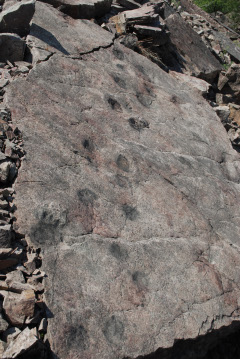
At first glance the evidence does not look very impressive. The tracks are preserved as shallow indentations on the surface of large limestone slabs from Zachelmie Quarry in the Holy Cross Mountains of Poland. The rough surfaces have an array of roundish indentations arranged in lines (figure 2). But, with the use of lines and diagrams (figure 3), the authors have argued a strong case that these indentations are indeed trackways of four legged animals that resembled large lizards. They were even able to show the shape of the foot within some of the individual prints and identify the toe marks (figure 4). From the dimensions of the prints they concluded that some animals were more than 2 metres long.
These trackways are a remarkable find but tracks are not particularly unusual in the fossil record. Thousands of trackways of land animals have been found in many different locations all over the world. What has captured world attention is that that these tracks are dated at 397 million years, which makes them fully 18 million years older than Tiktaalik. If four-legged animals existed 18 million years earlier, then Tiktaalik can’t be the transitional fossil it has been claimed to be. It’s suddenly been demoted to an evolutionary dead end along with all the other fossils connected with it. In other words, all those neat evolutionary diagrams that vividly displayed the transition from fish to four-footed animal ancestor (such as figure 1) need to be disposed of. The evolutionary house of cards, so proudly paraded before the world, collapses with a breeze of evidence from Poland.

A total upset
This is not some small correction or a minor detail. It has turned the paleontological world upside down. Something of the magnitude of the upset can be gleaned from statements made about the find.
- “They force a radical reassessment of the timing, ecology and environmental setting of the fish-tetrapod transition, as well as the completeness of the body fossil record.”5
- “[It] will cause a significant reappraisal of our understanding of tetrapod origins.”6
- “[They] could lead to significant shifts in our knowledge of the timing and ecological setting of early tetrapod evolution.”7
- “We thought we’d pinned down the origin of limbed tetrapods. We have to rethink the whole thing.”8
- “That’s surprising, but this is what the fossil evidence tells us.”9
- “These results force us to reconsider our whole picture of the transition from fish to land animals.”10

Note the terms “radical reassessment”, “reappraisal”, “surprising”, “reconsider … whole picture” and “rethink”. We are given the impression that paleontologists scratch around in the sediments and the evidence for evolution just pops out. Creationists are castigated because they are accused of working by faith and not evidence. Well, this Polish upset demonstrates that evidence does not speak for itself. It takes thought, ingenuity, mental exercise and interpretation to make sense of it. The paleontological world is going to take quite some time to rethink their stories.
What could be some of the thoughts running through their minds? Remember that each scientist comes to the evidence with their own beliefs, biases and … vested interests. Those who have invested their lives and careers in the standard fish-to-beast story will not be very enthused by the implications of the latest find. They will be reluctant to change, especially since they have nothing to replace it with. Here are a few ideas that I came up with of what they may be thinking.
Are they really tracks?
Some may be wondering whether the impressions in the rocks are really footprint trackways. Perhaps they were not made by tetrapods. Could there be any other explanation for the depressions on the surface? Such an approach would spoil the fun and the novelty. But the beautiful evolutionary stories of fish to land animal, which have been so vigorously promoted for so long, can be retained intact. If the evidence consisted of an isolated footprint it would certainly be open to much question but these are a series of related footprints connected into a trackway and represent very strong evidence that they are indeed made by four-legged animals. But the thought of questioning the tracks is likely to be one option followed in the paleontological community. In fact, that is exactly the line that palaeontologist Ted Daeschler from the Academy of Natural Sciences, Philadelphia, Pennsylvania, has taken. He pointed out to National Geographic News that tracks and trackways are notoriously difficult to interpret with full confidence and said he’s awaiting more evidence before abandoning existing explanations for the transition.7
Are the tracks dated too old?
Others may be wondering whether the trackways are as old as claimed. Is there something wrong with the dating? It would be really nice if the tracks could be dated some 20 or 30 million years later. Once again, the cherished evolutionary stories could be retained intact.
If the dating had been carried out by some isotopic method (e.g. Argon-Argon or Rubidium-Strontium) there would be many avenues by which the date could be challenged and dismissed, such as appealing to an inherited age, excess argon, open-system behavior, contamination or sampling error. (See The way it really is: little-known facts about radiometric dating). However, isotopic dating was not used on the limestone because it is not suited to that sort of method.
The “securely dated” dates referred to were assigned from the conodont fossils found in nearby strata.11 From their fossil content the rocks were classified as the Eifelian stage of the Devonian system, and the dates for this stage have been assigned by the International Commission on Stratigraphy as between 391.8 and 397.5 million years.12 Once the rocks are classified it is just a matter of looking the dates up on a chart. The only possibility would be for the rocks to be assigned to a different stage on the stratigraphic chart. For that to happen, paleontologists would need to re-examine the fossil evidence used in the original classification, perhaps by searching for other fossils in the area or by examining the fossils on which the original assignment was made. It is not unusual for a rock classification to be changed as a result of examining different fossil evidence.
The assignment would need to move the rocks at least three stages younger, to the Famennian stage, which would be quite a large move. The type section that defines the Eifelian stage is reasonably close geographically, in pastureland near the town of Schönecken-Wetteldorf, Germany. So a reclassification of these rocks in Poland may affect the classification of strata in other regions of Europe, and that may call for a significant readjustment. However, such a reassignment of its date may be possible. The huge upset could be resolved by changing the classification of only one fossil site. I would not be surprised to hear of paleontologists seriously looking at this.
Are the other transitional fossils dated too young?
Other scientists may be wondering whether the dates of the other transitional fossil sequence (such as Tiktaalik and Panderichthys) can be made older. Again, this would enable the neat evolutionary story to be retained, albeit at a slightly different date. However, this would be a huge job because it would involve a re-examination of the fossils associated with each particular transitional animal and convincing the stake holders for each of these fossils to accept a different interpretation of the dates. It would be necessary to move the classification of each fossil to at least three stages older. The fossils that make up the transitional sequence were found in a number of countries (e.g. Tiktaalik in northern Canada and Panderichthys in Latvia) and so there could be room for juggling the global correlations used for the assignment of each stage. But many specimens would need to be reclassified so this option would not be very attractive as a research project.
Was the transition earlier than we thought?
The paleontological community seems to have resigned itself, at least publically, to accept the new evidence from Poland and toss their neat fish-to-animal transition into the garbage bin. Instead of exhibit number one, which was so convenient to promote evolution and blast creationists, they are prepared to accept an earlier transition and relegate their iconic transitional sequence to an evolutionary dead-end.
This means they have to start from scratch. At the present time they have absolutely zero body fossils to illustrate their evolutionary transition. So the search will now be on to find transitional fossils at an earlier date than the Eifelian stage of the Devonian. Philippe Janvier from the National Museum of Natural History, Paris, France, put it this way, “I suspect that now we can push the divergence back to the Emsian stage [one stage earlier in the Devonian] maybe 400 million years ago.”
In the meantime there is currently no body-fossil evidence and no detailed story for how the transition from fish to land animal took place. Darwin said that the absence of fossil evidence was the biggest problem for his theory. At the conclusion of the hoopla connected with the 150th anniversary of his book, the evidence for the fish-to-amphibian transition is still missing.
Without fossil evidence evolution is a belief system based on blind faith. But for evolutionists the evidence does not matter. They know evolution happened. They will now start looking for it in a different place.
Is our interpretive framework wrong?
I wonder if there will be anyone who will question the whole interpretive framework that is being used. Is there any scientist involved in this research who is prepared to think outside the box? Perhaps the fossils are not recording evolution over millions of years. Perhaps they represent instead the catastrophic burial of the entire biosphere of the earth during a recent global watery catastrophe—like Noah’s Flood. What a radical thought.
Yes, some scientists are prepared to think outside the box but they have been forced to work mostly outside of the academic establishment. These scientists look at the evidence from a biblical perspective and publish their findings in academic journals (such as Journal of Creation) and on websites (such as creation.com). These creationist scientists have been critical of the claims made about Tiktaalik and his “transitional” buddies. It seems now that their concerns have been dramatically vindicated by the footprints from Poland.
However, it is unlikely that this option would even cross the minds of scientists within the mainstream paleontological community. Most would not imagine that a serious alternative worldview exists. Evolution over millions of years is their starting assumption. Scientists have been feeding on this idea, like mother’s milk, from the time they were undergraduates. Evolution over millions of years is non-negotiable. And anyone who questions the paradigm will find research grants difficult to obtain, papers impossible to publish, and would almost certainly be Expelled.
For them there is no question that evolution happened. The debate is only over how it happened. In their minds this new evidence from Poland is just causing a small reassessment of the “how”. Even though new fossil finds are continually dropping spanners into the evolutionary works no one ever thinks (at least not on paper) outside the box. In this information age with so much creationist research material so readily available we hope that the message will start to penetrate and bring about change.
References
- Bryne, J., Four-legged creature’s footprints force evolution rethink, LiveScience.com, http://www.livescience.com/animals/100106-tetrapod-footprints.html, 6 January 2010. Return to text.
- <http://tiktaalik.uchicago.edu/> Return to text.
- Shubin, N., Your Inner Fish: A Journey into the 3.5-Billion-Year History of the Human Body, Pantheon Books, New York, 2008; see review by Colin Mitchell, Journal of Creation 23(1):29–32, 2009. Return to text.
- Youtube video: Tiktaalik (Your Inner Fish), music by the Indoorfins, 2008. Return to text.
- Niedzwiedzki, G., Szrek, P., Narkiewicz, K., Narkiewicz, M and Ahlberg, P., Tetrapod trackways from the early Middle Devonian period of Poland, Nature 463(7277):43–48, 2010; nature.com/nature/journal/v463/n7277/pdf/nature08623.pdf. Return to text.
- Editor’s Summary, Four feet in the past: trackways pre-date earliest body fossils, Nature 463(7277), 2010; nature.com/nature/journal/v463/n7277/edsumm/e100107-01.html Return to text.
- Roach, J., Oldest land-walker tracks found—pushes back evolution, National Geographic News, nationalgeographic.com/news/2010/01/100106-tetrapod-tracks-oldest-footprints-nature-evolution-walking-land.html 6 January 2010. Return to text.
- Palaeontologist Jennifer Clack, University of Cambridge, UK; in: Curry, M., Ancient four-legged beasts leave their mark, ScienceNOW Daily News, sciencenow.sciencemag.org/cgi/content/full/2010/106/2, 6 January 2010. Return to text.
- Palaentologist Philippe Janvier from the National Museum of Natural History, Paris, France; in: Amos, J., Fossil tracks record ‘oldest land-walkers’, BBC News, news.bbc.co.uk/2/hi/science/nature/8443879.stm 6 January 2010. Return to text.
- Palaentologist Per Ahlberg of Uppsala University, Sweden; in: Fossil Footprints Give Land Vertebrates a Much Longer History, ScienceDaily sciencedaily.com/releases/2010/01/100107114420.htm 8 January 2010. Return to text.
- Niedzwiedzki, G., Szrek, P., Narkiewicz, K., Narkiewicz, M and Ahlberg, P., Tetrapod trackways from the early Middle Devonian period of Poland, Nature 463(7277), supplementary information, 2010; http://www.nature.com/nature/journal/v463/n7277/suppinfo/nature08623.html; Conodonts have been described as “fascinating little whatzits”; Stearn, C.W. and Carroll, R.L., Paleontology: The Record of Life, John Wiley & Sons, p. 161, 1989. Return to text.
- International Stratigraphic Chart 2009, stratigraphy.org/upload/ISChart2009.pdf. Return to text.


Readers’ comments
Comments are automatically closed 14 days after publication.