

The (second) greatest catastrophe of all time
The Titanic sinking? The Pompeii devastation? What rates as the greatest ‘disaster’ ever?
A real worldwide flood?
Some have alleged that Noah’s Flood was nothing more than a localised event. But if this were true, Noah and his family could have moved to higher ground to escape. Also, animals outside the flooded area would not be in danger. Since there have been many serious floods in earth history, if the Flood was only local, this is akin to accusing God of lying when He promised to never again send such a flood.
Since it was global, it is no surprise that civilizations across the globe have Flood stories with many common features.

Disasters have long captured the public’s attention. News services thrive on them. Hollywood throws in liberal amounts of imagination and reaps millions of dollars from our fascination with disaster, making blockbusters such as Titanic, Twister, Armageddon, Volcano, and Deep Impact. Some of these reflect evolutionary belief that life on earth was once all but wiped out by meteorite bombardment from outer space. (‘Is this what destroyed the dinosaurs? And will it happen again?’)
According to Genesis, a massive worldwide catastrophe did occur in the past, and it certainly did destroy much of the animal and plant life. It was, however, a global Flood—not a mere meteorite collision.
The Bible makes it clear that no land-dwelling air-breathing life survived except for those aboard Noah’s Ark.1
Flood legends
The Flood, according to biblical chronology, occurred approximately 4,500 years ago. Most of the world’s cultures have legends of events which are remarkably similar to the Flood account recorded in Genesis. These stories have a common thread, conforming to local conditions: a warning is given by God (or gods) of a coming flood to punish wickedness; the person warned is instructed to build a vessel of safety for himself, his family, and the other living creatures; the world is destroyed by water; the occupants of the vessel repopulate the earth. Many other specific themes from Genesis (sending out birds, landing on a mountain, the rainbow, post-Flood sacrifice) are often present too.
Evolutionists are forced to explain these similarities by coincidence. But such widespread recollections across the world are precisely what we would expect if the Flood described in Genesis did take place. It is well-known that local traditions and embellishments tend to exaggerate and distort events as they become entrenched in a culture’s folklore, especially if transmitted orally. Hence, the addition of clearly mythical elements in some legends.
Many attempts have been made to explain away this persistent cultural evidence. A new book, recommended by the man who discovered the wrecked Titanic, suggests that Noah’s Flood was actually a real, though local, event several thousand years ago around the Black Sea in Asia.2 However, this would not explain the existence of a Flood story, uncannily similar to Genesis, in Western Australian Aboriginal folklore!3 Nor does it fit with the Genesis account.
The Bible record
How big was Noah’s Ark, really?
According to the Bible, God Himself gave the overall dimensions for building the Ark.
Length: 137 m (450 ft) |
Total floor space: 100,000 sq. feet |
Width: 23 m (75 ft) |
Total volume: 1,396,000 cubic ft. |
Height: 14 m (45 ft) |
Cargo capacity: 15,000 tons. |
Naval architects have shown that the ratio of the Ark’s dimensions was in fact ideal for its purpose.
It would have been an enormously stable vessel, able to resist being overturned even in the most massive seas.
Hong, S.W. et al., Safety Investigation of Noah’s Ark in a Seaway, J. Creation 8(1):26–36, 1994.
Genesis is written as a simple, but factual, account of history. Secular archaeologists have, more than once, had to ‘eat their words’ as it were when discoveries have shown the Bible’s record of history to be accurate, not mythical. Today, there are even Christians prepared to distort the Bible’s plain record of a globe-covering Flood (where even the birds had to be taken on board, for example), to make it seem as if it had only covered a local region. These sometimes join with unbelievers in ridiculing the idea of a global Flood, on the basis that the Ark could not have carried all the creatures, for instance. But such objections have now overwhelmingly been shown to be without foundation.4
The record in the earth
Is the evidence of the rocks more consistent with slow processes over billions of years, or with the biblical Flood and its aftermath? If the Bible is right, we would expect to find sedimentary layers (rock laid down by water) all over the earth. These rocks would contain the remains of many kinds of creatures. Where there are similar types alive today, these fossils would be basically the same as their living representatives. In other words, bats would still look like bats, turtles like turtles, etc., with no evolutionary changes. This is exactly what is found.5,6
In addition, many animals living before the Flood would have died out—marine creatures possibly during the Flood, land creatures during the succeeding centuries. Thus one would predict that many creatures would be found in the fossil record that looked quite unrelated to anything on earth today. This is what we do find—for example, the pterosaurs, (flying reptiles), as well as the dinosaurs and many other extinct types.
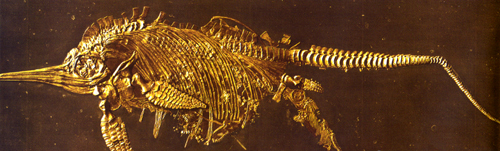
Many of the fossils would show creatures dying in distorted positions as they were buried suddenly and unexpectedly. This is precisely what we do find. We also find billions of fish beautifully preserved, sometimes over vast areas, with their fins and even sometimes scales intact—sometimes even still in the act of swallowing another fish.
Dead fish, even if there are no predators to eat them, fall apart in water after a few weeks at most, even if the water is perfectly sterile and oxygen-free.7 The evidence that these were rapidly buried, with rapid hardening, has even persuaded many evolutionist geologists to change their mind about slow processes.8
While it is not possible for science to prove or disprove anything about the past (which cannot be repeated nor directly observed) there is obviously a great deal of evidence consistent with the Flood described in the Bible. And many of the allegedly ‘impossible’ problems of Flood geology now have sound answers.9
Landmarks
Many of the world’s most magnificent landscapes show patterns more typical of having been formed by massive amounts of water quickly, rather than by slow and gradual processes over millions of years. America’s Grand Canyon10 and Australia’s Uluru11 (Ayers Rock) display much evidence in favour of them having been caused recently by the movement of lots of water in a short time, rather than slowly as evolutionists believe.
The 1980 eruption of the Mt St Helens volcano12 and the more recent Icelandic megaflood13 have given us small glimpses of how much damage large volumes of water can cause to a landscape. Features such as multi-layered sedimentary rock, canyons, and waterways which ‘look very old’ have been formed in only a few days!
Other real-life catastrophes throughout history
The ancient roman city of Pompeii was destroyed when Mt Vesuvius erupted in AD 79. Tonnes of volcanic ash buried the city to a depth of 3–6 metres (10–20 ft), killing at least 2,000 people. Pictured below (available in Creation) are the remains of citizens in the positions in which they died.
In modern times we hear much more about disasters such as the sinking of the Titanic, than we do about the greatest watery catastrophe in history, told to us in Genesis—Noah’s Flood. Help was far from those on board the Titanic on the night of 14 April 1912, where only 703 were saved of a total of 2,206. But God is willing to save, for all eternity, all who come to Him in repentance and faith.
At least 36,000 people died in the aftermath of the 1883 eruption of the volcano Krakatoa in Indonesia, which was heard 4,000 km (2,500 miles) away. The blast was so violent, it left a 300 m (1,000 ft) hole where the mountain originally stood, sucking in many ships as the sea rushed in to fill the hole, and causing 30 m tidal waves which swamped surrounding coasts.
The biblical Flood was sent upon the world because of man’s violence and sin. A warning was certainly given to the people of that day, to be saved by believing what God said and getting on board the Ark.
The Apostle Peter warned ‘Knowing this first, that there shall come in the last days scoffers, walking after their own lusts, and saying, Where is the promise of his coming? for since the fathers fell asleep, all things continue as they were from the beginning of creation. For this they willingly are ignorant of, that by the Word of God the heavens were of old, and the earth standing out of the water and in the water: whereby the world that then was, being overflowed with water, perished …’ (2 Peter 3:3–6).
Now, as then, people don’t believe that God’s judgment will fall. But the Bible is clear that, ultimately, all will face His judgment. During the Flood, the only way to be saved was by being aboard the Ark. And today the only way to be saved is by being ‘aboard’ God’s ultimate Ark of rescue, the Lord Jesus Christ.
Jesus said: ‘Truly, truly, I say to you, he who hears My word and believes on Him who sent Me has everlasting life and shall not come into condemnation, but has passed from death to life’ (John 5:24).
Post script
Why did our title indicate that Noah’s Flood was only the second greatest catastrophe in history?
Because the greatest catastrophe of all time was surely the Fall, when sin and death entered a perfect world. This drastically changed everything.
The whole creation has ever since been groaning in its ‘bondage to decay’ (Romans 8:19–22), awaiting its glorious restoration to a sinless, deathless condition, when God creates the heavens and the earth anew.
Some additional geological evidences consistent with a global Flood.
Note
|
References and notes
- Genesis 7:22 seems to restrict it to those who breathed through nostrils, perhaps limiting it to land vertebrates. Most insects, like water-dwelling animals, would not have needed an ark to survive. Insects could take refuge on all manner of floating vegetation clumps.
- Ryan, W., Pitman, W.C., Noah’s Flood: The New Scientific Discoveries About the Event That Changed History, Simon & Schuster, 1999.
- Coates, H., The Flood, Creation 4(3):9–12, 1981.
- Sarfati, J., How did all the animals fit on Noah’s Ark? Creation 19(2):16–19, 1997. Also, Woodmorappe, J., Noah’s Ark: A Feasibility Study, Institute for Creation Research, Santee, USA, 1996.
- Weston, P., Bats: sophistication in miniature, Creation 21(1):28–31, 1998.
- Weston, P., Turtles, Creation 21(2):28–31, 1999.
- Garner, P., Green River blues, Creation 19(3):18–19, 1997.
- The so-called ‘neocatastrophist’ school of thought generally assigns the millions of years to gaps between the layers of fossil-bearing rock, rather than the time taken to form the layers, as was once thought.
- Walker, T., Geology and the young earth, Creation 21(4):16–20, 1999.
- Even many old-agers now concede that the Grand Canyon was sculpted in one big rush by large volumes of water. Some creationist geologists think left-over water from the Flood, or the post-Flood Ice Age, breached a natural dam and catastrophically carved the Canyon.
- Snelling, A.A., Uluru and Kata Tjuta: Testimony to the Flood, Creation 20(2):36–40, 1998.
- Ham, K., I got excited at Mount St. Helens! Creation 15(3):14–19, 1993.
- Snelling, A.A., Iceland’s recent ‘mega-flood’, Creation 21(3):46–48, 1999.
Readers’ comments
Comments are automatically closed 14 days after publication.