
Dinosaur soft tissue and protein—even more confirmation!
Mary Schweitzer announces even stronger evidence, this time from a duckbilled dino fossil, of even more proteins—and the same amazingly preserved vessel and cell structures as before.
[Ed. note: subsequently published in Journal of Creation 23(3):10–11, 2009; see PDF.]
Background
Creationists were fascinated, and evolutionists mostly skeptical, when evolutionist Dr Mary Schweitzer claimed in the 1990s that an unfossilized piece of T. rex bone contained red blood cells. Further, that there was immunological and spectroscopic evidence of the presence of hemoglobin, the oxygen-carrying protein that gives red blood cells their colour.1
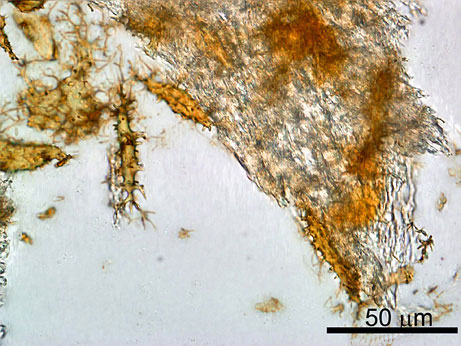
Then in 2005, Schweitzer announced a further sensational discovery in a different T.rex bone. After the mineral matrix was dissolved,2 what remained were structures with all the appearance of soft tissue, still soft and stretchy. Some of these appeared to be transparent branching blood vessels, with a substance inside them containing further structures looking just like nucleated red blood cells, and able to be squeezed out of the vessels like toothpaste.
How could such fragile structures survive for millions of years? Long-agers went into intense, but not very effective damage control, such as seen in the item (containing CMI’s response) Squirming at the Squishosaur.
Gradually, further evidence strengthened the case that Schweitzer had indeed discovered evidence of astonishing preservation of organic material in fossils. In 2007, in Squashing Squishosaur Scepticism, we reported that she and her team had performed careful tests to establish the presence of the protein collagen in the dino fossil—an important protein in bone. They were even able to sequence stretches of it, which showed that it was 58% similar to collagen from a chicken, and 51% similar to that from a frog.3
It has been pointed out many times that fragile, complex molecules like proteins, even if hermetically sealed, should fall apart all by themselves from thermodynamic considerations alone in well under the 65 million years that evolutionists insist have passed since Schweitzer’s T. rex specimen was entombed.4,5 Furthermore, bones of an Iguanodon allegedly twice as old (“dated” to 120 Ma) contained enough of the protein osteocalcin to produce an immune reaction.6
Many anti-creationists therefore breathed a sigh of relief when in mid-2008 a paper claimed to have found evidence that the transparent blood vessels, for instance, were the result of recent bacterial formation of biofilms, forming “endocasts” that followed the shape of where the original vessels lay, and that the red blood cells are actually iron-rich spheres called framboids. There were substantial reasons why not just creationists, but Schweitzer and other non-creationists were not at all convinced by these claims—see Doubting doubts about the Squishosaur.
The new findings

Now comes a further announcement by Schweitzer and others, in the prestigious journal Science, of substantial additional evidence to bolster her previous findings.7 The specimen on this occasion was a piece of fossil hadrosaur (duckbilled dinosaur) bone (Brachylophosaurus canadensis) regarded by evolutionary assumptions as being 80 million years old.
In short, the researchers found evidence of “the same fibrous matrix, transparent, flexible vessels, and preserved microstructures she had seen in the T. rex sample”.8 Only this time they went to exceptional lengths to silence critics.
Critics said that her claims, which given the millions of years perspective are indeed “extraordinary”, required extraordinary evidence. But this is a cliché; in reality, they just require evidence, and that has been amply provided. Yet the critics demanded additional protein sequencing, super-careful handling to avoid claims of contamination, and confirmation from other laboratories. So Schweitzer and her team set about doing just that when they looked at the leg bone of this hadrosaur encased in sandstone.
Extraordinary measures were taken to keep the sample away from contamination until it reached the lab. They used an even more sophisticated and newer mass spectrometer, and sent the samples to two other labs for confirmation. They reported finding not just collagen, but evidence of two additional proteins—elastin and laminin. They also found structures uncannily resembling the cells found in both blood and bone, as well as cellular basement membrane matrix. And there were, once again, hints of hemoglobin, gleaned from applying hemoglobin-specific antibodies to the structures and seeing if the antibodies would bind to them.
Some scientists are still skeptical about the hemoglobin, which is “difficult to identify with current technology”. Dr Pavel Pevzner of the University of California, was quoted as saying that if it is not a contaminant, it would be “much bigger news [than the confirmed discoveries of blood vessels and other connective tissues in] this paper.”9
Even leaving aside the hemoglobin, the Schweitzer et al paper is huge news. Pevzner had been critical of the technique used in Schweitzer’s analysis of the T. rex protein, but now he says that her new study “was ‘done the right way,’ with more stringent controls to guard against contamination”, for one thing.
There were eight collagen proteins alone discovered from the hadrosaur fossil, which revealed twice as many amino acids as the previous tyrannosaur specimen. These were compared with sequences from animals living today as well as from mastodon fossils and her T. rex sequences. The hadrosaur and tyrannosaur collagens were closer to each other than the others, and each were closer to chickens and ostriches than to crocodilians, for instance—results which would also confirm her previous identification of T. rex collagen.
The samples were identified as collagen by both sophisticated mass spectroscopy and antibody-binding techniques. They were also examined via both light and electron microscopy, which confirmed that they had the appearance of collagen as well.
As Schweitzer says, “These data not only build upon what we got from the T. rex, they take the research even further.”
Power of the paradigm
Philosophers of science have written much about the power of a paradigm, especially when it has worldview implications, such as long-age belief. Such a paradigm is seldom, if ever, overthrown simply because of observations that contradict its expectations. Even Schweitzer herself, despite professing to be an evangelical Christian, is extremely defensive about the old-age paradigm—see Schweitzer’s Dangerous Discovery.
What happens is that “auxiliary” hypotheses and assumptions are constructed to preserve the intactness of the “core” hypothesis, in this case what is known as “deep time” (see further explanation). In simple terms, proteins should simply not have been able to last for these tens of millions of years. So when they are found in specimens dated this old, the paradigm is under serious threat.
The most straightforward fit to the evidence is that the time of burial of these dinosaurs was not millions of years ago at all, but only thousands of years ago at most. As the evidence continues to mount that dinosaur fossils do indeed contain well-preserved soft tissue structures and identifiable proteins, the assumption that will increasingly be made is that “we now know that such tissue components can last that long, after all.”
Not many will see this as the paradigm-rescuing assumption that it is. Consider the line of reasoning:
1). We know that this dinosaur fossil is 80 million years old.
2). Calculations based on operational (observational) science indicate that no collagen should survive anywhere near that long.
3). Collagen has been identified in these dinosaur fossils. Therefore:
4). There must be a mistaken assumption in the calculations mentioned in Point 2)—though we don’t know for sure how, collagen must be able to survive for 80 million years. How do we know that? Because
5). We know that this dinosaur fossil is 80 million years old.
Notice how points 1) and 5) are identical, revealing the circularity. The following chain of reasoning is far more science-based:
1). This dinosaur fossil is claimed to be 80 million years old.
2). Calculations based on operational (observational) science indicate that no collagen should survive anywhere near that long.
3). Collagen has been identified in these dinosaur fossils. Therefore:
4). The claim in point 1) is wrong. The fossil cannot be anywhere near that old. This matches the expectations of a worldview based on the history given to us in the book of Genesis.
We hope that many readers will be able to use this sort of evidence to gently pry open many closed minds.
Update 9 May 2009: see answer to a critic who disputes that these findings are a big deal.
Further update 10 August 2009: Schweitzer’s original find of soft tissue remains in a T. rex was strongly disputed, with some suggesting that the proteins found were the result of contamination. However, a reanalysis due to be published September 4 in the Journal of Proteome Research “has confirmed traces of protein from blood and bone, tendons, or cartilage.” (Reexamination Of T. Rex Verifies Disputed Biochemical Remains, www.ScienceDaily.com, July 31, 2009)
Postscript: Phil Currie on Mary Schweitzer’s May 2009 finds
The ‘extras’ on CMI’s 2009 documentary DVD The Voyage that Shook the World include extended interviews with several scientists. One of these is evolutionist and world-renowned dinosaur expert Dr Phil Currie, who talks about Mary Schweitzer’s astonishing finds, prior to her latest research above, and how the “paradigm is shifting”. There are many ways in which this DVD can be used to break down barriers of resistance to the Gospel. Don’t miss it! See the free trailer.
References
- Schweitzer, M.H. et al., Heme compounds in dinosaur trabecular bone, Proceedings of the National Academy of Sciences of the USA 94:6291–6296, June 1997. Return to text.
- With the strong chelating agent EDTA that extracted metal ions from the mineral while leaving proteins intact. Return to text.
- To put this into perspective, human and frog collagen is 81% similar. Return to text.
- Nielsen-Marsch, C., Biomolecules in fossil remains: Multidisciplinary approach to endurance, The Biochemist, pp. 12–14, June2002. Return to text.
- Doyle, S., The real ‘Jurassic Park’? Creation 30(3):12–15, 2008. Return to text.
- Embery G. et al., Identification of proteinaceous material in the bone of the dinosaur Iguanodon, Connect Tissue Res. 44 Suppl 1:41–6, 2003; . The abstract says: ‘an early eluting fraction was immunoreactive with an antibody against osteocalcin.’ Return to text.
- Schweitzer, M.H. et al., “Biomolecular
characterization and protein sequences of the Campanian hadrosaur B. canadensis”,
Science 324(5927):626–631, 1 May 2009 | DOI: 10.1126/science.1165069,
<www.sciencemag.org/cgi/content/full/324/5927/626?ijkey=47dc1272e069cf51caab0651d4462cbe5045f92c> Return to text. - “Proteins, Soft Tissue from 80 Million-Year-Old Hadrosaur Show that Molecules Preserve Over Time”, www.physorg.com/news160320581.html, accessed 3 May 2009. Return to text.
- Oldest Dinosaur Protein Found—Blood Vessels, More, nationalgeographic.com, May 1, 2009. The insert in square brackets was in the original from this source. Return to text.


Readers’ comments
Comments are automatically closed 14 days after publication.