
Dino protein denial
This is the pre-publication version which was subsequently revised to appear in Creation 32(2):18.
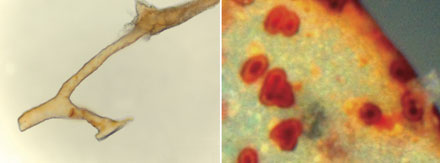
Left: The flexible branching structures in the T. rex bone were justifiably identified as “blood vessels”. Soft tissues like blood vessels should not be there if the bones were 65 million years old.
Right: These microscopic structures were able to be squeezed out of some of the blood vessels, and can be seen to “look like cells”, paralleling this latest report of the North Dakota hadrosaur. So once again there is scope for Dr Schweitzer to ask the same question she asked over a decade ago (see Dinosaur bone blood cells found), “How could these cells last for 65 million years?”
Discoveries of soft tissue and proteins in dinosaur remains are unacceptable to many scientists. That’s because if dinosaurs have been extinct for 65 million years, as evolutionary dogma teaches, then cells and even proteins should have decayed long ago.
That view can radically affect how researchers view the evidence.
For example, electron microscopy and X-ray imaging of a well-preserved hadrosaur (“duck-billed” dinosaur) fossil unearthed in North Dakota revealed what was described as “cell-like structures comparable to those of living vertebrates”.1
Note that University of Manchester researchers Phil Manning and Roy Wogelius were unwilling at that stage to call them “cells”. But subsequent analysis of the hadrosaur skin and a claw found amino acids (constituents of proteins) “suggesting that the cell-like structures were indeed cells”.
The blatant evolutionary bias of the researchers is highlighted by their reaction to their findings, as reported by New Scientist:
“Manning says the presence of amino acids, rather than whole proteins, is a good sign. After 66 million years, proteins in soft tissue should have broken down into amino acids, so finding large proteins would likely be a sign of contamination. The high concentrations of amino acids in the fossil, compared with only traces found in the surrounding sediment, support the idea that they came from the fossil.”1
In other words, if intact proteins had been found in the hadrosaur fossil, the researchers would have denied the result, instead dismissing it as “contamination”. Such is the sacrosanct view of the millions-of-years timeframe, the researchers would rather question their own analysis than the supposed age of the fossil!
This is not the first time that evolutionists have taken such a stance. Evolutionary paleontologist Hans Larsson has actually called for 14C testing (“14C dating should be done”)2 of the “still-soft-and-stretchy” T. rex samples reported by fellow paleontologist Mary Schweitzer.3 Note that this is not because he wants to “date” the dinosaur remains, but in order to determine whether they have been contaminated by modern microbes! (I.e., the presence of 14C cannot be from a 70-million-year-old T. rex, Larsson would reason, because 14C cannot last that long, therefore the 14C is from recent contamination, therefore non-dinosaurial. However, contamination can’t explain the widespread 14C in diamonds, which thus can’t be billions of years old as evolutionists claim. See Diamonds: a creationist’s best friend: Radiocarbon in diamonds: enemy of billions of years.)
The evidence of intact proteins and soft tissue being found in dinosaur remains continues to mount—see Dinosaur soft tissue and protein—even more confirmation!—right in line with the Bible’s timeframe of history. The dinosaur fossils date back no more than a few thousand years at most, not millions of years.
References
- Hecht, J., Dinosaur “cells” shed light on life 66 million years ago, New Scientist 203(2715):8, 4 July 2009. Return to text.
- Soft tissue in dinosaur fossils? The evidence hardens, Science 314(5801):920, 10 November 2006. Return to text.
- Schweitzer, M., Wittmeyer, J. and Horner, J., Gender-specific reproductive tissue in ratites and Tyrannosaurus rex, Science 308(5727):1456–1459, 3 June 2005. Return to text.
Readers’ comments
Comments are automatically closed 14 days after publication.