
Mars
The red planet

Credit: NASA/JPL/Cornell University
MARS is the famous “red planet”, and is not surprisingly named after the Roman god of war. The fourth planet from the sun, it can approach the third planet, Earth, as closely as 54.5 million kilometres (33.9 million miles). Of course, this is still a huge distance, so it’s only recently that a number of probes have been sent there, but this is still easier than most other planets. It also makes it one of the brightest objects in the night sky, surpassed only by the Moon, Venus and sometimes Jupiter.
Another factor makes Martian probes even more attractive to secular scientists. While Venus can approach closer to earth—42 million km (26 million miles)—it is a hellhole, with temperatures hot enough to melt lead, and an atmosphere 90 times denser than ours that’s mostly carbon dioxide and clouds made of sulfuric acid. By contrast, many hope that Mars is hospitable to life.
These hopes have not been realized, and are not likely to be. Mars is a dry, frigid world—yet recent discoveries point to huge floods in the past.
What is Mars like?
Mars is only about half the diameter of Earth, and one tenth the mass. In fact, it is roughly intermediate in size between the earth and our moon. Mars itself has two moons, Phobos and Deimos, but they are much tinier than our moon and orbit much closer. Phobos is only 27 km long and orbits just over 9,000 km from Mars, Deimos is even smaller at 15 km long, but orbits over 23,000 km away. Because they are so small they are irregularly shaped—with insufficient gravity to stabilize into a roughly spherical shape.
Mars has the distinction of having the largest volcano in the solar system: Olympus Mons, 27 km high—three times the elevation of Mount Everest. Being a shallow-sloping shield volcano, it is enormously wide, 550 km (342 miles). In fact, Mt Everest could fit in its crater!
Mars is nowhere near as hospitable as Earth, with an atmosphere 100 times thinner than ours and about 95% carbon dioxide. And while Mars is only 50% further from the sun, it’s enough to cause temperatures well below freezing most of the time, and no known liquid water. Conversely, Earth’s orbit, as well as its size, are well designed for life.
Mars’ famous redness is caused by ferric (iron) oxide, basically rust. Mars has polar ice caps, which grow and shrink visibly over the seasons. But they comprise mainly dry ice, or solid carbon dioxide. (For more information, see Mars Facts, below.)
Mars’ origin according to an eye witness
For the truth about the origin of anything, it helps to have a reliable eye-witness record. Such a record always outweighs any circumstantial evidence that might be interpreted in another way. Genesis claims to be a witness of One who was there—the Creator. Genesis 1:14–19:
14 And God said, Let there be lights in the expanse of the heavens to divide the day from the night; and let them be for signs, and for seasons, and for days, and years:
15 And let them be for lights in the expanse of the heavens to give light upon the earth: and it was so.
16 And God made two great lights; the greater light to rule the day, and the lesser light to rule the night: he made the stars also …
19 And the evening and the morning were the fourth day.
The Hebrew word for “stars”, כוֹכָבִים kôkābîm, refers to any bright object in the sky, so includes objects that become ‘shooting stars’ (meteors), planets of our solar system, and by extension, any planets around other stars.1 So Mars was created on Day 4 of Creation Week, three days after Earth, about 6,000 years ago.2
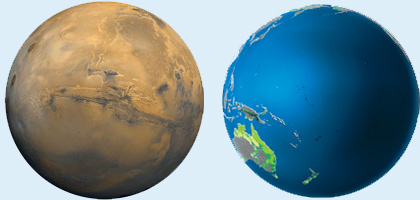
Which planet had a global Flood?
Many secular geologists agree that there were huge floods on the left planet, although it hasn’t a drop of liquid water. Yet they deny a global flood on the right planet, which is 70% covered by water—and if all the mountains were flattened down and ocean bottoms raised so the solid surface was completely even, this water would cover the whole surface to 3 km deep. Why? The latter Flood shows that God judges sin, and will do so again, and secularists don’t want to admit their accountability to their Creator. Mars shows that they are willingly ignorant, as the Apostle Peter said (2 Peter 3:3–7).
Life on Mars?
This cold, dry, rusty planet has been the subject of the most famous ‘alien invasion’ story of all time, The War of the Worlds, by evolutionist and eugenicist3 Herbert George Wells (1866–1946). A radio broadcast on 30 October 1938 by famous actor and producer Orson Welles (1915–1985) caused panic as some of the listeners people mistook fiction for fact (although the extent of the panic was hugely exaggerated by sensationalist newspapers).
It’s no accident that evolutionists like Wells liked the idea—after all, if life evolved on Earth, then surely it must have evolved elsewhere. Such ideas still greatly motivate searches for extra-terrestrial life.4
Canals?
Much of the hope sprang from astronomer Giovanni Schiaparelli (1835–1910), who claimed that he had found long straight lines on Mars that he called canali. This is actually Italian for “channels”, but was mistranslated “canals”, yet he didn’t rule out that they might be artificial. This inspired American businessman and astronomer Percival Lowell (1855–1916) to study Mars extensively, and he thought that the “canals” were built by an intelligent civilization to tap the polar icecaps, which he thought was the last source of water for a dying world. But Vincenzo Cerulli (1859–1927) showed that these canals/channels didn’t even exist, but were an optical illusion. Similarly, a much-touted giant “face” on Mars was conclusively proven to be an illusion from shadows of an ordinary land mass.5
Missions to Mars
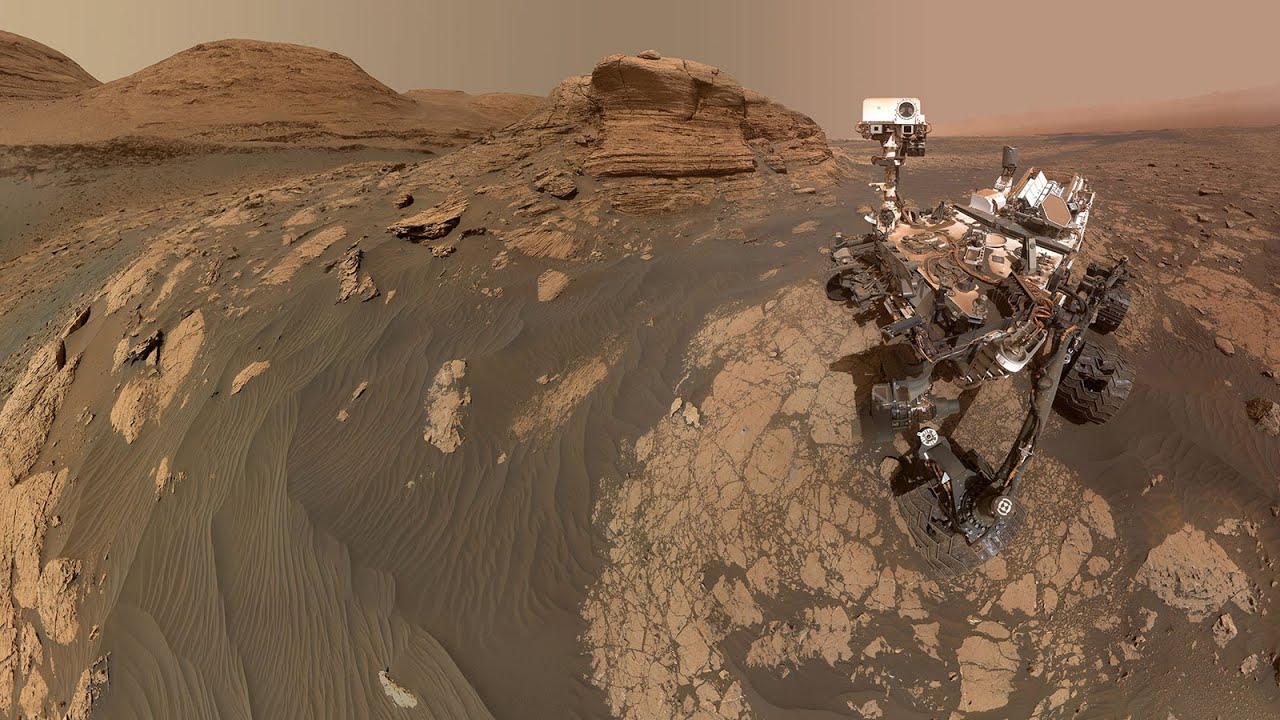
However, a number of missions were sent to Mars, largely to find life. The two Viking probes landing in 1976 were equipped with advanced miniature chemical laboratories to analyze the Martian soil. But to much secular disappointment, they found not the slightest trace of life. Some hopes came from certain reactions in the soil, but most scientists regard them as the result of super-oxidising chemicals, which would actually destroy life. Later, the 2008 Phoenix mission to the poles found perchlorate (ClO4–), a very powerful oxidizer, which would destroy life.
Meteorite with life from Mars?
In 1996, around the time the movie Independence Day was launched, NASA made huge headlines with claims that a meteorite from Mars, ALH84001, had remains of living cells. The atheists and humanist groups of course made much of it. But immediately CMI pointed out6 that the alleged evidence was very doubtful, e.g. chemicals like PAHs (polycyclic aromatic hydrocarbons) and magnetite crystals have been shown to form from non-living processes. We showed that there was much evidence against the claim, such as the wrong isotope ratios, and the fact that the alleged structures were far too small to hold enough DNA to store the minimal information required for life.7
Our stance has stood the test of time,8 while the extravagant claims were quietly dropped, although there were tentative revivals from time to time. But this is typical of much evolutionary propaganda: announced with front page fanfare, while downplaying or even retraction receives little publicity, if any.
Floods on Mars?
Yet although there is no water on Mars now, there are many features on Mars that point to huge floods in its history.9 There is also evidence for glacial movement, sedimentary processes, and even geysers.10 Secular scientists even refer to a “Noachian epoch” on Mars, named after the southern land mass Noachis Terra, in turn meaning “land of Noah”. [See also box below for implications.]
At the very least, many scientists agree that Mars was once much wetter. In 2001, NASA announced, “Mars may once have been a very wet place. A host of clues remain from an earlier era, billions of years ago, hinting that the Red Planet was host to great rivers, lakes and perhaps even an ocean.”11 More recently, geographers have analyzed an advanced map generated by computer from satellite images. They concluded that there was a giant ocean in the northern hemisphere, fed by an extensive river network, in turn fed by rainfall.12,13
Yet water could not have lasted long without evaporating in the low pressure, and there is no known limestone, which surely would have formed in a watery world with a CO2-rich atmosphere.14
Mars Facts1 | |
|---|---|
| Mean distance from Sun | 228 million km or 141.6 million miles (1.5 × Earth) |
| Eccentricity of orbit | 0.093 (Earth’s = 0.017) |
| Orbital period (around Sun, i.e. year) | 687 Earth days, 1.88 Earth years |
| Orbital inclination | 1.850° (Earth’s = 0 by definition) |
| Rotation period (day) | 24 hours 39 minutes 35 seconds |
| Inclination of equator to orbital plane | 25.19° (cf. Earth 23.45°) |
| Apparent magnitude | 1.8 to -2.9 |
| Radius | Equatorial 3,396 km; polar 3,376 km (~53% Earth) |
| Surface area | 145 million km2 (28.4% Earth) |
| Volume | 1.632 × 10¹¹ km3 (15% Earth) |
| Mass | 6.42 × 10²³ kg (10.7% Earth) |
| Density | 3.933 g/cm3 (70% Earth) |
| Surface temperature | Polar winter -87°C; equatorial noon -5°C; average -60°C |
| Atmospheric pressure | 0.6–1.0 kPa (~1% Earth) |
| Atmospheric composition | CO2 95.3%, N2 2.7%, Ar 1.6%, O2 0.13% (Earth N2 78%, O2 21%, Ar 0.9% … CO2 0.038%) |
| Gravitational acceleration at surface | 3.69 m/s2 (0.376 g; Earth’s = 1 g) |
| Escape velocity | 5.02 km/s (Earth 11.18 km/s) |
|
|
Conclusion
Mars is an intriguing red heavenly object, created as a sign and a marker of times. And while many have hoped for life, it’s an inhospitable, cold, dry world. Yet there is good evidence that it had huge flooding. Since Mars is not that much further from the sun than Earth, and is freezing, it shows how finely God tuned the earth’s orbit to support life.
Re-posted on homepage: 5 July 2023
References and notes
- Spencer, W., The existence and origin of extrasolar planets, Journal of Creation 15(1):17–25, 2001; creation.com/extrasolar. [Update: see Spencer, W., Planets around other stars, Creation 33(1):45–47, 2011; creation.com/extrasolar2.] Return to text.
- Freeman, T., The Genesis 5 and 11 fluidity question, Journal of Creation 19(2):83–90, 2005, creation.com/fluidity; Sarfati, J., Biblical chronogenealogies, Journal of Creation 17(3):14–18, 2003, creation.com/chronogenealogy; Cosner, L., Can Christians believe “dogmatically” that the earth is 6,000 years old? creation.com/dogmatic-6000-years, 19 December 2009. Return to text.
- Bergman, J., “H.G. Wells: Darwin’s disciple and eugenicist extraordinaire”, Journal of Creation 18(3):116–120, 2004. Return to text.
- For an overview, see Bates, G., Did God create life on other planets? Otherwise why is the universe so big? Creation 29(2):12–15, 2007; for much more detail, see Bates, G., Alien Intrusion: UFOs and the Evolution Connection, Master Books, Green Forest, Arkansas, 2004. Return to text.
- Bates, G., The “face” on Mars, Creation 31(1):22–23, 2008. Return to text.
- In fact it was my very first article for our magazine and journal: Life on Mars? Separating fact from fiction, Creation 19(1):18–20, 1996, creation.com/marslife; Life on Mars? Journal of Creation 10(3):293–296, 1996. Return to text.
- A minimum genome consists of 387 protein-coding and 43 RNA-coding genes, and this would be very fragile; Glass, J., et al., Essential genes of a minimal bacterium, Proceedings of the National Academy of Science USA 103(2):425–430, 2006. See also Sarfati, J., By Design, ch. 11, Creation Book Publishers, 2008. Return to text.
- Sarfati, J., Conclusive evidence for life from Mars? Remember last time!, creation.com/mars 15 May 2002. Return to text.
- Spencer, W., Mars’ catastrophic geology, Journal of Creation 22(2):10–11, 2008. Return to text.
- Shiga, D., Fizzy water powered “super” geysers on ancient Mars, New Scientist News, 17 March 2008, space.newscientist.com. Return to text.
- The case of the missing Mars water, science.nasa.gov/headlines/y2001/ast05jan_1.htm, 30 June 2004. Return to text.
- Luo, W. and Stepinski. T., Computer-generated global map of valley networks on Mars, Journal of Geophysical Research 114, 20 November 2009. Return to text.
- von Radowitz, J., Giant ocean covered Mars, new map reveals, The Independent (UK), 24 November 2009. Return to text.
- Bates, G., Water, water, where are you? Confusion reigns on the Martian surface, Creation 27(3):23–26, 2005. Return to text.




Readers’ comments
Comments are automatically closed 14 days after publication.