

Journal of Creation 24(3):46–53, December 2010
Browse our latest digital issue Subscribe
Flood models and biblical realism
Biblical creationists by definition believe in a globe-covering flood. But how this occurred has been a matter of intense debate within the creationist geologist community. Some general observations can be made from a theological, philosophical, and scientific perspective.
Hold the Bible strongly; hold models loosely

The Bible, as God’s written word, should be non-negotiable. Its teachings are propositional truth, and must be the foundation for all our teachings, including about the Flood. This applies not only to explicit statements, but to anything logically deducible from these statements.1 In fact, Jesus Himself endorsed the Flood as a real event, the Ark as a real ship, and Noah as a real person (Luke 17:26–27), so how can any of His professing followers deny it?
But where the Bible is genuinely silent, we are free to use science to help build models to help elucidate the clear teachings of Scripture. But these models are just man-made—they must never be given the same authority as Scripture. In any case, science is always changing, so being married to a model today will probably result in being widowed tomorrow. Worse, if the Bible is too tied up with a model later discarded, many will think that the Bible itself was refuted (cf. the church’s adoption of Aristotelian cosmology v Galileo2,3).
Model-building should be an example of the ministerial use of science. In contrast, the magisterial use of science, practised by all compromisers on Genesis, overrules the clear teaching of the Bible to come up with a meaning inconsistent with sound hermeneutics. Instead of the Reformation principle of Sola Scriptura (Scripture alone), this is Scriptura sub scientia (Scripture below science).4 With these principles, some popular ideas can be examined.
Pre-Flood paradise?
Many creationist works from a few decades ago portrayed the antediluvian world as a paradise, which was horribly spoiled at the Flood. But this is not taught in Scripture. Furthermore, it obscures the teaching that the big spoiling of paradise occurred at the Fall.5 This was the time that death, childbirth pain, and thorns and thistles were introduced, when Adam and Eve were tossed out of the Edenic paradise, and when the whole creation started groaning in pain.6
The only genuinely biblical evidence adduced for a pre-Flood paradise is that people before the Flood lived for over 900 years, while lifespans dropped exponentially after that. Yet Noah’s lifespan wasn’t shortened despite spending the last third of his life in the alleged ruined environment. Rather, in the 1990s, it was proposed that the decline in lifespans had genetic causes.7 Recent advanced computer programs vindicate this proposal, showing that an exponential decline of lifespans fits well with accumulating mutations after the catastrophic population bottleneck at the Flood.8,9,10,11

The only remaining support for an environmental cause of the decreasing lifespan is Shem, born before the Flood bottleneck, but living only ⅔ as long as most of his ancestors. But here there is also a plausible genetic explanation: he was born when his father was 502,12 i.e. over half-way through his lifespan. His ancestors were much younger when they begot their named sons.
It has long been known that children born to aged mothers have a higher risk of developing non-hereditary genetic disorders such as Down’s Syndrome, and it is plausible that Mrs Noah was about the same age as Noah. But even if she were much younger, more recent research points to aged fathers as a major source of genetic disorders. This should not be surprising since men keep producing sperm throughout their lives, and older men have more mutations.13
So it is not surprising that Shem, while very fit by today’s standards, would have been considerably less fit than his parents, and carried extra heritable mutations.
No rain before Flood?
Many older creationist models asserted that there was no rain or rainbow before the Flood, based on Genesis 2:5, “for the Lord God had not caused it to rain on the land”, and the Noahic Covenant in Genesis 9:13. This is supposed to result in a warmer and more even climate in the antediluvian world.
Yet the first passage is describing the situation before Man was created; it is silent on whether there was subsequent rain in the 1656 years before the Flood (Genesis 5). And there are plenty of examples in Scripture where God took pre-existing objects or actions and bestowed a new covenantal meaning on them. For example, bread and wine obviously pre-dated the Lord’s Supper.
Furthermore, the Bible gives no indication that the ‘laws of nature’ (really God’s regular ways of upholding His creation14) were any different before the Flood from what they are now. Yet they would have to be if there were no evaporation, precipitation and differential refraction before the Flood.
Higher atmospheric or oxygen partial pressure
One idea for the pre-Flood world, derived partly from the fallacious pre-Flood paradise assumption, is that oxygen concentration15 or atmospheric pressure was higher than today. This would supposedly have beneficial effects duplicated in today’s hyperbaric chambers. These increase the oxygen partial pressure16 as per Dalton’s Law.17
Yet would they be as beneficial as claimed, given the known health benefits of anti-oxidants? To be fair, evolutionists have also proposed higher oxygen concentration or higher atmospheric pressure in the past.18 This is supported by some scientific evidence, yet this does not hold up:19
Higher oxygen levels in amber air bubbles: yet they are not a closed system—gases diffuse in and out. Furthermore, contraction under solidification would shrink bubbles, thus raising pressure according to the law named after the creationist ‘father of modern chemistry’, Sir Robert Boyle (1627–1691), that gas pressure is inversely proportional to volume. Also, even the formation of bubbles in itself must increase pressure, to counteract the resistance of surface tension to producing the new surface area of the inside of the bubble. This excess Laplace pressure is given by the equation:
ΔP = 2γ∕r
where ΔP is excess pressure, or difference between inside and outside; γ = surface tension; r is bubble radius. This extra pressure is considerable in tiny bubbles, so the partial pressures would also be increased, according to Dalton’s Law.
Pterosaurs need high pressure to generate enough lift to fly: but previous models of pterosaur flight overlooked the function of the tiny pteroid bone, that would have supported a controllable flap. This would greatly increase lift in both takeoff and landing.20,21
Gigantic insects could not have gained enough oxygen under normal pressure. The fossil record shows huge insects such as Meganeura, a dragonfly with a wingspan of 71 cm. For a long time, scientists thought that insects didn’t breathe, and oxygen diffused passively through holes (spiracles) through tiny tubes in the abdomen (tracheae). Since this could work only over very short distances, how could such a creature survive without extra oxygen?22 Yet recent synchrotron X-ray microscopy shows that insects really do ‘breathe’ by squeezing the tracheae, such that half the gas is exchanged every second.23,24
This doesn’t disprove a higher oxygen concentration and air pressure, but it shows that they were not needed scientifically. They are definitely not needed on biblical grounds.
Meteorite impact
In the Bible, the first cause for the Flood was “all the fountains of the great deep burst forth” and the second was “the windows of the heavens were opened” (Genesis 7:11). Keil and Delitzsch comment:
“The same day were all the fountains of the great deep (תהום te hôm the unfathomable ocean) broken up, and the sluices (windows, lattices) of heaven opened, and there was (happened, came) pouring rain (גשם geshem) in distinction from מטר (mātār) upon the earth 40 days and 40 nights.’ Thus the flood was produced by the bursting forth of fountains hidden within the earth, which drove seas and rivers above their banks, and by rain which continued incessantly for 40 days and 40 nights.”25
Thus the Flood began with fountains in the sea and other deep parts of the earth, and only secondarily from the rain. However, some Flood models involve a meteorite initiating the Flood. But this could never be derived from the biblical text, and is instead driven by ‘science’. But could it be acceptable anyway?
Certainly, there is strong evidence of large numbers of impacts on the earth and other solar system bodies. Further, the evidence from lunar craters—their location mainly in one quadrant and the ‘ghost’ craters26,27 —suggests that the main source of bombardment was a narrow meteoroid swarm that passed by before the moon had moved very far in a single orbit.28 A likely time for this swarm was in the Flood year. Indeed, multiple impacts would provide sufficient energy to maintain the Flood, including causing much water (liquid and vapour) to shoot into the sky and return as rain. The Bible is genuinely silent on this, so such a model is biblically acceptable; whether it can solve all the geological problems is an ongoing question.29
But a meteorite as an initiator of the Flood seems unacceptable. This contradicts the clear teaching that the Flood began deep within the ocean and underground, not the sky. Furthermore, this is not an argument from silence, but an argument from conspicuous absence. If a meteorite really were the primary cause, then why does Genesis not mention such a dramatic event? Elsewhere in Scripture, we have the description of “stars falling from heaven”,30 and in both Hebrew and Greek, any bright heavenly object was called a ‘star’, including a ‘shooting star’. So one would expect Genesis 7:11 to read “a star fell from heaven, and all the fountains of the great deep burst forth … ”, or even “God cast a star down from heaven … ”.
In formal logical terms, an argument from conspicuous absence is a valid argument called denying the consequent (or modus tollens): if something as dramatic as a meteorite caused the Flood, then the Bible would have mentioned it. The Bible doesn’t mention it, therefore a meteorite didn’t cause the Flood. Conversely, an argument from silence is a logical fallacy called denying the antecedent: if the Bible had mentioned that Noah used nails to build the Ark, then Noah used nails; the Bible doesn’t mention nails, therefore Noah didn’t use them.31
One defence is that Noah didn’t see the meteorite, but only the resulting tsunamis, so the Bible recorded only the latter. But by the same token, would Noah have seen the happenings in the deep central ocean either? Even more serious, this is identical in principle to a major argument of local flood compromisers: the world was flooded as far as Noah could see, but it was still only regional. In any case, the Genesis Flood account was clearly a God’s-eye view, hence the revelation of the global character of the Flood by its repeated use of “all” (Hebrew כל kol), including the ‘double kol’ in Genesis 7:19.32
Canopy theory
The canopy theory, as a model for the beginning of the Flood, aligns strongly with this ‘antediluvian paradise’ idea. This asserts that the ‘waters above’ referred to a canopy of water vapour, which condensed and collapsed to provide the rain for the Flood (figure 1). A few decades ago, this was very popular—for good reason, since it seemed to explain many things about rain, rainbows and longevity. Now it is rejected by most informed creationists.
However, the real problem was that some creationists gave the impression that it was a direct teaching of Scripture; CMI cautioned against such dogmatism back in 1989 when the model was still very popular among many creationist writers.33 After all, for most of church history, no one had seen a canopy in the actual text of Scripture, yet God specifically wrote Scripture to teach, i.e. to be understandable (2 Timothy 3:15–17). Furthermore, it seems to contradict Scripture, since Psalm 148:4 says: “Praise him, you highest heavens, and you waters above the heavens!” Clearly these waters could not have been a canopy that collapsed during the Flood, since they were still present during the time of the Psalmist over a thousand years later.
Many of the arguments for the canopy were faulty on scientific grounds. For example, one argument is that the canopy would protect us from damaging radiation, and explain the extremely long lifespans. But water vapour is not a great shield for UV—you can be sunburned on a cloudy day and while swimming. When it comes to cosmic radiation, there is no evidence that this is involved in longevity, and as stated above, the cause of decreasing lifespans was genetic rather than environmental.
What water absorbs very well is infrared, as any vibrational spectroscopist knows.34 It is actually a far more important ‘greenhouse gas’ than CO2, accounting for about 66% of the atmospheric ‘greenhouse effect’ on Earth, or maybe even as much as 95%.35 This leads to the major scientific problem with the canopy theory—a water vapour canopy thick enough to provide more than about a metre’s worth of floodwater would cook the earth.36
Catastrophic plate tectonics
This is probably the most popular model among informed creationists today.37 This accepts much of the evidence adduced to support uniformitarian plate tectonics, but solves a number of problems. The CPT model begins with a pre-Flood super-continent (possibly indicated by Genesis 1:9). While uniformitarian models assume that the ocean plates have always had the temperature profile they display today, the CPT model starts with some additional cold rock in regions just offshore surrounding the supercontinent. Since this rock was colder, it was denser than the mantle below. At the start of the Flood year, this began to sink (figure 2).
One problem with this created instability is that it would be a ticking time bomb. This is not necessarily an insuperable difficulty, though, since it is akin to the issue of (and answer to) “why are some features designed to hurt other things, if God created a world without death and suffering?” While some things can be explained as an adaptation from plant-eating structures, such as some teeth, other things cannot. A good example is jellyfish’s stinging cells with a catapult mechanism. Here, it is not adequate to claim that they once stung plants. Rather, since God foreknew the Fall, He programmed latent genetic information that would be switched on at the Fall.38

But how can it sink more rapidly than ocean plate subducts today? The answer lies in laboratory experiments that show that the silicate minerals that make up the mantle can weaken dramatically, by factors of a billion or more, at mantle temperatures and stresses. If a cold blob of rock is sufficiently large, it can enter a regime in which the stresses in the envelope surrounding it become large enough to weaken the rock in that envelope, which allows the blob to sink faster, resulting in the stresses becoming a bit larger still, and causing the rock inside the surrounding envelope to weaken even more. Moreover, as the blob sinks ever faster, the volume of the envelope of weakened rock grows ever larger. Rather quickly the sinking velocity of the blob of dense rock can reach values of several km/hour, on the order of a billion times faster than is happening today. This is called runaway subduction.
The sinking ocean floor would drag the rest of the ocean floor along, in conveyor belt fashion, and would displace mantle material, starting large-scale movement throughout the entire mantle. However, as the ocean floor sank and rapidly subducted adjacent to the pre-Flood super-continent’s margins, elsewhere the earth’s crust would be under such tensional stress that it would be torn apart (rifted), breaking up both the pre-Flood super-continent and the ocean floor.
Thus, ocean plates separated along some 60,000 km where seafloor spreading was occurring. Within these spreading zones hot mantle material was rising to the surface to fill the gap caused by the rapidly separating plates. Being at the ocean bottom, this hot mantle material vapourized copious amounts of ocean water, producing a linear chain of superheated steam jets along the whole length of the spreading ridge system. This is consistent with the biblical description of the ‘fountains of the great deep’ (Genesis 7:11; 8:2). This steam would disperse, condensing in the atmosphere to fall as intense global rain (“and the flood-gates of heaven were opened”, Genesis 7:11). This could account for the rain persisting for 40 days and 40 nights (Genesis 7:12).
Not only is CPT backed up by supercomputer modelling that even impresses uniformitarians,39 but it has also provided further fruitful research avenues for creationists, including a mechanism for Earth’s rapid magnetic field reversals40 and hydrothermal solutions to carve huge caves.41 All the same, weather experts have been modelling the weather for decades, yet there are still many flaws; some argue that we should not place too much faith in modelling for plate tectonics either. Defenders argue that there are fewer unknowns in a confined solid state modelling of CPT than in the fluid (liquid and gas) dynamics and variable solar activity modelled in weather simulations.
Thus I think it is still the most promising theory, explaining the data supporting uniformitarian plate tectonics, and solving a number of its problems. That is why I have promoted it in my two largest books, Refuting Compromise (2004) and The Greatest Hoax on Earth? (2010). Its strong points include explaining high-pressure minerals and simultaneous uplift of all of today’s high mountains. Furthermore, under Uniformitarian PT, plates are moving too slowly to penetrate past the upper layers of the mantle; rather, they should blend in long before they reach the lower mantle. Yet studies show that the subducted plates have penetrated much further, and are still relatively cool. This is consistent with the subduction being fast enough to penetrate the mantle, and recently enough so they haven’t had time to heat up.
But CPT is not a direct teaching of Scripture, so it is legitimate for creationists to question or reject it as a model, and a number of knowledgeable creationist geologists do.42,43 Opponents argue that it concedes too much to uniformitarianism, and that it doesn’t explain the whole of the Flood, but only the last half.
Another problem that seems unsolved is getting rid of the excess heat. It is hardly satisfactory to suggest that God miraculously removed the heat. If one is going to resort to “God of the Gaps” reasoning44 for a tiny part of the model, then why not just be done with a search for a mechanism and say, “God caused the Flood supernaturally”? After all, the Flood was a major disjunction in biblical history, and clearly a time of special intervention by God. Biblical creationists need not be closed to miraculous causes for such one-off, special events, rather than worry about ‘scientific’ rigour or ‘economy of miracles’. After all, we don’t need to find a quasi-naturalistic explanation for the Resurrection or feeding the 5,000. This is different from ordinary repeatable ‘operational’ science, where “God did it” is not acceptable.45 Since models like CPT are trying to make an operational-science cause of the Flood, an ad hoc appeal to the miraculous is likewise unacceptable, unlike saying that the whole thing was miraculous.
Hydroplate
This model of Dr Walter Brown46 has many passionate supporters. Brown explains:
“Before the global flood, considerable water was under the earth’s crust. Pressure increases in this subterranean water ruptured that crust, breaking it into plates. The escaping water flooded the earth. Because hydro means water, those crustal plates will be called hydroplates.”
Furthermore, water and rocks were hurled at speeds exceeding escape velocity, so this explains the origin of comets, asteroids and meteorites (figure 3).47
The origin of the Flood under the ocean is a biblical strength of the model. Furthermore, ‘the Flood caused meteors’ lacks the biblical weakness of ‘meteor caused the Flood’. Yet it has failed to attract the support of many creationist geologists and geophysicists, many of whom have no reason to reject a successful flood model.
Furthermore, few creationist astronomers would accept an Earth origin for comets, meteors and asteroids. The Bible doesn’t require it and it is scientifically suspect—reaching Earth’s escape velocity of 11.2 km/s would be hard enough, and such objects would burn in the atmosphere. Note that our spacecrafts are launched in stages: first, they are taken up to a low earth orbit, where the speed is about 8 km/s. Then another stage accelerates the craft to escape velocity, which is a little lower as it is further from Earth’s gravity—about 10.9 km/s. But to launch comets into orbits reaching beyond Pluto would require speeds just a little less than the escape velocity with respect to the sun’s gravity at the earth’s orbit, or 42.1 km/s—and that’s after overcoming atmospheric resistance. Note that the Voyager space probes were able to move past Pluto only by using “gravitational slingshots” of handily aligned planets to augment their speeds.
The Journal of Creation has published an article about various Flood models, including the hydroplate, which was treated neutrally.48 But for the creationist community to take it further, Dr Brown should publish it in a journal such as this, and respond to criticisms from creationist experts in geology, e.g. that there is more water still inside the mantle than in the oceans.49 A forum similar to a previous one on CPT50 would be most instructive.
‘Vanishing Flood’ models
The Bible doesn’t directly teach anything about the pre-Flood and post-Flood boundaries. It doesn’t even directly teach that fossils and rocks are the result of the Flood. Yet 2 Peter 3:3–6 is an important passage:
“Scoffers will … deliberately ignore this fact, … the world that then existed was deluged with water and perished.”
This strongly implies that the Flood must have left some dramatic evidence, otherwise why would scoffers be held culpable for “deliberately ignoring” the fact of the Flood if there is no evidence? By similar reasoning, Romans 1:18–22 is a good argument against theistic evolution. Verse 20 says:
“Ever since the creation of the world his invisible nature, namely, his eternal power and deity, has been clearly perceived in the things that have been made. So they are without excuse.”
This passage clearly teaches that unbelievers won’t have the slightest excuse for unbelief, because God’s power and deity can be “clearly seen” from nature. This seems to be a strong support for the argument from design. However, according to Gould, one of Darwin’s main motivations was to counteract the argument from design.51 So if evolution were true, or that there was “gobs of evidence” for it as one professing creationist recently asserted,52 then where is the clear evidence for God’s power from what has been made? Far from being evidence for a divine hand, evolution, according to Gould, gives ‘evidence’ that “there’s nothing else going on out there—just organisms struggling to pass their genes on to the next generation. That’s it.” So once again, if evolution were true, there is no evidence for a God from what has been made, but evidence only for ruthless struggle for existence. So why would unbelievers be “without excuse” if evolution were true?
The same applies to the uniformitarianism of Flood scoffers, such as Darwin’s mentor Charles Lyell who tried to “free the science [of geology] from Moses”.53 Widespread fossils of soft-bodied creatures and huge animals, as well as wide and flat sedimentary layers certainly fit the bill. Thus this passage rules out certain extreme versions of the ‘Anglo-European’ or ‘Recolonization’ Flood Model, which become ‘vanishing Flood’ models, where most of the geology of the earth formed after the Flood.54,55 And of course, this would rule out the view of certain ‘progressive creationists’ such as Hugh Ross that the Flood was local and left no traces.56
Tas Walker’s ‘Biblical Geology’ model
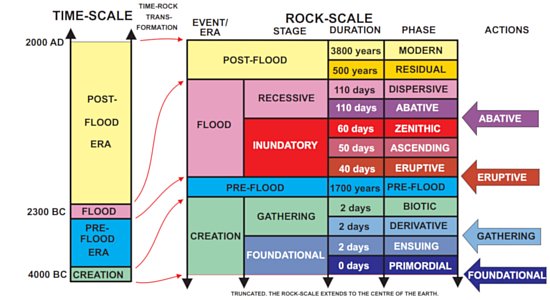
So, given that the Flood left behind considerable evidence, as this passage teaches, what can be predicted? Walker has proposed a geological framework (although not an explanation of the Flood per se) by which to understand rock layers and fossils, not just for the Flood year, but for all of Earth history—from the Creation Week to the present time (figure 4). He did this by using the clear descriptions of Scripture, as well as more loosely holding inferences from what we think we know about sedimentology and hydrology.
Since the Bible clearly teaches that the waters rose to cover the whole earth, then retreated, Walker proposes two main stages of the Flood ‘year’ (really 370 days): ‘inundatory’ and ‘recessive’. There might be some minor deviations, since variations in topography, floodwater and chemistry, mean that the results of Flood processes might not be strictly synchronous, even though the rocks produced might be the same.
The former is subdivided further: the earliest is the ‘eruptive phase’, derived from the explosive implications of the “fountains of the great deep bursting forth”; second, ‘ascending phase’, derived from the waters “increasing” upon the Earth (Genesis 7:17–18); third, the ‘zenithic’, from the biblical teaching of the Flood waters “prevailing” for so long with the mountains all covered, as well as the common-sense observation that the waters must have peaked some time.
The latter (‘recessive’) stage is subdivided not according to Scripture per se, but according to hydrological observations (which is why it is called a model).57 First, large amounts of water moving off a surface that was wholly submerged would first start to flow in huge sheets. This phase is called ‘abative’. Then, as the water level dropped and land emerged, the flow would be divided into large channels, hence the ‘dispersive’ phase.
This makes good sense of many geological features hard to explain under uniformitarian models,58 of which I will mention two. First, planation surfaces, which look like someone had taken a giant plane over the surface and shaved it flat, regardless of orientation or hardness. This is just what a giant sheet of water would do in the abative phase.59 Second, water gaps: instead of rivers following the path of least resistance around mountains, many go through gaps in them. This is consistent with violent channelized flow of huge volumes of water overtopping perpendicular barriers and carving channels straight through them. Since water gaps were formed after much erosion had occurred, they are consistent with having been formed in a later stage of the recessive stage.60
Verified predictions are a strength of a model, but they cannot logically be considered a proof—that would be a logical fallacy called affirming the consequent.1
Conclusion
The biblical global Flood is a vital teaching of Scripture, and essential for understanding Earth history. Yet we were not there, so trying to understand it has a number of difficulties. So it is not surprising that there are a number of different creationist proposals, and a few errors in some.
The starting point must be the explicit statements of Scripture, and propositions that logically follow from them. Since the Flood was a historical event, then our description of its details is at heart historical.
For finding out the details, science is useful as a forensic tool, but is not the driving discipline. This can show how known processes in hydrology and sedimentology would work under the constraints of the biblically-derived propositions. Where the Bible is truly silent, one is free to invoke known phenomena, but models involving these should be held loosely.
With so many unknowns, it is not surprising that there are a number of different models. But multiple models are a good thing in science, especially when it comes to trying to understand what happened in the unobservable past. What ultimately matters is what is true, not what fits a particular scientific model.
References
- Sarfati, J., Loving God with all your mind: logic and creation, J. Creation 12(2):142–151, 1998; creation.com/logic. Return to text.
- Schirrmacher, T., The Galileo Affair: history or heroic hagiography, Journal of Creation 14(1):91—100, 2000; creation.com/gal-affair. Return to text.
- See Sarfati, J., The Galileo quadricentennial: myth vs fact, Creation 31(3):49–51, 2009; creation.com/galileo-quadricentennial. Return to text.
- Sarfati, J., Refuting Compromise, Master Books, AR, pp. 49–59, 2004. Return to text.
- Much the same error is made by illustrations or animatronics of Adam and Eve’s children playing with baby carnivorous dinosaurs. The Fall predated any children (cf. the murderer Cain, the first child ever born, and clearly fallen (Genesis 4)), and the Fall also marks the beginning of animals eating each other—tooth marks in dinosaur bones and coprolites with dinosaur remains show that carnivory was well established by the Flood. In any case, it would be dangerous to have kids with some herbivorous animals as well, e.g. elephants. Return to text.
- Smith, H., Cosmic and universal death from Adam’s Fall: an exegesis of Romans 8:19–23a, J. Creation 21(1):75–85, 2007; creation.com/romans8. Return to text.
- Wieland, C., Decreased lifespans: Have we been looking in the right place? J. Creation 8(2):138–141, 1994. Return to text.
- Sanford, J.C., Genetic entropy and the mystery of the genome, Ivan Press, Lima, NY, 2005; see review by Truman, R., J. Creation 21(1):43–47, 2007. Return to text.
- Sanford, J.C., Genetic Entropy (DVD), CMI, from presentation in Australia, 2009. Return to text.
- Sanford, J.C., Baumgardner, J.R., Brewer, W.H., Gibson, P. and ReMine, W.R., Mendel’s Accountant: A biologically realistic forward-time population genetics program, Scalable Computing: Practice and Experience 8(2):147–165, June 2007; scpe.org/index.php/scpe/article/view/407/77. Return to text.
- Sanford, J.C., Baumgardner, J.R., Brewer, W.H., Gibson, P. and ReMine, W.R., Using computer simulation to understand mutation accumulation dynamics and genetic load, in Y. Shi et al. (Eds.), Computational Science—ICCS 2007, Part II, Lecture Notes in Computer Science 4488, Springer–Verlag, Berlin, Heidelberg, pp. 386–392; www.springerlink.com/content/l636614g73322302. Return to text.
- Noah was 500 when his first son (Japheth) was born (Genesis 5:32), and 600 when the Flood came. Shem had Arphaxad 2 years after the Flood, when he was 100 (Genesis 11:10), therefore Shem was only 98 when the Flood came. Return to text.
- Green, R.F., Association of paternal age and risk for major congenital anomalies from the National Birth Defects Prevention Study, 1997 to 2004, Ann Epidemiol. 20(3):241–249, March 2010. Return to text.
- See Sarfati, J., Miracles and science, creation.com/miracles, 1 September 2006. Return to text.
- That is, its volume fraction in a mixture, i.e. relative proportion. Return to text.
- The partial pressure of a gas is the pressure it would exert if it occupied the whole volume. The ability of oxygen to diffuse across lung membranes and dissolve in water, and its reactivity, depend on partial pressure, not concentration. But for a given total pressure, partial pressure is proportional to the concentration. Return to text.
- The sum of partial pressures of all gases in a mixture equals the total pressure of the gas mixture—at least for ideal gases (1801). Return to text.
- Dudley, R., Atmospheric oxygen, giant Paleozoic insects and the evolution of aerial locomotor performance, The Journal of Experimental Biology 201:1043–1050, 1998. Return to text.
- See also Wieland, C., Blame CMI? And what about the Canopy theory? creation.com/cannot-blame-cmi, 17 April 2010. Return to text.
- Wilkinson, M.T., Unwin, D.M. and Ellington, C.P., High lift function of the pteroid bone and forewing of pterosaurs, Proc. R. Soc. 273(1582):119–126, 2006 | DOI: 10.1098/rspb.2005.3278. Return to text.
- Sarfati, J., Pterosaurs flew like modern aeroplanes, Creation 28(3):53, 2006; creation.com/pterosaur. Return to text.
- Graham, J.B., Dudley, R., Aguilar, N.M. and Gans, C., Implications of the late Palaeozoic oxygen pulse for physiology and evolution, Nature 375(6527):117–120, 1995 | doi:10.1038/375117a0. This proposes a maximum O2 concentration of 35%. Return to text.
- Westneat, M.W. et al., Tracheal respiration in insects visualized with synchrotron X–ray imaging, Science 299(5606):558–560, 2003 | doi:10.1126/science.1078008. Return to text.
- Catchpoole, D., Insect inspiration solves giant bug mystery, Creation 27(4):44–47, 2005. Return to text.
- Keil, C.F. and Delitzsch, F., Commentaries on the Old Testament, n.d., original German in the 19th century, English translation published by Eerdmans, Grand Rapids, MI, The Pentateuch, 1. Return to text.
- A ‘ghost crater’ is “the bare hint which remains of a lunar feature that has been practically destroyed by some later action.” Alter, D., Pictorial Guide to the Moon, 3rd ed., Thomas Y. Crowell Company, New York, 1973. Return to text.
- The problem is that huge ancient meteorite impacts would both obliterate previous craters and smash open the crust and release lava. This leaves a very narrow time window for new impact craters to form, then be partially buried by the lava, leaving ‘ghosts’. Walker, T. and Catchpoole, D., Ghost craters are young too, Creation 31(3):18, 2009; Samec, R.G., On the origin of lunar maria, J. Creation 22(3):101–108, 2008; creation.com/lunar-maria. Return to text.
- Faulkner, D., A biblically-based cratering theory, J. Creation 13(1):100–104, 1999; creation.com/cratering; Spencer, W.R., Response to Faulkner’s ‘biblically-based cratering theory’, J. Creation 14(1):46–49, 2000; creation.com/crateringresponse. They propose that a brief, narrow swarm of space objects impacted the moon producing the distinctive, dark, basaltic maria (‘seas’). This explains why the maria are almost exclusively confined to one quadrant—the swarm passed before the moon had time to turn on its axis (it is tidally locked) and expose the other side. Return to text.
- Oard, M.J., How many impact craters should there be on the earth? J. Creation 23(3):61–69, 2009; further discussion in letter by Bernitt, R. and reply by Oard, 24(1):48–49, 2010. Return to text.
- Even if some of the references are apocalyptic, this would be deduced from the literary genre of the passages as a whole, not merely because they mention stars falling. Return to text.
- See explanation of valid implications vs. logical fallacies in Sarfati, J., ref. 1. Return to text.
- Genesis 7:19: “all (kol) the high mountains under the entire (kol) heavens”. “ … the text disposes of the question of the universality of the Flood”, Leupold, H.C., Exposition of Genesis 1:301–302, Baker Book House, Grand Rapids, MI, USA, 1942. Return to text.
- See Wieland, C., Hanging loose, Creation 11(2):4, 1989; creation.com/hanging_loose. Also, a number of creationists had criticized the model in CRSQ in the 1970s and 1980s. Return to text.
- Vibrational spectroscopy includes infrared and Raman spectroscopy, as per Sarfati, J., Olfactory design: smell and spectroscopy, J. Creation 12(2):137–138, 1998; Sarfati, J.D. and Burns, G.R.: The pressure, temperature and excitation frequency dependent Raman spectra; and infrared spectra of CuBrSe3 and CuISe3, Spectrochimica Acta Part A: Molecular Spectroscopy 50(12):2125–2136, November 1994 | doi:10.1016/0584-8539(94)00176-6. Return to text.
- A molecular vibration absorbs infrared radiation only if it changes the molecule’s dipole moment. CO2 is a highly symmetric linear molecule O=C=O, and a symmetric stretch of the C=O bonds (i.e. in phase) cancels out the dipole change, so this vibration doesn’t absorb, while the other ones do. Water (H2O) is a bent polar molecule, and all its vibrational modes strongly absorb infrared. Return to text.
- Vardiman, L. and Bousselot, K., Sensitivity studies on vapor canopy temperature profiles, Proc. 4th Int’l. Conf. Creationism, 1998; www.icr.org/research/index/researchp_lv_r05/. Return to text.
- Baumgardner, J.R., Catastrophic Plate Tectonics: the physics behind the genesis flood, Fifth International Conference on Creationism, Creation Science Fellowship, Pittsburgh, PA, August, 2003; globalflood.org/. Return to text.
- See for example Sarfati, ref. 4, ch. 6; Catchpoole, D., Skeptics challenge: a God of love created a killer jellyfish? Creation 25(4):34–35, 2003. Return to text.
- Beard, J,. How a supercontinent went to pieces, New Scientist 137:19, 16 January 1993. Return to text.
- Humphreys, D.R., Discussion of J. Baumgardner, Numerical simulation of the large-scale tectonic changes accompanying the Flood, Proc. First Int’l. Conf. Creationism, Creation Science Fellowship, Pittsburgh, PA, 2:29, 1986. Return to text.
- Silvestru, E., Caves for all seasons, Creation 25(3):44–49, 2003. Return to text.
- Reed, J.K. (Ed.), Plate Tectonics: A Different View, Creation Research Society Monograph 10, St Joseph, pp. 11–23, 2000. Return to text.
- Akridge, A.J., Bennett, C., Froede, C.R., Klevberg, P., Molèn, M., Oard, M.J., Reed, J.K., Tyler, D. and Walker, T., Creationism and Catastrophic Plate Tectonics, Creation Matters 12(3):1,6–8, 2007; www.creationresearch.org/. Return to text.
- Creationists are not generally guilty of “God of the Gaps” arguments, despite dishonest caricatures by atheopaths and their churchian allies. See Weinberger, L., Whose god? The theological response to the god-of-the-gaps, J. Creation 22(1):120–127, 2008. Return to text.
- See Sarfati, J., Naturalism, Origins and Operational Science, creation.com/naturalism, 2000. Return to text.
- Brown, W., In the Beginning: Compelling Evidence for the Creation and the Flood, 6th (special) ed., Center for Scientific Creationism, Phoenix, AZ, 1996. Return to text.
- The origin of asteroids and meteoroids, Center for Scientific Creationism, www.creationscience.com/onlinebook/Asteroids2.html. Return to text.
- McIntosh, A.C., Edmondson, T. and Taylor, S.C., Flood models: the need for an integrated approach, J. Creation 14(1):52–59, 2000. Return to text.
- Silvestru, E., Water inside fire, J. Creation 22(1):4–5, 2008. Return to text.
- Baumgardner, J. and Oard, M., Forum on catastrophic plate tectonics, J. Creation 16(1):57–81, 2002; creation.com/cpt_forum. Return to text.
- Wieland, C., Darwin’s real message: Have you missed it? Creation 14(4):16–19, September—November 1992; creation.com/realmessage. Return to text.
- Wood, T.C., The truth about evolution, toddcwood.blogspot.com/2009/09/truth-about-evolution.html, 30 September; a confused fideistic tirade that a number of atheopathic evolutionists adored. Return to text.
- Bailey, E., British men of science: Charles Lyell, pp. 77–78, Thomas Nelson and Sons Ltd, London, Great Britain, 1962. Return to text.
- McIntosh, A.C., Edmondson, T. and Taylor, S.C., Genesis and catastrophe: the Flood as the major biblical cataclysm, J. Creation 14(1):101–109, 2000. Return to text.
- Reed, J.K., Kulikovsky, A.S. and Oard, M.J., Can recolonization explain the rock record? Creation Research Soc. Quarterly 46(1):27–39, 2009. Return to text.
- Sarfati, ref. 2, pp. 264–5. Return to text.
- See also Oard, M., Flood by Design, Retreating Water Shapes the Earth’s Surface, Master Books, AR, 2008. Return to text.
- Oard, M., Defining the Flood/post-Flood boundary in sedimentary rocks, J. Creation 21(1):98–110, 2007. Return to text.
- Oard, M., It’s plain to see: Flat land surfaces are strong evidence for the Genesis Flood, Creation 28(2):34–37, 2006. Return to text.
- Oard, M., Do rivers erode through mountains? Water gaps are strong evidence for the Genesis Flood, Creation 29(3):18–23, 2007. Return to text.
- Rush, D.E. and Vardiman, L., Pre-Flood vapor canopy radiative temperature profiles; in: Proceedings of the Second International Conference on Creationism, Volume 2, Creation Science Fellowship, Pittsburgh, PA, pp. 231–245, 1990. Return to text.
- Brown, W.T., The fountains of the great deep; in: Proceedings of the First International Conference on Creationism, Volume 1, Creation Science Fellowship, Pittsburgh, PA, pp. 23–38, 1986. Return to text.


Readers’ comments
Comments are automatically closed 14 days after publication.